Translate

Showing posts with label women artists. Show all posts

01 May 2013

First American Art Magazine Is Online!

First American Art Magazine, the new magazine dedicated to serious coverage of arts of Indigenous peoples of the Americas, North and South, is now available for free online at www.firstamericanartmagazine.com.

High quality, glossy print versions of the magazine are available online as well. This pilot issue profiles:
  • Orlando Dugi
    Diné beadwork artist and fashion designer
  • Anita Fields
    Osage-Muscogee Creek ceramic artist
  • Tom Jones Jr.
    Ho-Chunk photographer and conceptual artist
  • Erin Shaw
    Chickasaw–Choctaw painter and mixed media artist.
Feature articles include "More Than Just a Trend: Rethinking the 'Native' in Native Fashion," by Dr. Jessica R. Metcalfe (Turtle Mountain Chippewa); "Northern Lights: Greenlandic Art in the 21st Century," by America Meredith (Cherokee Nation), and "Something Imperialistic Happened on the Way to the Louvre: Delegation Amérindienne 2012, An Artist's Perspective," by Roy Boney Jr. (Cherokee Nation). Departments include book and art show reviews, a graphic design column by Neebinnaukzhik Southall (Rama First Nation Chippewa), literature by Dr. Reid Gómez (Navajo), art news, classified ads, memorial articles, and much more.

The First American Art Magazine website has calendar listings for upcoming Native American art events and calls for entries, grants, fellowships, and other opportunities.

23 May 2012

Moundbuilders art show, May 25-June 3

Year of the Dragon 2012, monotype, Linda Lomahaftewa
Santa Fe, NM — Moundbuilders: Exploring the Ancient Southeastern Woodlands, a two-person art exhibit inspired by the journey artists Linda Lomahaftewa (Choctaw-Hopi) and America Meredith (Cherokee Nation) took through the Deep South to explore ancient Native American mound sites, opens with a reception on Friday, May 25, from 6 to 9 p.m. On display will be prints, paintings, photography and mixed media works inspired by the sites, smells and scenery observed on their trip. The exhibit takes place at Ahalenia Studios, known for its edgy, fun and important art exhibits, at 2889 Trades West, Unit E, off of Siler Road (note: street parking only). This event is free and open to the public. 

Thanks to the online funding platform Kickstarter, Lomahaftewa and Meredith took a two-week trip in 2011 to visit 15 mounds and other archaeological sites in the southeast, from Spiro Mounds in Oklahoma and to Echota Mounds in Georgia. Both artists were able to visit the Mother Mounds of their respective tribes: NanihWaiya, origin of the Choctaws, in Mississippi and Kituwah, mother mound of the Cherokee, in North Carolina.

Lomahaftewa, an instructor at the Institute of American Indian Arts and artist who has exhibited internationally, says, “It was the trip of a lifetime.” Painter, printmaker and arts educator Meredith concurs, but adds, “It was great to learn how contemporary tribal people maintain such a vibrant and living relationships to these mounds.”   

Mounds are colossal earthworks built by hand by Native Americans prior to European contact. They flourished during the Mississippian Era, a time period from 800 to 1400 AD characterized by city-building, hierarchal governments, intensive maize agriculture and a unique iconography that spanned from Oklahoma to Florida. Several of the sites Lomahaftewa and Meredith visited, such as the Poverty Point, date back much further. Poverty Point in Louisiana is a planned community marked by elaborate earthworks dating back to 1650 and 700 BC and predating agriculture.

Moundbuilders: Exploring the Ancient Southeastern Woodlands will be open to the public from 1 to 6 p.m. on Saturday, May 26, Sunday, May 27, Saturday, June 2 and Sunday, June 3. From May 28 through June 1 the show will be open by appointment only, which can be arranged by sending an email to ahalenia@yahoo.com.

For more information on the exhibit, including a blog from the journey, visit www.ahalenia.com/woodlands  

07 February 2012

Narcissa Chisholm Owen: The Mother of Cherokee Painting?

Narcissa Owen, 1907, WikiMedia Commons
If Cecil Dick (1915–1992) is the “father of Cherokee painting,” then would a Cherokee woman born 84 years before him be the “mother of Cherokee painting”? Narcissa Chisholm Owen (1831–1911) won awards for her naturalistic oil painting, and several of her works survive in museum collections today.

Narcissa was born on October 3, 1831 at Webber Falls, Indian Territory (Jacobson and d’Ucel 265). Her father, Thomas Chisholm, was a third chief of the Old Settlers, the Cherokees who migrated west prior to the 1838 forced removal known as the Trail of Tears.

She gave an extremely colorful version of her family tree, describing Thomas Chisholm as the “last hereditary head of the seven great clans that comprise the Cherokee Nation,” giving his Cherokee name as “Heil-Steky-Yearle” or “Little-Rusty-Knife.” She also described her ancestor as “Queen” Quatsis (NYT 1911), completely bypassing and overshadowing others’ claims of Cherokee Princess ancestors. Emmet Starr writes that Thomas Chisholm, who married Malinda Wharton, was elected Third Chief of the Western Cherokees on 16 July 1834, under the Principal Chief John Jolly (Starr 474). The Owen family was predominantly of Scots-Irish descent; however, her father belonged to the ᎠᏂᎩᎶᎯ, Anigilohi, or Longhair Clan (NYT).

Narcissa majored in music and art at the Anderson’s Female Seminary in New Albany, Indiana (Owen and Kilcup 56; Cocker), and graduated from the Fayetteville Female Academy. In 1853 in Tennesseee, she married Robert Owen, a European-American railroad tycoon, and the couple eventually moved to Lynchburg, Virginia (265). The Civil War and aftermath left the family in poverty. Robert died in 1873, so Narcissa taught music to support herself and her two sons (265). in 1850 (OHS). By 1880, Narcissa moved back to Indian Territory, with Robert Latham “Oconostota” Owen Jr. who served as an Indian Agent in Muskogee before being elected as one of Oklahoma’s first US senators. Narcissa Owen taught music at the Cherokee Female Seminary, one of the first institution of higher learning for women west of the Mississippi.

At the age of 62, Narcissa devoted herself seriously to painting (NYT). “In oil painting and miniatures I have of late years found great interest,” she told the New York Times reporter. "I also sometimes indulge in sketching in watercolors as an agreeable pastime."

Both Narcissa’s father and grandfather had been friends with Thomas Jefferson (Jacobson and d’Ucel 265). Her two oil paintings, Thomas Jefferson and His Descendants, won a medal at the Louisiana Purchase Exposition, more commonly known as the St. Louis Exposition, in 1904. An additional painting won a diploma (NYT). Her three painting and several of her tapestries “were admired by the many thousands who visited the Territory pavilion” (US 270).

Thomas Jefferson and His Descendants
is now part of the Herman Collection of the University of Virginia Art Museum. The medal belongs to the Oklahoma Historical Society, who also owns her 1896 self-portrait and a copy she made of Charles Bird King’s portrait of Sequoyah (Jacobson and d’Ucel 266).  Three portraits, including one of her stepfather, William Wilson, are the Gilcrease Museum in Tulsa (Cocker).

In 1907, Owen published the book, A Cherokee Woman's America: Memoirs of Narcissa Owen, which has recently been republished in 2005 in a version edited by Karen L. Kilcup. Owen died on July 16, 1911 in Lynchburg, Virginia.

Both her self-portrait and the surviving Thomas Jefferson painting are technically adept and rooted in realism. Attention is lavished on details such as hair, faces, furniture, eyeglasses, and jewelry. The backgrounds and textiles are soft and muted, showcasing the warm, glowing flesh tones of the subjects. Even with such a small corpus of surviving known works, Owen’s pride in her Cherokee heritage is evident in her portrait of Sequoyah, the inventor of the Cherokee syllabary.

With her academic American art education and embrace of contemporary easel art techniques, Owen joins the ranks of Angel De Cora (Hochunk) and Edmonia Lewis (Ojibwe). Although these 19th century indigenous women artists had an education based on European-American perspectives, they used Native subject matter in their works, albeit not exclusively. Most significantly they exhibited their art in the mainstream art arena and kept abreast of new developments of the art world.

Bibliography

Sequoyah, Narcissa Owen after Charles Bird King
  • Cocker, Jordan Poorman. "Narcissa Chisholm Owen." Gilcrease Museum. Web.
  • Jacobson, Oscar B. and Jeanne d’Ucel. “Art in Oklahoma.” Chronicles of Oklahoma 32, no. 3 (1954): 263–77. Web.
  • “Mother of U.S. Senator an Indian Queen; Mrs. Narcissa Owen, Daughter of the Last Chief of the Seven Great Cherokee Clans, Is a Charming Old Lady of Distinction Whose Talent in Art Has Won Recognition.” New York Times. 22 Jan 1911. Web.
  • Starr, Emmet. History of the Cherokee Indians and Their Legends and Folk Lore. Oklahoma City, OK: The Warden Company, 1921. Web.
  • United States, Louisiana Purchase Exposition Commission. Final Report of the Louisiana Purchase Exposition Commission, 1906. Washington, DC: Government Printing Office, 1906.

12 January 2012

Upcoming Art Events

In the juggling act between writing about and creating art, the latter has taken the front seat recently. Some upcoming art events I'll be participating in include the following.

Facing the Sunland: Works by America Meredith + Sally Ann Paschall + Kay Walkingstick
Jan 20–Feb 13: Berlin Gallery at the Heard Museum
2301 No. Central Ave, Phoenix, Arizona
Opening reception: Friday, Jan 20, 6–8pm
Indigenous Visions artist talk: Saturday: Jan 21, 1:30–2:30pm


Lumen: IAIA
Jan 27–Feb 20: Red Dot Gallery, 823 Canyon Road, Santa Fe, NM
Opening reception: Friday, January 27th, 5-7pm


H2OK: Native Responses to Water Issues
February 10—March 10:  120 E. Main Street, Norman, OK
April 6—May 13: Bacone College Art Gallery, Art Building, Old Bacone Road, Muskogee, OK
Website.


Heard Museum Guild Indian Art Market
March 3 & 4: Heard Museum, 2301 No. Central, Phoenix, Arizona
Sharing a booth with Linda Lomahaftewa, Roger Amerman, and Marcus Amerman.

05 December 2011

Review | Manifestations: New Native Art Criticism, Part 1

Manifestations: New Native Art Criticism, the culmination of three years’ work, is finally available. This book is part of the Institute of American Indian Arts’ “Vision Project,” an effort to showcase Native American art writers and new artists, through discussions, writing, and a series of solo exhibits at the Museum of Contemporary Arts (former IAIA Museum). The project involved 21 Native art writers and 60 artists.

What I witnessed of the process of the Vision Project was painful to watch, but, nonetheless, the results are inspiring. A committee chose the artists, selecting living artists, established, mid-career, and some emerging artists, who were active last three decades.

Only artists from Canada and United States, including Hawaii, were chosen. Why? Perhaps it’s an Anglophone bias, one certainly found in Canadian and United States academia but one that doesn’t conceptually hold any water. James Luna (Luiseño/Mexican), Mario Martinez (Yaqui), and Jennifer Vigil (Diné/Latina) represent the Americas south of the Rio Grande, and hopefully future projects of this nature will be hemispheric in scope, since innumerable cultural exchanges have taken place from South to North.

The writers were limited to only 500–word essays on each artist; somewhat hamstringing any attempt at in-depth analysis. On the plus side, given such a limited space, the writers chose their words carefully, resulting in beautifully written biographies of contemporary artists. Many of the artists are also writers and vice versa, so meeting and collaborating on this project will no doubt spark future collaborations. Magazine and book editors now have a showcase of talented Native art writers—with many more accomplished Native writers who were not part of this project. The Vision Project shows the world that Native art writers more than up to the task to write about Native art.

How does this differ from projects such as American Indian Art Magazine’s selection of 35 Native artists’ profiles for their 35th anniversary issue? In fact eight artists (Marcus Amerman, Arthur Ammiotte, David Bradley, Bob Haozous, Shelley Niro, Preston Singletary, Roxanne Swentzell, and Denise Wallace) were included in both projects. The immediately difference is that the magazine primarily chose non-Native authors.

Diane Pardue’s profile of Denise Wallace uses more marketing-inspired adjectives, “graceful,” “enchanting and engaging,” (AIA 73) and discusses technique in great detail, while Barry Ace goes more into the context of art in tribal society (Mithlo 186), but the profiles are astonishingly similar. Jennifer Vigil discusses Roxanne Swentzell’s art about women’s body issues (Mithlo 174-5) while Zena Pearlstone doesn’t even touch on the subject but does mention Swentzell’s work in permaculture (AIA 70). Both Mary Jan Lenz and Mique’l Icesis Askren describe Preston Singletary’s being raised away from his culture and his initial pursuit of music; however, Askren, the Manifestations author, looks at the irony of European techniques reconnecting Singletary with his people and that his glass sculptures take become kinetic, when illuminated by light. Ryan Rice touches on Shelley Niro’s “multi-nationality” but gives more straightforward resume information (awards, collections, degrees) than Zena Pearlstone does in her essay, which describes a range of Niro’s works (Mithlo 148-9, AIA 61). And so on it goes.

Trust me, I desperately want to see wide disparities between the two publications approached to art writing; however, the differences are subtle. Over time, the subtleties add up—aesthetics and techniques or content? Tribal ethnologies or contemporary tribal political realities? Some Manifestations art writers make a more dramatic departure. Overall the Vision Project's selection of artists lean towards the more conceptual, more difficult, and not always aesthetically pleasing artwork and there’s more space to discuss harsh realities. But as Nancy Mithlo points out, "the presence of contemporary Native art made from the broken legacy of America's attempt to destroy our communities is powerfully compelling, stark and well, I'll just say it, beautiful" (Mithlo 19).

In this project, women writers were able to analyze women artists and discuss women’s issues, which upon reflection, is not all that common. My personal observation has been that women artists are much better represented in the Native art world than in the mainstream art world; however, gender inequalities do exist. Of the 60 artists, 24 are women. 40% is a positive sign.

It so good to see the focus of Native art writing on content for a change. Thanks to Nancy Mithlo, Manifestations editor; Stephen Wall; Will Wilson, Vision Project manager; Sarah Sense, former Vision Project Director; and everyone else who made this project and publication possible. So far the book is only available through the MOCNA gift shop. Their website is "under construction," but their phone number is 1-888-922-4242.

15 June 2011

Review | Teri Greeves: Storied Beads

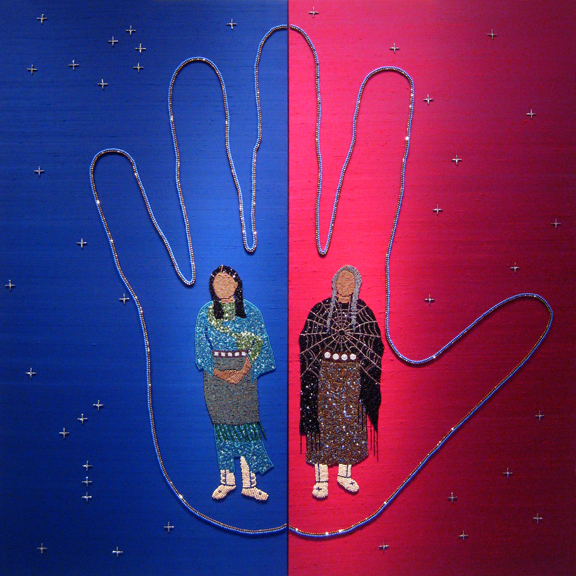
Sunboy's Women, ©2011 Teri Greeves
Storied Beads marks Teri Greeves’ first solo exhibition in Santa Fe in over three years. The Kiowa-Comanche-Italian bead artist has been busy — traveling nationwide, teaching, showing in major group exhibitions, and beading. Her new series, unveiled at the show, takes beadwork to a completely new level.

Hung in Shiprock’s main gallery hall, the works are immense. Five new, monumental beaded appliqué pieces are mounted on shimmering raw silk and luminescent vinyl. The tallest piece looms at 80” high.

The trend in beadwork is to use the smallest possible beads — to achieve fine detail and to display the beader’s technical prowess. However, an ongoing challenge for bead artists is to have their audience not just admire the technical skill in a piece but go beyond to see the composition, palette, and most importantly the content. Beadwork is an art medium loaded with historical implications; however, it’s still an art medium.

By blasting past expectations, Greeves carves a new space for expression. In these new works, she uses pony beads, large-scale beads that can be a centimeter or more width. These oversized beads, in glass, crystal, brass, and wood, coupled with mother-of-pearl disks showcase the reflective, translucent, textured, or glittering surfaces of the individual beads — approaching almost a mosaic quality, which is beautifully offset by the raw silk. While beadwork is most often seen in motion — on personal adornment, dance or ceremonial regalia, moving rattle or fan handles — the glittering quality of the cut-beads and crystals are activated when the viewer walks along, bringing the piece to life. In Sunboy's Women, Swarovski crystals flicker in the starry night sky.

Detail of Wa-Ho: The First Song After the Flood
Stars are a perfect allegory for the Kiowa oral history that inspired these works. The stories reflect unchanging truths, standing outside of daily timeframes, and serves as navigational guides like stars. “This is how our histories are passed on to us: through the vibrations of sound spoken from one individual to another,” writes Greeves in her artist’s statement. “It is also the basis of much conflict between how we see history and how history is written and read by non-Natives.” The subject matter in the show is highly specific. Greeves truly wants people to know and understand the stories, so she included lengthy artist’s statements for each work. The gallery has posted her statements in toto on their website; however, the staff at Shiprock is so gracious and outgoing, you would feel completely welcome reading the entire statements in the gallery at your leisure.

The centerpiece of the show is Sunboy's Women, a 72” x 72” diptych mounted on blue and red raw silk, the colors worn by Kiowa gourd dancers. Sun Boy or Half-Boy are cultural heroes that were born from an earth woman who fell in love with the Sun. She died trying to return to the earth from the sky world, so the orphaned Sun Boy was raised by Spider Woman, an adoptive grandmother. The figures of the two women are portrayed side by side—young and old—encased in a giant handprint, dividing in half like Sun Boy.

The figures in the show are women, each portrayed representational but faceless, giving them a timeless or universal quality. Greeves’ figurative style calls to mind the work of Virginia Stroud, a Muscogee-Cherokee artist who was adopted Kiowa and who helped revive ledger painting in the 1960s and 1970s. Text is also a key feature of the works, graffiti-esque text in the thought bubble above NDN GRRRL! and the embellished script of a lullaby in Wa-Ho: The First Song After the Flood.

detail of Wa-Ho: The First Song After the Flood
The haunting She Loved Her People struck me the most. A lone, faceless female figure stands on a burgundy background, brandishing a sword.  Curliqued script proclaims that “She loved/her people.” Strategically sewn darker beads create an illusion of shadow on the figure, and mother-of-people discs stand in for elk’s teeth on the yoke of her dress, composed of sparkling cut midnight blue beads. Greeves explains how a 16-year-old Cheyenne girl witnessed Custer’s massacre of her people, including most of her relatives, at the Washita River. The girl saw Custer slice through the belly of a pregnant woman, dismembering her unborn child. This survivor joined a war party, traveled north to Little Big Horn. She fought in that battle and ultimately found Custer. She slit him open from naval to neck with his own sword. Today the German silver trailers that Southern Plains women wear at their waist commemorates this girl’s bravery.

The juxtaposition of feminine grace and bloodshed might seem incongruent, especially expressed through the “delicate” medium of beadwork. However, this and other works are about family and the willingness to stand up and fight for family. The young Cheyenne girl’s act of resistance restores some harmony and balance in the face of atrocities. So therefore the depiction of the girl is with grace and respect. The oral histories, although not necessarily “pretty”, bind together generations of an extended families and tribes. Greeves is offering the public a window into the encompassing and protecting web of stories and relations that help shape her tribe and her own family.

Storied Beads will be on exhibit through June 30, 2011 at Shiprock Santa Fe, Old Santa Fe Trail, 2nd Floor on the Plaza.
www.shiprocksantafe.com

07 April 2011

Review | Double Vision: New Works by Hulleah J. Tsinhnahjinnie

Recovering forgotten histories of 19th century Native American photographers, curating shows, and organizing international indigenous photography conferences, the self-identified “aboriginal savant” Hulleah J. Tsinhnahjinnie has dedicated herself to furthering  the cause of Native photography. The Diné-Seminole-Muscogee artist created a new series of digital prints on fabric at the Great Plains Art Museum in downtown Lincoln, Nebraska. She responds to photography by non-Natives — photographs in the Great Plains Art Museum’s permanent collection.

When invited to view early photos of indigenous peoples, Tsinhnahjinnie writes that she does “hesitate when invited to view or respond to them. I scan the messages, intentional and unintentional messages” and “reflect[s] upon the intention of the ‘subject’."

“It is my hope that these new works present a visual confrontation,” Tsinhnahjinnie writes, “an argument with premise that should be critically reviewed and endless questioned.”

Tsinhnahjinnie created large-scale digital prints on poly-satin, hung from curtain rods. Digital art, existing in the zero-space of a computer, can take a range of forms from computer monitors, light projections, or on prints on paper resembling traditional photographic prints. By choosing poly-satin, a polyester fabric with a dramatic sheen, Tsinhnahjinnie ‘s pieces become movie theater-esque — "silver screens."

Her dark palette of blacks, silvery blues, purples, browns, and a process cyan referencing CMYK prints, imbues the work with a dreamlike or nightmarish quality, punctuated by bright citron, red, and orange accents.

The first piece that confronts the viewer is one of the strongest, A Penny for Your Thoughts, derived from Laton Alton Huffman’s Stereoscope postcard, Taking the Tongues. Images of the buffalo nickel form a border below a giant buffalo nickel combines with Huffman’s print, featuring a man stretching a tongue for cutting from a buffalo corpse, one of eight – some partially butchered. The overarching, larger buffalo from the nickel resembles snowcapped mountains. Tsinhnahjinnie  changed the nickel’s text to “United States of Amnesia,” which is a little predictable; however, the text E Pluribus Unum takes an ominous tone, when one considers that the buffalo were slaughtered almost to extinction to destroy Plains Indians way of life and pen them on reservation to ultimately try to assimilate them in mainstream American society; that is, to make many people into one.

Laton Alton Huffman’s Taking the Tongues, is displayed next to Tsinhnahjinnie’s response. It’s a diminutive and faded sepia-toned Stereopticon (think View-Master) from Miles City, Montana, of the lone hunter butchering the eight buffalo carcasses; his rifle resting on one. I studied the piece carefully to clues to the hunter’s identity–was he Native or not? Ultimately it didn’t matter; one man killing eight buffalo at once is excessive no matter what their background is.

This image and the presence of the “Buffalo Nation/Bison Nation,” as the artist describes the animals so crucial to Plains culture, form a backbone to the show. The second work by Tsinhnahjinnie, Taking the Tongues, shows the same image darkened with the right image reversed to form a mirror with Ronald McDonald leaping through the frames. Ronald McDonald, who looks fairly demonic even in the best of times, presents a jarring representation of contemporary consumer culture, the demise of buffalo, and our own health – a food imperialist.

Another of Tsinhnahjinnie’s digital collages, Five Minutes Work, uses an earlier photo from the same series. The inversed image, mostly cyan, reminiscent of an architect’s blueprint, features the same eight buffalo carcasses with a lone horse instead of a man. In the first panel, “Excuse me” is scrawled above the horse and in the second, “I did not sign up for this!” Tsinhnahjinnie’s multilayered, darkly humorous work, braiding together history and 21st century banality,  reminds me of my favorite contemporary British artist, David Godbold. Anticolonialism figures strongly in both the artists’ work.

Two photographers provide Tsinhnahjinnie with the majority of her inspiration: Laton Alton Huffman (1854-1931) from Iowa, learned photography from his father, was attached once by Dull Knife (Cheyenne), and settled in Fort Keogh, Montana in 1879-1880. He later became a hunting guide and rancher and sold buffalo hides to supplement his photography sales (Sharyl Ferrall). The second photographer is William Henry Jackson (1843-1942), who owned a portrait studio in Omaha, Nebraska and was the first published photographer of Yellowstone National Park and the Ancestral Pueblo cliff dwelling at Mesa Verde (Getty Museum).


The Jackson Brothers provide the albumen print, Pawnee Indian—the inspiration for Mega Sale.  The Pawnee man in a fur hat and buffalo space is given a black scrawl down his face (a single tear?) and is treated to either the “dry brush” or “watercolor” filter in Photoshop, a program that also surprisingly has a “smudge stick” filter. A graffiti monkey and writing complete the piece, which is captioned by a Hawaiian Punch-esque font proclaiming: “The idea that history is about us.”

Since Photoshop is so associated with advertising and desktop publishing, it’s disconcerting when the rules of typography and graphic design are broken. For instance, The Special features a variety of disconcordant fonts from the original William Henry Jackson photograph, with “Pawnee, Omaha Special, specializing in authenticity!”  added in a font featuring stars for the i-dots. This piece is flanked by several 19th century photographs of the photographer’s work places — ranging from a cowhide tent, with a railroad and power lines faintly visible in the background to images of large interior spaces with workers a sinks, revealing that photography of Native Americans and the West were big business.

The show concludes with a tetraptych, Today I Was Thinking… At first it seemed like an afterthought, but luckily the space is ideal for sitting with the art. After awhile it began working on me. The four horizontal printed textiles were inspired by L. A. Huffman’s hand-colored platinum print, copyrighted in 1912, Buffalo Grazing the Big Open, shot in northern Montana in 1880. They feature the buffalo herd on a black background, accents with yellow and orange. The first has a photographs of moon phases, the second warped citron moons arching over the sky, as if referencing the eons passing with the buffalo herds shaping the Plains landscape; in the third Ronald McDonald once again rears his ugly head; and finally peace is restored and the buffaloes quip that “Real Indians eat curry.” This piece seems like Paiute prophet Wovoka’s vision of the buffalo returning but really says they never left the Plains and contemporary consumerism is just a blip in the timeframe of the Bison Nation/Buffalo Nation.

Hulleah Tsinhnahjinnie's website

Images: © Hulleah J. Tsinhnahjinnie. Nota bene: Images in art show reviews fall under the doctrine of fair use. Landes, William M. “Copyright, Borrowed Images, and Appropriation Art: An Economic Approach.” George Mason Law Review. Fall 2000: 6.

15 March 2011

Cheyenne Quilling Society

For thousands of years, indigenous people created and evaluated art according to our own standards. In the last few centuries, non-Native people have collected, critiqued, categorized, and theorized about Native art to such an extant, that in some venues they temporarily drowned out Native perspectives. Fortunately the tide is turning, with more tribes establishing their own museums, more Native peoples curating their own art shows, and more Native writers contributing to the canon of Native American art history. One window into historical indigenous perspectives on one genre of art can be found in Plain’s women’s quilling societies.

While warrior societies among Plains tribes are well known, many tribes also had artistic guilds. One such guild was the quilling society, which was the most prestigious women’s society among many Plains tribes. Specifically I want to look at the Cheyenne women’s quilling society. The Cheyenne name for their quilling society was Mëëno’istst , which meant “quiller”–specifically “one who applies quills to hide”. Eme e ni means “she sews on quills” (Grinnell 160). The women who belonged to the society were known not only for their artistic skill but also for their moral standing (Western History Association 6).

Quillwork, the aesthetic use of porcupine quills on textiles, hides, and other surfaces, is an art form unique to North America. Quillwork has been popular from coast to coast, taking hold throughout the range of the porcupine. The earliest examples of quills used as binding agents were found in caves in Utah and Nevada, dating back to 530 BCE, and the oldest quillwork found on moccasins date back to the 6th century CE (Palmer 75).

My incomplete understanding is that a cultural hero named the Buffalo Wife first brought the art of quilling to the Plains tribes. Picking Bones Woman, a Cheyenne told the story about Buffalo Wife to anthropologist George Bird Grinnell, and she describe the human man who married Buffalo Wife. This man learned quilling while living among the buffalo. When he returned to Cheyenne society, he created the quillworkers’ society and instructed the women in the sacred protocol of quillwork (Grinnell 163).

The quilling society was an intergenerational institution, with older women instructing younger women. “Not only were the quillwork guilds instructional, but they embodied a religious element as well, not unlike a sisterhood. To join this prestigious society was to assume a station of respect and power” (Her Many Horses and Horse Capture 9). Women created other art forms, which had their own societies, but quillwork was considered the pinnacle of women’s artwork (Williams 70).

The accomplishments of quillers were on par with battle honors among men’s societies (Grinnell 159). As Beatrice Medicine and Patricia Albers write, “[T]he contributions of women were recognized by the Plains peoples, even though they have not been so recognized by anthropologists and art historians. Excellent in craftwork brought prestige and wealth to the woman and to her family” (Albers and Medicine 109). The artist had a place in Cheyenne society.

When the women decided upon a quilling project, a specialized camp crier would publically announce their plans to the whole camp (Grinnell 160). Quills had to be harvested, dyed, and processed. They were softened with saliva and pulled between teeth to flatten.

When a young woman quilled her first robe, she threw a feast. She would sit in the back of the lodge with the elder who instructed her sitting on her right. A poorer member of the tribe would be invited to witness the young woman quill her first robe and this poorer individual would be given a present, often a horse. Afterward if the visitor were a man, he would ride through the camp and sing a song mentioning the young women’s name and that she quilled her first robe (Grinnell 161).

To protect the robe while it was being quilled, a woman would covered her hands with white clay or burnt gypsum (Grinnell 164). If a woman made a mistake when quilling, a ceremony had to be preformed, in which a brave man counted coup on the robe being quilled. The man would say, “And when I scalped him, I did it in this way,” as he cut the errant quills from the robe with a knife owned by the quilling society (Grinnell 166).

To ensure success of a relative or to health someone in ill health, a girl or young woman could create a quilled robe for a healer, religious leader, or warrior in a specific ceremonial manner. The girl would offer a gift to an elder member of the quilling society and ask her help in the project. The elder would respond with a particular ceremony and then she would instruct the girl. Upon successful completion, the girl could attend quilling society feasts and teach others the techniques she learned (Grinnell 160).

At certain gatherings, women would recount the quilling accomplishments, which would be attested to by a witness or said over an arrow or pipe (Grinnell 162).

The elder members of the quilling society “had strict rules in their designs and they kept secret the meaning and arrangement of the colors, as well as the relation of the designs to each other,” as Rodolphe Petter wrote in his 1915 Cheyenne-English Dictionary.

When preparing to quill a hide, a woman might ask an elder to visit her lodge and draw a design on the robe with a stick and white clay, for which she would be given a gift or clothing and food (Grinnell 163).

As Petter wrote, “The designs were always symbolic and talismanic, representing concrete organic objects, whereas the color were more emblematic of the abstract in creatures and creations, e.g., white for active life, very light blue for quietness, peace, serenity (from the cloudless sky); green for growing life; red for warmth, food, blood, home from blood); amber yellow, ripeness, perfection, beauty (from the sunsets); black for cessation of enmity, hostilities (from a dead glow being no more hot)” (Grinnell 168-9).

It’s intriguing that genres within quilling fell into a strict hierarchy. Woman began quilling moccasins, then cradleboards, stars or circular disks for lodges, buffalo robes, then finally lodge linings, backrests, and “possible sacks” (Grinnell 161). Those who completed these increasingly prestigious items increased their own prestige. Quilling an entire lodge by oneself was a great accomplishment but the highest accomplishment was quilling thirty complete buffalo robes. Doing so guaranteed the quiller a “long life full of good fortune" (Neithammer).

The quilling society came to an end in the late 19th century (Her Many Horses and Horse Capture 9), after the Southern Cheyenne relocated to Indian Territory and the Northern Cheyenne moved onto their reservation in Montana. However, quilling itself never died and has never been completely replaced by beadwork.

“Sacred protocol” and “moral standing” are not exactly common art terms today. It’s interesting to consider how many community members were involved in creating quillwork, or repairing it, or celebrating its creation. Wealth was tied to art before the reservation era, as was prestige; however, the nature of wealth is different in a reciprocal society than in a capitalist society. The Cheyenne quilling society is an example of how certain artists were perceived by a tribe and how their work strengthened relationships within the community.

  • Albers, Patricia and Beatrice Medicine. The Hidden Half: Studies of Plains Indian Women. Lanham, MD: University Press of America, 1983.
  • Grinnell, George Bird. The Cheyenne Indians: Their History and Ways of Life. Lincoln: University of Nebraska Press, 1972.
  • Her Many Horses, Emil and George Horse Capture, eds. Song for the Horse Nation: Horses in Native American Cultures. Golden, CO: Fulcrum Publishing, 2006.
  • Neithammer, Carolyn. Daughters of the Earth: The Lives and Legends of American Indian Women. New York: Simon and Schuster, 1977.
  • Palmer, Jessica Dawn. The Dakota Peoples: A History of the Dakota, Lakota and Nakota through 1863. Jefferson, NC: McFarland, 2008.
  • Petter, Rudolphe. English-Cheyenne Dictionary. Kettle Falls, WA: Valdo Petter, 1915. Link.
  • Western History Association. The American West. Volume 10. Cody, WY: Buffalo Bill Historical Center, 1973.
  • Williams, Lucy Fowler. Guide to the North American Ethnographic Collections at the University of Pennsylvania Museum of Archaeology and Anthropology. Philadelphia: University of Pennsylvania Museum, 2003.
For Cheyenne art in the collection of NMAI, including quillwork, click here.

23 January 2011

Wheel: Nancy Marie Mithlo

A Realist View of Image Politics Reclamation of the ‘Every Indian’
Nancy Marie Mithlo (Chiricahua Apache)

In Nancy Mithlo’s essay, she examines the role of Native women artists and stereotypes of Native Americans in her “an attempt to define a critical indigenous arts theory” (105).

Asking if negative stereotypes of Native Americans in popular culture matter, Mithlo answers, “Yes” – a view backed up by cognitive science. She sees mascots and other stereotypical caricatures of Natives as having real world ramifications, including violence; however, she argues that artists can use stereotypes as tools for cross-cultural communication, and cites examples of artists using the two most common stereotypes of Native women, the “squaw” and “princess,” to educate their audiences.

Mithlo points out that tribes and Native people themselves sometimes contribute to these stereotypes. For instance, the poster child of the "Indian princess" stereotype, the Land O’ Lakes butter maiden, was actually designed by Red Lake Ojibwe artist Patrick DesJarlait (Anthes 99).

Often non-Native’s ignorance of diverse tribes is blamed for the stereotypes; however, this has not proven to be the case, especially in areas where non-Native peoples are competing for limited resources with high concentrations of Native peoples (114). In the art world, this means when Native artists are designated by tribe and exhibiting in their own venues, such as Indian markets, prejudice is reduced; however, when Native artists seek to show their work in elite, mainstream environments, prejudice is more likely to occur. Mithlo provides several appalling examples of the backlash that occurs when Native artists exhibit in the mainstream arts arena instead of “knowing their place.”

Over and over the discussion of “segregation” of Native art comes up, but Mithlo puts things in perspective: why should the contemporary arts world be a place devoid of any ethnicity? It’s “an odd kind of segregational racism” (114). I think it’s important to hear about experiences from Latino, Black, Asian, and other artists and writers with similar experiences – they are also often directly or indirectly asked to downplay their own cultural heritage to “make it” in the mainstream.

“To talk about Indian art, you must talk about race,” (107) she writes, and “a negation of ethnicity also implies a negation of history.” Besides being an ethnic definition, “Native American” is also a political definition, with rights and access to resources relayed through citizenship in sovereign tribes.

The Native women Mithlo interviews discuss being part of a tribe – a communal approach to art making that flies in the face of the iconic mainstream Rugged Individualist Art Hero. Mithlo argues that in contemporary Indian art the communal aspect should take precedence over the individual. Instead of trying to separate the art and the artists from the fabric of their daily life or home, their “extended lives as mothers, tradition-bearers, and wage earners” are important components to examine in interpreting and appreciating their art (111). It is not that the artists Mithlo profiles do not express individually, but their work gains depth and meaning when seen in the context of their respective community circles.

However, many Native artists are clear that they cannot speak for their tribes; it’s a more nuanced matter of seeing the individual as a community member – in Diné artist Gloria Emerson’s words, "a case study, of what’s going on throughout the reservation" (111).

Mithlo admits, “Both the motivation to alter preconceived notions of the Native as well as the availability of counternarratives are strikingly missing from general discourse…” (121) Mainstream media and the global art world tend to simply ignore real Natives in favor of the stereotypes. Native artists in the mainstream art world defy preexisting categories and are therefore threatening and subsequently ignored.

"Native artists who move in both mainstream fine arts and rural reservation communities defy the dated analysis that strictly sees the tribal as separate in time and space from the modern. The concept of Native Americans as mobile, contemporary, and, simultaneously, tribal has not yet been recognized by the non-Indian public," she writes (121).

It is not enough to simply study the aesthetic qualities of Native art – to take the formalist, Modernist approach of the mid-20th century. Mithlo concludes, “To fully engage in Indian arts, one must participate in a fairly rigorous intellectual exercise in which personal doubt may productively serve to further one’s depth of understanding. Counterintuitive measures such as an embrace of stereotypes, generic Indian identity, and realism are reasonable places to start the difficult process ahead” (123).

• Anthes, Bill. Native Moderns: American Indian Painting, 1940-1960. Durham, NC: Duke University Press, 2006.
• Blomberg, Nancy J., ed. [Re]inventing the Wheel: Advancing the Dialogue on Contemporary American Indian Art. Denver: Denver Art Museum, 2008. ISBN 978-0914738596.