Translate

Showing posts with label visual language. Show all posts

01 May 2013

First American Art Magazine Is Online!

First American Art Magazine, the new magazine dedicated to serious coverage of arts of Indigenous peoples of the Americas, North and South, is now available for free online at www.firstamericanartmagazine.com.

High quality, glossy print versions of the magazine are available online as well. This pilot issue profiles:
  • Orlando Dugi
    Diné beadwork artist and fashion designer
  • Anita Fields
    Osage-Muscogee Creek ceramic artist
  • Tom Jones Jr.
    Ho-Chunk photographer and conceptual artist
  • Erin Shaw
    Chickasaw–Choctaw painter and mixed media artist.
Feature articles include "More Than Just a Trend: Rethinking the 'Native' in Native Fashion," by Dr. Jessica R. Metcalfe (Turtle Mountain Chippewa); "Northern Lights: Greenlandic Art in the 21st Century," by America Meredith (Cherokee Nation), and "Something Imperialistic Happened on the Way to the Louvre: Delegation Amérindienne 2012, An Artist's Perspective," by Roy Boney Jr. (Cherokee Nation). Departments include book and art show reviews, a graphic design column by Neebinnaukzhik Southall (Rama First Nation Chippewa), literature by Dr. Reid Gómez (Navajo), art news, classified ads, memorial articles, and much more.

The First American Art Magazine website has calendar listings for upcoming Native American art events and calls for entries, grants, fellowships, and other opportunities.

06 December 2011

Review | Manifestations: New Native Art Criticism, Part 2

Manifestations: New Native Art Criticism features four essays by Nancy Marie Mithlo, Stephen Fadden and Stephen Wall, Sherry Farrell Racette, and Mario A. Caro. These alone are worth the price of the book.

The First Wave… This Time Around

In “The First Wave… This Time Around,” Nancy Marie Mithlo discusses the Vision Project in terms of the current state of affairs in Native contemporary art. She sees mainstream art critics being impatient with Native artists’ insistence on referencing their tribal communities and histories, but “Indian people continue to insist on being Indian” (Mithlo 18). “Why,” she asks, “when it would be so much easier to simply seek out hybrid, transnational, post-Indian or some such trendy association, do we insist on claiming our identities as Native peoples?” (19).

Mithlo asks the compelling question, “Is there bad Indian art?” (21), but doesn’t answer it, instead pointing out that markets and artists institutions make qualitative evaluations of indigenous art, as does the “intellectual capital” an artwork earns, through art writing. Most of the writing about Native art comes from the non-scholarly, “light press” (21). That’s especially evident here in Santa Fe, where local newspapers and magazines repeat each other’s same factual errors. She writes, “non-intellectual sources are guiding the assessment of contemporary American Indian arts, and that this casual, cultural art-of-the-week variety of arts writing has exerted a harmful influence on the development of a more serious field of inquiry” (21). She concludes that “[t]he ability to represent ourselves as Native peoples—intact and collectively—is a human right, too frequently ignored” (27).

“Indigenous curatorial methodologies” Mithlo says are defined “by four criteria: it is long-term, reciprocal, mutually-meaningful, and includes mentorship” (24-5). To art critics that question the need for self-defined indigenous criteria, she writes, “A dismissal of the logic and strategies of Native nations (and their artists) to move forward with their own communities intact mirrors the logical colonialism” (25).

Invisible Forces of Change:
United States Indian Policy and American Indian Art

Steve Fadden and Stephen Wall, both professors in IAIA’s Indigenous Liberal Studies Department, co-wrote “Invisible Forces of Changes: United States Indian Policy and American Indian Art.” They share US Indian history 101 and put forward three examples of artists that exemplify major eras in Indian policy. David Cusick, a founder of the Iroquois Realist School, illustrates the Formative Era of 1776–1810 when tribes were relatively as strong as the fledgling United States (29-30). Angel DeCora, whose life and work is defined by Indian boarding schools, defined the Allotment Era of 1880-1932, when assimilation into European-American society was the government’s mission (32, 34). Allan Houser, the first Chiricahua Apache born outside of captivity since 1886, is part of the Indian Reorganization Era of the 1930s and 1940s. Houser directed benefited from the Indian New Deal reforms allowing tribal governance, education, and self-expression in the arts (34-35).

As destructive and capricious as US Indian policy has been, Fadden and Wall argue, it’s impossible to ignore its role in Native art history. They do not describe any of the three artist’s work. Is familiarity with Cusick and DeCora’s art a given for the general readership? It’s curious that they do not reference Rennard Strickland and Margaret Archuleta’s Shared Visions: Native American Painters and Sculptors in the Twentieth Century, which also traces the influence of US federal Indian policy on Native arts.

Encoded Knowledge: Memory and Object in Contemporary Native American Art

While pointing out the dangers of generalization about Native art, Sherry Farrell Racette puts forward some of the underpinnings of indigenous art theory, which takes a great deal of bravery. She does so in a lyrical manner, showing respect for the subject matter—cherished belief systems and values—which, in print, have most commonly been written in print in the cold, reductionist language of Western anthropologists. Racette quotes the Traditional Care Committee of NMAI: “Objects are alive and must be handled with respect” (Mithlo 41). Contemporary mainstream Western art tends towards the nonreligious, but for indigenous art, an animist reading is appropriate and should be explored further, because that quote is literately true.

“Oral traditions were never solely oral,” Racette writes (41), as many artworks are mnemonic devices with their own visual language. Through examples, she illustrates the need of living Native peoples to engage with Native art for meanings to be activated and realized. The challenges of writing about traditional knowledge is the vulnerability of sharing long held beliefs with the public and that, in my personal opinion, all Native artists and writers have a gate-keeping role—determining what is appropriate to share with the public and what is not.

Continuity is a guiding principle in comparing Native art throughout time. “New objects become the storied object,” Racette writes (43). The one aspect of Native art theory that seems most agreed upon is the narrative quality of the art.

In the section “To Make It Correctly” (43-45), Racette points out that process and materials can have meaning and significance beyond simply being a means to an end. Technique has been exalted in the Native art world; however, Racette writes that the attitude and energy of the process has its own importance (45).

Artists, such as Diego Romero and Nicholas Galanin, use “strategies of deconstruction and contradiction” to explore and disrupt colonial attitudes and racism (50). Because what is familiar to a Natives can be jarring and challenging to a non-Natives, artists have to be conscious of the multiple audiences for their work.

“Many objects are a form of visual literacy,” Racette concludes, “not only in terms of the symbols coded on their surface or the actions and gestures that provide their human context, but for the words, prayers, tears and fervent hopes that are spoken into them at the moment of their creation and over their lifetime” (52).

Owning the Image: Indigenous Arts since 1990

In his overview of developments in the last twenty years of Native arts, Mario A. Caro covers a lot of ground in a short space. He sees “a vibrant field with every-increasing participation by … Native practitioners involved in determining how Native art is contextualized” (56). He chose 1990 as a starting point, since that is when NAGPRA and the American Indian Arts and Crafts Act were both passed into legislation, rapidly followed by the 1992 Columbus quincentenary (57).

In the 1990s, identity politics figured largely in the mainstream art world, when James Luna participated in the Whitney Biennial and later collaborated with outspoken Latina/o artists Coco Fusco and Guillermo Gómez-Peña.

Art history and anthropology have guided Native art writing, often with damaging effects, leading to their reassessment. Caro sees Native Art History finally emerging as a coherent discipline, and “it is the entry of Native scholars into the field that advanced theoretical frameworks based on paradigms of thought originating from within their communities” (60). The exoticism, objectification, and general “Other-ing” of Native art are cut through by self-representation.

Jolene Rickard’s doctoral thesis states “that Native art is, and has always been, a form a knowledge production informed by Native perspectives” (60). This might seem obvious but it is anything but, especially in light of the abundance of narcissistic 20th-century writing by European-Americans suggesting Native art was created and controlled by European-American institutions for a European-American audience.

The increasing corpus of Native art writing is rich in exhibition catalogs and anthologies, but still lacking general art surveys and scholarly art criticism (61). What surveys exist do not begin to cover the last several decades of artist production. Monographs are slowly increasing in numbers. Writing about individual might go against the collectivist impulse of Native scholars but are opportunities for in-depth investigation and analysis often lacking in Native art writing.

Museums have been primary sources of information about Native art, and the increase of tribal museums founded on indigenous perspectives, as well as the establishment of NMAI in DC, has drastically changed the institutional landscape of the indigenous art world (63). NMAI and indigenous curators participating in major biennial art fairs creates an international presence for indigenous arts of the Americas (64). Museum collections have influenced the market value of art.

The gallery system is not as strong, and prominent contemporary Native art galleries are located away from major art centers such as New York or London. Indian art markets have increased dramatically in number; however, these compete against themselves.

A lack of support network and infrastructure hampers the growth of many indigenous artists; however, community-based non-profit centers have increased and provide some mentorship (66-7).

Thoughts

Perusing the footnotes, one can see the impact of the internet in fostering dialogue. Personal interviews and correspondence directly with the artists is common. One of the draws of Native art, for natives and non-natives, is that most of the artists are accessible and willing to communicate to the public.

While certainly valuable for a collective updating of contemporary art for the general readership, is Manifestations really art criticism? W. H. Auden (Anglo-American, 1907-1973) is quoted in A Short Guide to Writing About Art defining what functions a critic can provide:
  1. Introduce me to authors or works of which I was hitherto unaware.
  2. Convince me that I have undervalued an author or a work because I have not read them carefully enough.
  3. Show me relations between works of different ages and cultures which I could never have seen for myself because I do not know enough and never shall.
  4. Give a “reading” of a work which increases my understanding of it.
  5. Throw light upon the process of artistic “Making”
  6. Throw light upon the relation of art to life, to science, economics, ethics, religion, etc. (Barnet 8).
Seen in this light, Manifestations is a success. Evaluation is only one aspect of art criticism and not the most vital. Introducing and mapping the artists’ perspective backgrounds and philosophical perspectives as well as their cultural contexts is invaluable. The book lets the public know that the Native American art world is building firm ground on which to stand.

So far the book is only available through the MOCNA gift shop. Their website is "under construction," but their phone number is 1-888-922-4242. It's finally available on Amazon.com, at a good discount too.

11 September 2011

Spiro Mounds, Oklahoma

Spiro Mounds in LeFlore County in the Choctaw Nation was our first stop today. The weather was perfect, the clouds rolled in, and butterflies and ladybugs dotted the gorgeous landscape. Lind and I were happy to have Nuket Duman and Joseph Erb join us in hiking through the site. We’re incredibly glad that the site was open on a Sunday and that Dennis Peterson answered my battery of questions.

Spiro Mounds was a Mississippian ceremonial site that flourished from 850 to 1450 CE but was occupied before and after. This ceremonial center containing at least twelve was built by the ancestors of the Caddos and Wichitas, especially the Kitsai, who are today enrolled in the Caddo and Wichita tribes (Watkins 155-6). At its height, its population was about 7,500 with more outlying settlements.

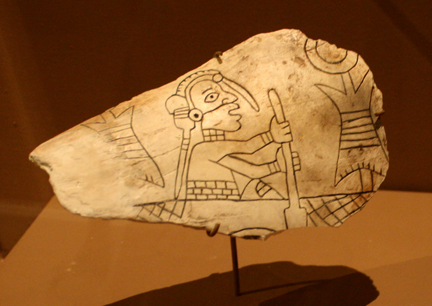
Replica of a incised lightning whelk shell dipper
Spiro never had major defensive structures and no evidence of major warfare. It was the major western center in the Mississippian world and was linked to a continental trade routes. Olivella shells from the California coast have been found there. It is notable for having the widest range of shell carvings, dippers and gorgets carved from Busycon contrarium or the lightning whelk shell imported from the Gulf Coast and Florida. Designs are highly elaborate and many are not repeated elsewhere. The dippers were used for serving ceremonial medicine, such as black drink. The gorgets were worn around the neck. The distinct iconography, which forms a visual language used through the southeast, has been widely debated. I would love someday to see an intertribal gathering in which oral historians share their interpretations of the imagery to compare to the interpretations from the archaeological community.

Craig Mounds
Beginning in the 1830s, Choctaw freedmen settled and farmed around the site, and one family in particular tried to protect them mounds. Unfortunately family members leased the land to the Pocola Mining Company in 1933. Those pothunters pillaged the mounds, selling items and burning others. They even burned human remains they unearthed from their graves. The State of Oklahoma finally passed legislation to protect the site in 1935, and in 1936 the University of Oklahoma and WPA workers started a scientific excavation (Peterson).

We saw pokeberries, pecans, acorns, yellow wood sorrel, and other edible plants. Reading about the Spiroan diet of venison, corn, hickory nuts, chestnuts, persimmons, and wild grapes makes me really wish for a Southeastern Native Foods Festival.

Joseph, Nuket, and Linda under a venerable oak tree
As Oklahoma’s only archaeological site open to the public and one of the richest archaeological sites in the US, the museum is grossly underfunded. It seems that Oklahoma would want to promote tourism to the site, and the first step would be putting up signs on the roads leading to the site. Seriously, even spray painted wooden planks would be of great assistance to travelers!
  • Peterson, Dennis. “Spiro Mounds.” Oklahoma Historical Society. Web.
  • Watkins, Joe. “Artefactual Awareness: Spiro Mounds, Grave Goods and Politics.” Fforde, Cressida, Jane Hulbert, and Paul Tumbull. The Dead and their Possessions: Repatriation in Principle, Policy, and Practice. London: Routledge, 2002.
Brother Juniper Helps Out at Spiro, America Meredith, acrylic on canvas, 5"x5", 2004

    06 June 2011

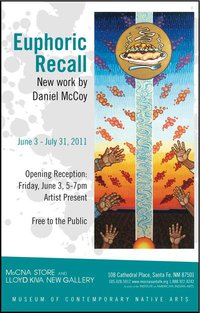
    Review | Euphoric Recall: New Work by Daniel McCoy

    Daniel McCoy, Jr. unveiled eight new works in his (mostly) solo exhibit, Euphoric Recall, at the Museum of Contemporary Native Arts’ Lloyd Kiva New Gallery. Euphoric Recall happens when an addict remembers only the good experiences from her or his addiction.  The description is apt—as angst and heartbreak are portrayed, to quote Henry Rollins, "with a renewed vigor and enthusiasm not seen by many."

    The Muscogee Creek-Citizen Band Potawatomi artist hails from Bristow, Oklahoma, attended IAIA in the early 1990s and 2000s, and moved back to Santa Fe after living at Lake Havasu. McCoy describes his work as a “visual time line” documenting his “past triumphs, current disasters.”

    In his art statement, McCoy writes of his paintings, “I try to make them as busy as possible.“ That is no lie. Repetitive mark making and patterns set the pieces in motion, and his tragicomic narration buzzes, crackles, and pulsates with a simmering dynamic energy.

    The largest piece in the show, The Letter, is also the most enigmatic. The acrylic-oil enamel painting is a collaboration between McCoy and Topaz Jones (Shoshone-Lummi-Kalapuya-Molalla). Bisected vertically down the middle, McCoy predominantly paints the left side and Jones takes the right, with an oversized heart drips blood from center stage. In a heavily outlined style reminiscent of R. Crumb or José Guadalupe Posada, a celestial woman surveys a mummified man in cowboy hat reading a letter. The clouded sky is populated by classic tattoos: swallows, daggers, scrollwork emblazoned with the phrase “Impending Doom.” The sky shifts to night on the right, with a map of Turkey and a projected Bat Symbol over a purple pueblo scene. A loose leaf notebook paper is a scrawled letter, with the words “Daniel, I forgive you” and “Love always, Topaz Jones.” Below is a yeti-like form on a pillow. This chaotic soiree leaves one with more questions than answers.

    The Letter, Daniel McCoy and Topaz Jones


    In the drawing Forbidden Art #1, a bright-eyed and plucky Deerlady, ala Veronica Lodge from Archie comics, stands with arms akimbo in a shiny pool of blood. A stompdance skirt and turtleshell dance shackles reveal her hairy cloven hooves, as she cheerfully presides over the grasping, screaming faces of her male victims, and she beams with pride over her accomplishments.

    The show’s centerpiece, The Indian Taco Made by God, an acrylic painting on canvas, is quite beautiful, with a sky is stitched together from slashes of paint. Heavily articulated hands reach out for absolution from the perfect Indian Taco. Showcasing McCoy’s flair for visual puns, the clouds resemble bubbles in hot lard.  Taco can be taken as a lightly, as a clever joke, but underneath the dazzling colors and masterful graphic strokes lies questions. Why does Indian Country fetishize a food so unhealthy, born of poverty and privation? Nostalgia for comfort food is a running theme in McCoy’s work — Frito pies, Spam, commodities — but we are what we eat.

    What refreshing about McCoy’s approach is that he is more questioning than didactic. His work is socially conscious but occupies a universe filled with possibility and contradictions — a young schoolgirl hauling an oversized Bible dreaming about Liz Taylor’s Cleopatra — comic book style with theological implications.

    Euphoric Recall will be up through July 31st.

    15 March 2011

    Cheyenne Quilling Society

    For thousands of years, indigenous people created and evaluated art according to our own standards. In the last few centuries, non-Native people have collected, critiqued, categorized, and theorized about Native art to such an extant, that in some venues they temporarily drowned out Native perspectives. Fortunately the tide is turning, with more tribes establishing their own museums, more Native peoples curating their own art shows, and more Native writers contributing to the canon of Native American art history. One window into historical indigenous perspectives on one genre of art can be found in Plain’s women’s quilling societies.

    While warrior societies among Plains tribes are well known, many tribes also had artistic guilds. One such guild was the quilling society, which was the most prestigious women’s society among many Plains tribes. Specifically I want to look at the Cheyenne women’s quilling society. The Cheyenne name for their quilling society was Mëëno’istst , which meant “quiller”–specifically “one who applies quills to hide”. Eme e ni means “she sews on quills” (Grinnell 160). The women who belonged to the society were known not only for their artistic skill but also for their moral standing (Western History Association 6).

    Quillwork, the aesthetic use of porcupine quills on textiles, hides, and other surfaces, is an art form unique to North America. Quillwork has been popular from coast to coast, taking hold throughout the range of the porcupine. The earliest examples of quills used as binding agents were found in caves in Utah and Nevada, dating back to 530 BCE, and the oldest quillwork found on moccasins date back to the 6th century CE (Palmer 75).

    My incomplete understanding is that a cultural hero named the Buffalo Wife first brought the art of quilling to the Plains tribes. Picking Bones Woman, a Cheyenne told the story about Buffalo Wife to anthropologist George Bird Grinnell, and she describe the human man who married Buffalo Wife. This man learned quilling while living among the buffalo. When he returned to Cheyenne society, he created the quillworkers’ society and instructed the women in the sacred protocol of quillwork (Grinnell 163).

    The quilling society was an intergenerational institution, with older women instructing younger women. “Not only were the quillwork guilds instructional, but they embodied a religious element as well, not unlike a sisterhood. To join this prestigious society was to assume a station of respect and power” (Her Many Horses and Horse Capture 9). Women created other art forms, which had their own societies, but quillwork was considered the pinnacle of women’s artwork (Williams 70).

    The accomplishments of quillers were on par with battle honors among men’s societies (Grinnell 159). As Beatrice Medicine and Patricia Albers write, “[T]he contributions of women were recognized by the Plains peoples, even though they have not been so recognized by anthropologists and art historians. Excellent in craftwork brought prestige and wealth to the woman and to her family” (Albers and Medicine 109). The artist had a place in Cheyenne society.

    When the women decided upon a quilling project, a specialized camp crier would publically announce their plans to the whole camp (Grinnell 160). Quills had to be harvested, dyed, and processed. They were softened with saliva and pulled between teeth to flatten.

    When a young woman quilled her first robe, she threw a feast. She would sit in the back of the lodge with the elder who instructed her sitting on her right. A poorer member of the tribe would be invited to witness the young woman quill her first robe and this poorer individual would be given a present, often a horse. Afterward if the visitor were a man, he would ride through the camp and sing a song mentioning the young women’s name and that she quilled her first robe (Grinnell 161).

    To protect the robe while it was being quilled, a woman would covered her hands with white clay or burnt gypsum (Grinnell 164). If a woman made a mistake when quilling, a ceremony had to be preformed, in which a brave man counted coup on the robe being quilled. The man would say, “And when I scalped him, I did it in this way,” as he cut the errant quills from the robe with a knife owned by the quilling society (Grinnell 166).

    To ensure success of a relative or to health someone in ill health, a girl or young woman could create a quilled robe for a healer, religious leader, or warrior in a specific ceremonial manner. The girl would offer a gift to an elder member of the quilling society and ask her help in the project. The elder would respond with a particular ceremony and then she would instruct the girl. Upon successful completion, the girl could attend quilling society feasts and teach others the techniques she learned (Grinnell 160).

    At certain gatherings, women would recount the quilling accomplishments, which would be attested to by a witness or said over an arrow or pipe (Grinnell 162).

    The elder members of the quilling society “had strict rules in their designs and they kept secret the meaning and arrangement of the colors, as well as the relation of the designs to each other,” as Rodolphe Petter wrote in his 1915 Cheyenne-English Dictionary.

    When preparing to quill a hide, a woman might ask an elder to visit her lodge and draw a design on the robe with a stick and white clay, for which she would be given a gift or clothing and food (Grinnell 163).

    As Petter wrote, “The designs were always symbolic and talismanic, representing concrete organic objects, whereas the color were more emblematic of the abstract in creatures and creations, e.g., white for active life, very light blue for quietness, peace, serenity (from the cloudless sky); green for growing life; red for warmth, food, blood, home from blood); amber yellow, ripeness, perfection, beauty (from the sunsets); black for cessation of enmity, hostilities (from a dead glow being no more hot)” (Grinnell 168-9).

    It’s intriguing that genres within quilling fell into a strict hierarchy. Woman began quilling moccasins, then cradleboards, stars or circular disks for lodges, buffalo robes, then finally lodge linings, backrests, and “possible sacks” (Grinnell 161). Those who completed these increasingly prestigious items increased their own prestige. Quilling an entire lodge by oneself was a great accomplishment but the highest accomplishment was quilling thirty complete buffalo robes. Doing so guaranteed the quiller a “long life full of good fortune" (Neithammer).

    The quilling society came to an end in the late 19th century (Her Many Horses and Horse Capture 9), after the Southern Cheyenne relocated to Indian Territory and the Northern Cheyenne moved onto their reservation in Montana. However, quilling itself never died and has never been completely replaced by beadwork.

    “Sacred protocol” and “moral standing” are not exactly common art terms today. It’s interesting to consider how many community members were involved in creating quillwork, or repairing it, or celebrating its creation. Wealth was tied to art before the reservation era, as was prestige; however, the nature of wealth is different in a reciprocal society than in a capitalist society. The Cheyenne quilling society is an example of how certain artists were perceived by a tribe and how their work strengthened relationships within the community.

    • Albers, Patricia and Beatrice Medicine. The Hidden Half: Studies of Plains Indian Women. Lanham, MD: University Press of America, 1983.
    • Grinnell, George Bird. The Cheyenne Indians: Their History and Ways of Life. Lincoln: University of Nebraska Press, 1972.
    • Her Many Horses, Emil and George Horse Capture, eds. Song for the Horse Nation: Horses in Native American Cultures. Golden, CO: Fulcrum Publishing, 2006.
    • Neithammer, Carolyn. Daughters of the Earth: The Lives and Legends of American Indian Women. New York: Simon and Schuster, 1977.
    • Palmer, Jessica Dawn. The Dakota Peoples: A History of the Dakota, Lakota and Nakota through 1863. Jefferson, NC: McFarland, 2008.
    • Petter, Rudolphe. English-Cheyenne Dictionary. Kettle Falls, WA: Valdo Petter, 1915. Link.
    • Western History Association. The American West. Volume 10. Cody, WY: Buffalo Bill Historical Center, 1973.
    • Williams, Lucy Fowler. Guide to the North American Ethnographic Collections at the University of Pennsylvania Museum of Archaeology and Anthropology. Philadelphia: University of Pennsylvania Museum, 2003.
    For Cheyenne art in the collection of NMAI, including quillwork, click here.