Translate

Showing posts with label art materials. Show all posts

04 September 2014

An Experiment in Acrylic Painting

Women in Cultural Context, a group exhibit, showed at Tansey Contemporary on Canyon Road. I went to see Teri Greeves’ large scale wall pieces—beadwork mosaic appliqués on raw silk. While there, I discovered the work of another artists in the show, Patrick McGrath Muñiz.

Muñiz is Puerto Rican artist who uses Renaissance techniques to make biting and clever social commentary on today’s global society. Besides his portfolio website, he maintains an informative blog. I poked around and discovered his post “Sharing My Own Approach to Painting Sixteenth CenturyVenetian Way.” Artists willing to share their hard-won techniques are rare and should be celebrated for their magnanimity.

These days, since launching First American Art Magazine, I don’t have any time left to paint; however, I agreed to participate in ImagoMundi. This international art exhibit showcases Luciano Benetton’s collection of artworks from around the word—all 12 cm x 10 cm—Imago Mundi is presently focused on Native America. So I had a tiny panel to paint and a new method about how to paint it. We’re running an article about Mapuche silverwork, so I thought perhaps I could paint something on that subject.

When I work from historical photographs, I try to find works in the public domain, such as Gustavo Milet Ramírez’s 1890 photo of a young Mapuche woman from Traiguén, Chile. The French-Chilean photographer, who lived from 1860 to 1917, was known for his photographs of Mapuche people.  Milet Ramírez took several shots of the same girl, many of which were made into postcards; I chose the photo in which she was grinning. Being extraordinarily nearsided, I’m fairly adept at teasing out information from grainy black-and-white photographs. The texture of her clothes and mantle are different; coarse woven material versus fur, which might be a quillango, a guanaco-fur cloak. Guanacos are the increasingly rare, wild cousins of llamas and alpacas, and their pelts are tawny with creamy-white underbellies.

The day before I had painted the wooden panel purple, so I began sanding it down to create a drawing surface; however, the texture was appealing, so I left it for the background and just gessoed the area that the girl would occupy. Gesso is far easier to draw upon than white paint. In composing the piece, I included the hands, since hands can be an expressive as the face

Step #2 Disegno (drawing)

In his blog post, “Sharing My Own Approach to Painting Sixteenth Century Venetian Way,” Patrick McGrath Muñiz’s Step #1 is Bozzetto (preliminary sketch). He recommends drawing on a separate paper and transferring it to the canvas for Step #2 Disegno (drawing) I just draw the girl’s basic features and jewelry directly on the panel.

Step #3 is Sotto Disegno (underdrawing)
His Step #3 is Sotto Disegno (underdrawing), in which he suggests paints the lines with burnt umber and turpentine. I should mention I’m painting with Golden acrylics, not oil paints, so mixed the Burnt Umber with Golden Acrylic Flow Release, which reduces surface tension and makes the paint “wetter.” The end result looks something like an R. Crumb illustration, and her eyes are way too big—but it’s painting; it can be fixed!

Step #4 Imprimatura (toned canvas),
Step #4, Imprimatura (toned canvas), requires a translucent wash of Venetian Red thinned with linseed oil and turpentine. Golden recommends substituting Red Oxide for Venetian Red. I used my typical concoction of Acrylic Flow Release, Retarder, and Acrylic Glazing Liquid. Typically this makes a wonderful “soupy” transparent wash that doesn’t dry quickly; however, I found Step #5: Togliere Strofinare (wipe-out technique) challenging. With oils, you can wipe the light areas clean with a cotton cloth; however, my wash dried quickly. I could wipe away sections but the transition was not smooth, so I just touched up the lighter areas with Titanium White. I’m impressed that at every stage of the painting, Muñiz’s sketch of Titian’s The Gipsy Madonna was gorgeous. Mine had ups and downs, but wacky looking stages can be redeemed.

Left: Step #5: Togliere Strofinare (wipe-out technique). Right: my typical painting formula
Step #6 is Sotto Dipinto (underpainting) involves two processes—painting the cool, backgrounds with a grisaille, a range greys mixed from Ivory Black to White, and a citronage, a range of colors mixed from Ivory Black, Yellow Ochre, and White. I’m a huge advocate of underpainting, especially for fleshtones. Typically I use a verdaille, or an olive-green underpainting, which makes fleshtones pop beautifully.

Palette for the citronage: tones of Titanium White mixed with Yellow Ochre,
and shades of Ivory Black mixed with Yellow Ochre


Step #6 Sotto Dipinto (underpainting)
The heavy lifting is done, so Muñiz’s final step is Step #7 Velaturas (color glazing)—the fun part! First step—I hate the Red Oxide wash over the purple, so to move the background back to the back, I gave it an Anthraquinone Blue wash. I also painted her clothing blue, then used Payne’s Gray and Titanium White for her silver jewelry.

Step #7 Velaturas (color glazing)
I laid down the base colors for her guanaco fur cloak, then painted on the furry texture. Here soupy paint bleeds too much; the paint should be less diluted, because the individual strokes should show clearly. I had to fight myself and use the No. 2 brush as much as possible before skipping to the extremely fine 0/20 brush. I tweaked out too much on the right side of the fur, so tried to stay loose on the left side, then went back and smoothed over areas on the right side of the fur cloak. More work does not necessarily mean a better painting, nor does more detail. The detail should be concentrated on the composition’s focus—in this case, the girl’s face—not every corner of the painting.

Step #7 Velaturas (color glazing)
Finally the time has come to cure the girl’s extreme case of jaudice! Her eyes and teeth both look okay as is, so I add color to her lips—the challenge being to make her look natural, not as if she were wearing lipstick. Dramatic shifts between the lip color and dots of white highlights help make the lips appear moist.

I can finally give her skin some color. My typical palette for fleshtones include Titanium White, Naples Yellow, Pyrrole Red, Burnt Sienna, Raw Umber, and Payne’s Gray. In larger, more detailed portraits, Violent Oxide is fantastic for shadows, but not needed here. Here’s where the paint should be extremely soupy, with generous portions of Acrylic Glazing Liquid for transparency and blending. Each stroke is nerve-wracking because the slightest shift to a mouth, an eyelid, etc. completely changes the expression of the subject.

This is a seriously tiny painting: 12 cm x 10 cm
The purple dress was annoying me, so I gave it a glaze of Alizarin Crimson Hue (Golden doesn’t create toxic colors, so approximates the more historical toxic colors as close as possible). Her jewelry was lumpy, so I tried to straighten it out with bolder edges. It’s a gamble whether to paint silver-like colors or actually to use silver paint; however, this can often look fake and cheap. Gold paint is very attractive, but silver paint can flop, so I opted to leave the jewelry blue-white.

In lieu of a frame, I sanded down the edges to the white gesso. So small, kind of funky, but finished!

Mapuche Girl after Milet Ramírez, 2014, acrylic on wooden panel
While painting I have hours to ponder issues such as cultural appropriation. Why am I, a Swedish-Cherokee artist painting a Mapuche person when I’ve never even been to Chile? By painting a portrait, hopefully I’m not stepping over the line of respectful outsider. I’m not trying to assume Mapuche identity; it would be bizarre if I tried to create Mapuche silver jewelry or painted drums—to attempt usurp their style.

Painting portraits based on historical photographs, although a ubiquitous practice is not by any stretch of the imagination cutting-edge art, and yet it does have some value. Our tribal histories are still invisible in mainstream culture. Painting is not a neutral representation—it’s a time-consuming practice laden with its own ancient history. Painting someone puts them on a pedestal, exults them. Taking this antique image and bringing into the 21st century, in vivid color, is a form of time travel and a statement that this person and her culture are important—that we in North America should look at and learn from South American tribes. I kept thinking about the idea of an “Indian princess,” because a “princess” is most ready European archetype to describe this young woman—confident and smiling—draped in luxurious furs and extravagant silver jewelry.

Thanks to Patrick McGrath Muñiz in sharing guidelines for this small experiment in painting!

09 July 2012

Heather Ahtone Reads Beneath the Surface

Parking Lot, Joe Feddersen (Colville), glass, 2003
In her 2009 essay, “Designed to Last,” Choctaw-Chickasaw artist, writer, and curator heather ahtone proposed a means of critiquing Indigenous American art based on Indigenous art theory. In her essay “Reading Beneath the Surface: Joe Feddersen’s Parking Lot,” presented at the College Art Association Conference and published earlier this year in Wicazo Sa Review, she puts her ideas into action by critiquing a sculpture by Joe Feddersen using Indigenous methodologies.

Her introduction lets us know exactly what's at stake. “Every time an Indigenous artist creates an object that reflects concepts rooted within her culture this same artists is perpetuating the culture one more day as an act of self-determination,” Ahtone writes at the opening of the essay. She continues, “While every effort of political and religious assault has been made historically to subdue these same cultures, their survival can be partially attributed to the continued production of visual and performance arts” (Ahtone 73).

Ahtone writes that Indigenous epistemology—“ways of knowing”—differs fundamentally from Western ways of knowing (74). While this is relatively obvious to most readers, she further points out that Indigenous learning is not “parallel or perpendicular” (74); that is, Indigenous knowledge is not the Other or opposite of Western knowledge. Indigenous knowledge is not universal but instead must be grounded in local tribal cultures and worldviews. To critique an artwork based on Indigenous values, Ahtone examines materiality, metaphor and symbolism, and cultural reciprocity (74).

Joe Feddersen, whose glass sculpture is critiqued here, is Okanagan and an enrolled member of the Confederated Tribes of the Colville Reservation in Washington State. He earned his MFA at the University of Wisconsin-Madison and was a printmaker and basket weaver before moving into glass art. Using textures from Plateau textiles that symbolize aspects of the natural environment, Feddersen creates a dialogue about the shifting environment and the impact of human development in the Columbia Basin (Askren).

Collaborating with Tlingit artist Preston Singletary, Feddersen embarked on an Urban Indian series. In 2003, he created Parking Lot, a 14 inch tall blown and sandblasted glass sculpture. The translucent, milky-white surface carries the texture of …, which is overlaid with an olive green rim and structures of perpendicular black lines.

Ahtone sees the overall cylindrical form as being reminiscent of a “sally bag,” a flexible basket common throughout the Plateau region (76). The materiality of the piece juxtaposes the implied basket’s soft and pliable surface with the rigidity of glass. Navajo-Wasco artist and author Elizabeth Woody wrote, “Feddersen’s use of glass speaks of our human fragility” and of his choice of the color white, Woody writes “the shell of the basket with the ephemeral density of a cloud” (78).

Feddersen’s use of metaphor and symbolism is overt and deliberate. A metaphor directly substitutes on concept or object for another, while a symbol implies something else. The symbol might be a much more simplistic shorthand for the concept it references. The Plateau weaving designs that Feddersen has incorporating into his printmaking, weaving, and glasswork are extremely spare, abstract geometric designs, and yet they are symbolic and inspired by elements seen in daily life, such as snake tracks on the ground (Askren). The textured surface of Parking Lot has four repeating patterns of chevrons etched on its surface. Feddersen explains that the chevrons “are actually the designs for woman in Plateau culture, kind of like an hourglass design, kind of a winding vase” (79). He learned traditional symbolism from Okanagan weavers but an elder pointed out that the meanings of the widespread symbols change from community to communities (79). By using this symbol, Feddersen “invigorates it as a continued part of the cultural dialogue and… contemporizes the language in its usage” (79).

Vessels themselves are commonly allegories for women. In the Okanagan worldview, “woman is a living metaphor for the earth” (79). The art audience can automatically juxtapose this view with the European-American view of woman as earth, and therefore, ripe for domination. Dynamical tension is conjured between these two referenced worldviews. Okanagan oral history describes the earth “as a woman ‘who gives birth to life forms’” who was once a human being and is still alive (79-80). The etched basket surface suggested grass, which is seen as the hair of the living female earth (80).

Then the black lines on the vessel are diagrams for parking lots, invented in the late 1920s. Ahtone sees these as referencing contemporary migration patterns, which “form the basis of how most Americans relate to the earth—through a mediated system of transit routes…” (80).

Cultural reciprocity is the third lens in which Ahtone critiques Indigenous art and is “an act of gratitude by an artist for their culture heritage” (81). Feddersen is keenly aware of place-based culture, and he incorporates landmarks, or “vital signs,” such as electric lines and railroad tracks into his expression of evolving Okanagan culture (81). “By using the traditional signs,” Feddersen says, “we talk about what the meaning is and they become part of our visual vocabulary rather than something that is purely historical” (82).

Looking at the artwork from a strict formalist approach, that is, looking only at visual aesthetic qualities of the work—an approach espoused by mid-20th century art critics—would completely miss the content of a work such as Parking Lot. Feddersen deliberately uses contemporary imagery and symbols to bring his cultural traditions into the present. Ahtone’s critique brings the content forward in a manner that could be understood by Native and non-Native readers alike. Personally, I’m well acquainted with the mental wall that some non-Native art audiences reach when viewing Indigenous artwork. Facing the situation of having to understand the cultural contexts of hundreds of different tribes seems overwhelming to fully understand Native art; however, it’s not a matter of getting cultural background to then get the works’ content. The cultural background is much the works’ content, and further understanding the worldview enhances the audience’s understanding of being Human.
  • heather ahtone, “Reading Beneath the Surface: Joe Feddersen’s Parking Lot,” Wicazo Sa Review, 27, no. 1 (Spring 2012), 73–84.
  • Mique’l.Askren,  “Joe Feddersen,” IAIA Museum of Contemporary Native Arts: Vision Project. Web.

15 June 2011

Review | Teri Greeves: Storied Beads

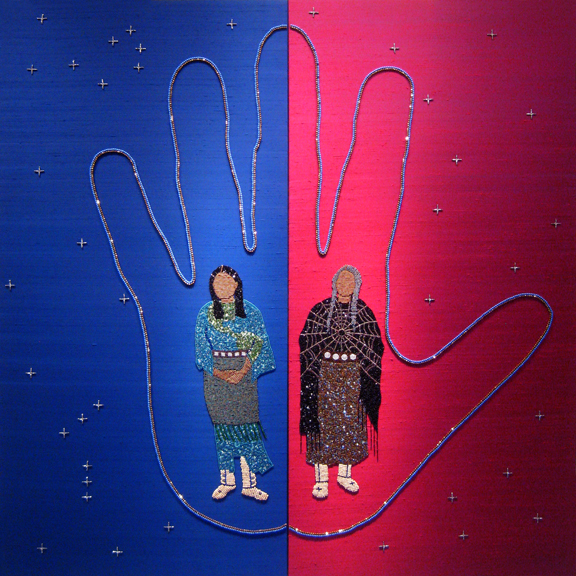
Sunboy's Women, ©2011 Teri Greeves
Storied Beads marks Teri Greeves’ first solo exhibition in Santa Fe in over three years. The Kiowa-Comanche-Italian bead artist has been busy — traveling nationwide, teaching, showing in major group exhibitions, and beading. Her new series, unveiled at the show, takes beadwork to a completely new level.

Hung in Shiprock’s main gallery hall, the works are immense. Five new, monumental beaded appliqué pieces are mounted on shimmering raw silk and luminescent vinyl. The tallest piece looms at 80” high.

The trend in beadwork is to use the smallest possible beads — to achieve fine detail and to display the beader’s technical prowess. However, an ongoing challenge for bead artists is to have their audience not just admire the technical skill in a piece but go beyond to see the composition, palette, and most importantly the content. Beadwork is an art medium loaded with historical implications; however, it’s still an art medium.

By blasting past expectations, Greeves carves a new space for expression. In these new works, she uses pony beads, large-scale beads that can be a centimeter or more width. These oversized beads, in glass, crystal, brass, and wood, coupled with mother-of-pearl disks showcase the reflective, translucent, textured, or glittering surfaces of the individual beads — approaching almost a mosaic quality, which is beautifully offset by the raw silk. While beadwork is most often seen in motion — on personal adornment, dance or ceremonial regalia, moving rattle or fan handles — the glittering quality of the cut-beads and crystals are activated when the viewer walks along, bringing the piece to life. In Sunboy's Women, Swarovski crystals flicker in the starry night sky.

Detail of Wa-Ho: The First Song After the Flood
Stars are a perfect allegory for the Kiowa oral history that inspired these works. The stories reflect unchanging truths, standing outside of daily timeframes, and serves as navigational guides like stars. “This is how our histories are passed on to us: through the vibrations of sound spoken from one individual to another,” writes Greeves in her artist’s statement. “It is also the basis of much conflict between how we see history and how history is written and read by non-Natives.” The subject matter in the show is highly specific. Greeves truly wants people to know and understand the stories, so she included lengthy artist’s statements for each work. The gallery has posted her statements in toto on their website; however, the staff at Shiprock is so gracious and outgoing, you would feel completely welcome reading the entire statements in the gallery at your leisure.

The centerpiece of the show is Sunboy's Women, a 72” x 72” diptych mounted on blue and red raw silk, the colors worn by Kiowa gourd dancers. Sun Boy or Half-Boy are cultural heroes that were born from an earth woman who fell in love with the Sun. She died trying to return to the earth from the sky world, so the orphaned Sun Boy was raised by Spider Woman, an adoptive grandmother. The figures of the two women are portrayed side by side—young and old—encased in a giant handprint, dividing in half like Sun Boy.

The figures in the show are women, each portrayed representational but faceless, giving them a timeless or universal quality. Greeves’ figurative style calls to mind the work of Virginia Stroud, a Muscogee-Cherokee artist who was adopted Kiowa and who helped revive ledger painting in the 1960s and 1970s. Text is also a key feature of the works, graffiti-esque text in the thought bubble above NDN GRRRL! and the embellished script of a lullaby in Wa-Ho: The First Song After the Flood.

detail of Wa-Ho: The First Song After the Flood
The haunting She Loved Her People struck me the most. A lone, faceless female figure stands on a burgundy background, brandishing a sword.  Curliqued script proclaims that “She loved/her people.” Strategically sewn darker beads create an illusion of shadow on the figure, and mother-of-people discs stand in for elk’s teeth on the yoke of her dress, composed of sparkling cut midnight blue beads. Greeves explains how a 16-year-old Cheyenne girl witnessed Custer’s massacre of her people, including most of her relatives, at the Washita River. The girl saw Custer slice through the belly of a pregnant woman, dismembering her unborn child. This survivor joined a war party, traveled north to Little Big Horn. She fought in that battle and ultimately found Custer. She slit him open from naval to neck with his own sword. Today the German silver trailers that Southern Plains women wear at their waist commemorates this girl’s bravery.

The juxtaposition of feminine grace and bloodshed might seem incongruent, especially expressed through the “delicate” medium of beadwork. However, this and other works are about family and the willingness to stand up and fight for family. The young Cheyenne girl’s act of resistance restores some harmony and balance in the face of atrocities. So therefore the depiction of the girl is with grace and respect. The oral histories, although not necessarily “pretty”, bind together generations of an extended families and tribes. Greeves is offering the public a window into the encompassing and protecting web of stories and relations that help shape her tribe and her own family.

Storied Beads will be on exhibit through June 30, 2011 at Shiprock Santa Fe, Old Santa Fe Trail, 2nd Floor on the Plaza.
www.shiprocksantafe.com

22 March 2011

Meta-Criticism: Responding to the Response to the Tipi: Heritage of the Great Plains at the Brooklyn Museum, Part One


New York is arguably the center of the art world, and the Brooklyn Museum’s exhibit, Tipi: Heritage of the Great Plains puts Native art, both historic and contemporary, in crosshairs of mainstream art writers. That it received so much attention from art writers is a coup for curators Nancy Rosoff and Susan Kennedy Zeller. However, the quality of much of the writing leaves something to be desired.

Johnson, Ken. “Plains Indian Culture, as Seen Through the Ingenuity of the Tepee.” New York Times. 14 March 2011.

I’ll begin with Ken Johnson’s New York Times review of Tipi: Heritage of the Great Plains, as it stands out as the most flippant and dismissive. He approves, albeit condescendingly, of the historical works but disregards the “kitschy pieces” by living artists.

Johnson’s critique opens with, “You know there’s trouble when the first object you encounter in a museum exhibition looks as if it had been misplaced from the gift shop.” The art piece to which Johnson refers is 21st Century Traditional: Beaded Tipi, a miniature tipi by Teri Greeves (Kiowa-Comanche-Italian), which he describes as “cartoonish” and “cheerfully saccharine.” Art is subjective and certainly he has no obligation to like the piece, but if it’s a true critique, the description should be accurate. The tipi, commissioned by the museum of the show, stands 46” tall and is made of brain-tanned deer hide, various seed and bugle beads, silver, pearls, raw diamonds, copper, cotton, rope, pine, poplar, and bubinga, a tropical African hardwood (Rosoff and Zeller 35). Kitsch refers to work that is cheap and mass-produced; this is a labor-intensive handmade piece with precious and semi-precious materials.

The beaded imagery is celestial (sun, morning star, and moon), zoomorphic (three buffalo), and various Native figures – faceless adults and children, a drum circle with microphone, and dancers. Nothing particularly screams “saccharine” — the palette is bold with the only pastel color being sky blue. Perhaps the imagery of adults holding or walking with children is too sweet? That’s a sad state of human affairs is that is the culprit. Otherwise, the “fault” must lie in the diminutive size of the piece. The art world is rife with size queens.

Johnson writes about the tipi, “the object has a relationship to the historic material that is perplexing at best.” Sorry, the relationship is painfully obvious and the title even underlines the point. The figures are all Plains Indians in 21st century dress—some Kiowa, some intertribal—and the piece shows that songs, dances, familial relations have maintained continuity over the centuries, as have Plains peoples relationships to celestial forces, despite changing technology, as exemplified by the microphone. Miniature tipis have an historical antecedent as young girl’s toys, but in the 20th century, they have increasingly been commissioned by museums. Just as the tipi is portable, the miniature tipi is a portable expression of Plains culture. The piece is upbeat, but that is part of the message: Kiowa people are alive and have much to celebrate. Greeves’ art statements are included in the labels and wall text; however, none of the art writers referred to these texts.

Johnson is disappointed that he believes the show “speaks down to its audience, assuming a low level of sophistication,” but frankly that’s not an inappropriate assumption—very unfortunately non-Natives tend to not have extensive knowledge of Native culture, as Johnson illustrates when he switches his spelling to “tepee” and simultaneously points out that Lyle Heavy Runner (Blackfeet not “Blackfoot” as Johnson writes) created a tipi with a “sacred design…handed down for generations” but describes it as looking “as if it had been borrowed from a roadside souvenir stand.” Which one is it? Apparently Johnson has only encountered tipis at roadside tourist traps and refuses to make the conceptual leap that tipis (and by extension Indians) have an existence independent of tourism and kitsch in the 21st century.

Húŋkpapȟa Lakota Butch Thunder Hawk’s Horse Head Effigy Stick is described by Johnson as resembling “a war club, with a horse-head-shaped business end.” The writer has never heard of the Horse Dance and doesn’t know that when a beloved horse dies, its owner will make or commission a wooden sculpture in the likeness of that horse to carry in ceremonial dances. Fair enough. But if I went to a museum and wasn’t familiar about art form, personally, I would opt to not publicly parade my ignorance; I would either read up or ask questions, but that would require the desire actually to learn about the art form in question.

Johnson suggests that the Native American Church material deserves its own exhibition, because he has never heard of the 2002 traveling exhibit Symbols of Faith and Belief: Art of the Native American Church with a superb catalog. Perhaps Google was down that day?

The gift shop with tipi-related products is repugnant to Johnson in light of “the tragic, still painful history evoked” by the exhibit. These reflect some of the “rules” about Indians that firmly implanted into the mainstream American psyche:

  • Indians are historic.
  • Indians are tragic. 
  • Indians are dead.
“The Plains Indian culture that gave rise to these kinds of objects,” Johnson insists “was practically destroyed by the United States government’s campaign to clear land for settlement by white people over a century ago.” But it wasn’t destroyed. The artists Kevin Pourier, Butch Thunder Hawk, Teri Greeves, Lyle Heavy Runner, and others are explicitly spelling this fact out through their art—Plains culture and Plains Indians is alive in the 21st century. These artists still have a relationship to their spirituality, their land, and their people, as well the buffalo, deer, and horse that have been so integral to Plains culture. It is an important message, which was lost on a man wearing his “selective-attention goggles,” but hopefully will not be lost on other museumgoers.

Tipi: Heritage of the Great Plains, Brooklyn Museum website

19 March 2011

Adventures in Egg Tempera

I finally got to answer a question that crosses the mind of every beginning egg tempera painter. Perhaps chicken eggs are the best-suited eggs for painting, but what about other bird's eggs? I finally got the opportunity to deviate from the prescribed course when I found quail eggs for sale at Talin International Market in Albuquerque. Ideally you paint with the freshest, organic eggs available, so it's definitely a risk to paint with quail eggs shipped in from California and have been sitting on shelves for an indeterminate period of time.


Egg tempera is an ancient painting medium using egg yolk as a binder for pigments. The yolk has to be separated completely from the white (paint with egg white paints was used in European medieval manuscripts and is called "glair"). The quail eggshells are quite beautiful, cream with brown speckles and pale blue on the inside. They are softer than chicken eggs and don't break as cleanly. On the plus side, probably due to the smaller surface area, the yolk sac isn't as fragile as a chicken's.

The quail egg yolk handled very much like chicken yolk. I use a 1:1 yolk-water ratio with a drop of vinegar to keep the paint from spoiling quickly. I had a 7"x5" true gesso panel and found an 19th-century tintype of a Cherokee girl from Indian Territory, that was in the public domain, to provide subject matter for this experiment. The underpainting is built up with transparent layers. Ideally you get some paint on your brush, wipe it off, and then create barely perceptible layers, but my patience only goes so far before I finally resort to cross-hatching the top layers. I leave visible brush strokes, but I like the energy this gives the work. Egg tempera is about the least spontaneous art medium I know of.

The handling and the end results of the quail egg tempera were good. The only advantage I can see to painting with quail eggs is the smaller yolks allow you to use exactly as much as you need every time you painting, instead of leaving the remaining yolk mixture in the 'fridge.

Although I've never heard it suggested that precontact peoples in the Americas used egg tempera, many tribes domesticated turkeys, so at least it's possible that egg tempera might have a history here. Indigenous paint binders I do know about include bear grease, lime, blood, squirrel fat, cherry sap, milkweed juice, cucumber juice, and pine pitch. I'd be very curious to know if tribes used rabbit fat or walnut oil as a paint binder.

From Ahalenia

07 February 2011

Heather Ahtone: Designed to Last

“Designed to Last: Striving toward an Indigenous American Aesthetic”
The International Journal of the Arts in Society. Volume 4, Number 2, 2009: 373-386.
Heather Ahtone (Choctaw-Chickasaw)

When I got my hands on “Designed to Last,” I handed it out to people like Chick tracts. So many people write about the need to assess Indigenous American art based on indigenous values; however, this essay was the first time I have ever seen anyone propose a way to do so. I will attempt to summarize her main points.

Choctaw-Chickasaw scholar Heather Ahtone is a doctoral candidate at Kansas University and a research associate for the University of Oklahoma’s Diversity in Geosciences Project. She draws upon the traditional knowledge of her relatives, tribespeople, and members of other tribes to complement her academic studies.

Ahtone was conducting research for the American Indian Cultural Center and Museum, when a Ponca man explained to her how the design of his floral beaded pipe bag was a map with a related hunting song (373). This revelation crystallized the complexity of Indigenous American art for her.

In the past scholarship of Indigenous America art came from a Eurocentric perspective. Art historians examined art collected with little information or cultural context or judged the art solely by its decorative. This formalist approach, popular in the Modern Era, barely skims the surface of the artwork’s meaning. The need for Indigenous methodologies in art history is clear. Donald Fixico (Shawnee-Sac & Fox-Muscogee Creek-Seminole) writes, “The scholar must consider the worldview of an Indian group to comprehend its members’ sense of logic and ideology” (374). Aaron Fry writes that “…after 150 years of ethnographic studies of Pueblo peoples, art historical examinations of twentieth-century Pueblo arts have failed to fully engage Pueblo concepts and perspectives on the production of these arts” (374). Western scholars often tend to divide ancient or contemporary Native art, instead of acknowledging the cultural continuity between the works.

In his article “In Search of Native American Aesthetics,” Leroy N. Meyer describes tribal cultures as “deeply integrated, unlike the fragmented, cosmopolitan culture of the dominant society” (375). Indigenous art cannot be separated from philosophy, spirituality, or daily life—different expressions of Indigenous cultures are integrated and complement each other.

Steven Leuthold proposed a framework for understanding Native art in his book, Indigenous Aesthetics: Native Art, Media, and Identity (University of Texas Press, 1998), that “addresses the relationship between aesthetics and other cultural realms with reducing one realm to the other. In this sense an artwork can be valued for its expressiveness, complexity, creativity, or formal structure… without artificially separating the experience of art from other valuative dimensions of experience: the moral, economic, political, interpersonal, or spiritual” (376). Leuthold’s methodology makes it clear that Western art theory, as Ahtone writes “serves to seek out point of distinction and difference, to use a linear approach to hierarchy for identifying culturally based expressions” (376). Leuthold applies his method to indigenous film and video, but Ahtone wonders if his approach would work the non-Western media of tribally specific traditional arts.

Instead of focusing on points of difference, Ahtone suggests that Indigenous art theory should be based on “finding relationships and shared commonalities” (376) She writes, “The use of relationships is a part of the coded language embedded in all aspects of Indigenous American culture” (376). These relationships can be expressed through “living metaphors” that are expressed through visual arts, dance, song, and oral history. Relationships of natural forces, including humans, reflect two fundamental values in indigenous society: balance and reciprocity. Balance, or harmony, reflects “the mutually dependent relationship that all forms of life have with each other.” Reciprocity is expressed through generosity and “the necessary acts of generosity that maintain balance between interacting forces, including human, natural, and spiritual” (377). Together these are part of “an interdependent pattern that extends like a spider web and draws strength form the interdisciplinary, yet tangible connections” (377). Looking at Indigenous aesthetic, one should also study science, humanities, religion, politics, and other disciplines because an integrated, interconnected, interdisciplinary approach will enhance one’s understand of all these and other fields.

“The traditional knowledge of Indigenous American culture, largely anchored to concepts of regeneration and reciprocity, is expressed and practiced in a network of symbols, metaphors, and myths,” Ahtone writes, which manifest in “ceremonies, prayers, songs, dances, and the arts—largely communal experiences” (377). Regeneration, or renewal, also play a key role in indigenous cultures.

Art materials can have intrinsic meanings and significance in Native art. Many indigenous art forms are made from materials gathered from the natural environment. A protocol of reciprocity often guides the gathering of the material, which reflects the artist’s relationship to the land or water. For example, indigenous California basket weavers have specific songs for gathering certain plants and observe strict menstrual taboos. Ahtone gives the example of Southwestern potters praying and giving offerings before gathering clay. The clay is often shaped into a hollow round form with a circular opening, resembling the earth and the emergence of the people from the underground to the surface. Designs painted on the clay can reference natural phenomena such as weather patterns. “Through this process of reverence and utilization of materials,” writes Ahtone, “many Indigenous people share a reverence for the objects based just on materials alone that is without comparison in the Western culture” (379).

Indigenous artists might use new designs with traditional materials, or they might use traditional designs with new materials, but either way, they are “expanding the visual dialogue about the Indigenous experience”—as opposed to departing from it (379). Ahtone credits art’s ability to convey traditional knowledge and spiritual beliefs as one of the reasons tribal cultures have survived despite centuries of colonialist suppression (379).

Metaphors—symbols used to represent related concepts or objects—are central to Indigenous art. The metaphoric mind—an intuitive mind in direct communication with the subconscious and nature—can perceive “beyond the limitations of our rational mind” (380). The symbols that create a metaphoric narrative were created and regenerated over generations. They represent natural forces and cosmological, both of which are timeless and interconnected. Many tribes’ oral histories contain both the past, present, and future, and much Native art is equally timeless in scope.

Leroy Little Bear (Blackfoot) writes, “The Native American paradigm is comprised of and includes ideas of constant motion and flux, existence consisting of energy waves, interrelationships, all things being animate, space/place, renewal and all things being imbued with spirit” (381). In this state of flux, symbols “provide anchoring points for Indigenous peoples to acknowledge and be reassured that their current dilemmas and circumstances are no more than an evolution of the difficulties and bounties shared by their ancestors,” write Ahtone (381).

The strength of symbols is that they can have multiple interpretations, and the artist can add their own personal meanings to the larger cultural meanings. These multiple readings enhance each other. This flexible and additive nature of symbolism helps Indigenous American arts “serve as a conduit for cultural perpetuity” (382). The repeated use of symbols invites personal memories to become attached to them and can invite self-reflection. An example new symbols being created is Seminole and Muscogee patchwork, which is a 20th century development. Seminole patchwork developed as an art form primarily in the 1920s and 1930s. By creating colorful appliqué patterns from scraps, Seminole women could create beautiful attire for themselves and their families during hard economic times. The patchwork designs were given names connected to natural forces, such as lightning or storms. Stories related to the imagery followed, and clans connected to the natural phenomena adopted certain designs. Worn during dances, state occasions, and ceremonies, the patchwork patterns become intertwined with self-identity and tribal self-determination.

The ability of these multilayered, collective and personal symbols, metaphors, and content-laden materials to relay cultural knowledge is reflected in many Indigenous artists’ statements. Ahtone cites the artist statement of the late Michael Kabotie (Hopi) as a prime example. He painted the Hopi feathered serpent, which, as Ahtone writes, “represents the dynamic between heaven and earth and the constant power struggle between these two energy sources” (383). In his work, the feathered serpent also speaks to our dangerous dependence on oil—a contemporary interpretation of a timeless symbol.

In oral societies, the arts have served as a visual language and connect tribal members across space and time. Ahtone concludes, “Using this aesthetic, those concepts of the metaphoric mind, uses of symbols and myths, within a culturally specific context, allows for a discussion about the art that incorporates the metaphysical without becoming romantic or sentimental” (383-4). She invites critical review and is currently putting her methodologies to work in critiquing contemporary Indigenous American art.

The entire essay can be ordered through: The International Journal of the Arts in Society.

Heather Ahtone is presenting her paper, “Reading Beneath the Surface: Joe Feddersen’s Parking Lot” at the College Art Association Conference in New York on Wednesday, February 9, 2011.

The Michael Kabotie interview is online here.