Translate

Showing posts with label art shows. Show all posts

25 October 2012

Inner Demons IV


The fourth annual Inner Demons group art show showcasing the dark, disturbed, and simply wrong. The opening reception is Friday, October 26th, 6:00–9:00pm at Ahalenia Studios, 2889 Trades West, Unit E, Santa Fe.


The show will be open:
• Saturday, Oct. 27 and Sunday, Oct. 28, 2-6pm
• Saturday, Nov. 3 and Sunday, Nov. 4, 2-6pm
 From Monday, Oct. 30 through Friday, Nov. 2, open by appointment. Email to make an appointment. All events are free and open to the public.

Street parking only!!

Participating artists include:
Jealousy, Sharon Vargas, mixed media on Plexiglas
• Bryon Archuleta (Ohkay Owingeh)

• Jamison Chas Banks (Seneca-Cayuga-Cherokee)
• Shaun Beyale (Navajo)
• Jason Reed Brown (Koyukon Athabascan)
• Miguel Cera (Spanish-American)
• Melissa Dominguez (Spanish-American)
• Lara Evans (Cherokee Nation)
• J. Luna Gaudi (Spanish-American)
• Sam Haozous (Chiricahua Apache-Navajo)
• Topaz Jones (Shoshone-Lummi-Kalapuya-Molalla)
• Russ McCabe (Scottish-American)
• Daniel McCoy, Jr. (Potawatomi-Muscogee Creek-Seminole)
• Melissa Melero (Fallon Paiute-Modoc-Taino)
• America Meredith (Cherokee Nation)
• Laura Paschall (Cherokee Nation)
• Tammy Rahr (Cayuga Nation)
• Felicia Rodriguez (Spanish-American)
• Joseph Sanchez (Mestizo)
• Jacqueline Smith (Navajo)
• Neebinnaukzhik Southall (Ojibwe)
• Sharon Vargas (Spanish-American)

Show website: http://www.ahalenia.com/demons.

21 August 2012

Art Exhibitions and the Cultural Landscape - Santa Fe Community College

Last week a golden opportunity came my way — teaching ARTS 165, "Art Exhibitions and the Cultural Landscape," at Santa Fe Community College. The 3-credit course will meet Wednesday, 9-11:30 am, beginning tomorrow, August 22nd; however, it's not too late to enroll! You can audit the class as well, without having to order transcripts. The class meets on SFCC's main campus in room 711.

This course will examine the social, cultural, and political complexities of art and exhibitions. We'll focus on the many cultural in the New Mexican art scene, especially Native American American and Latino, but will also look at cross-cultural communication, urban and rural art, and exhibiting internationally. Guest speakers will discuss cultural sensitivity, repatriation, their own experiences navigating their curatorial practices and finding a space for their artistic expressions in the larger art world. Besides museums and commercial gallery spaces, we will look at alternative art spaces and experimental exhibitions.

This course is a component in the SFCC Gallery Management degree program and transfers to IAIA. For more information, call (505) 428-1501. For registration information, go here.

16 August 2012

Low-Rez: Native American Lowbrow Art


l
"Reclamation: Manifestations of Changing Woman," Nani Chacon, oil on masonite
Santa Fe, NM — Low-Rez: Native American Lowbrow Art is a group art show of emerging and established Native artists working in the “lowbrow” genre of Pop Surrealism. The show runs from August 17 to September 1, 2012, and opens with a reception on Friday, August 17, 5:30 – 9:00 pm at 131 West San Francisco Street, First Floor near the downtown Santa Fe Plaza. A closing reception will be held on Saturday, September 1st, from 6:00 pm – 9:00 pm. Both events are free and open to the public.

Participating artists include: Jamison Chas Banks (Seneca-Cayuga-Cherokee), Nanibah “Nani” Chacon (Navajo), Brent Greenwood (Ponca-Chickasaw), Amber Gunn Gauthier (Ho-Chunk–Menominee), April Holder (Sac and Fox-Wichita-Tonkawa), Topaz Jones (Shoshone-Lummi-Kalapuya-Molalla), Randy Kemp (Choctaw-Yuchi), Linda Lomahaftewa (Hopi-Choctaw), Cannupa Hanska Luger (Mandan-Hidatsa-Arikara), Daniel McCoy, Jr. (Potawatomi-Muscogee Creek), America Meredith (Cherokee Nation), Chris Pappan (Osage-Kaw-Cheyenne River Sioux), Jeremy Singer (Navajo), Monty Singer (Navajo), Ryan Singer (Navajo), Hoka Skenandore (Luiseño-Oneida-Oglala Lakota), “The Werewulf” Micah Wesley (Kiowa-Muscogee Creek), and Debra Yepa-Pappan (Jemez-Korean). The show will also feature a mural by Jamison Chas Banks and Keith Secola (Northern Ute), both recent IAIA graduates.

Coming from diverse backgrounds and experiences, these artists are united in their use of pop cultural imagery to express themselves as contemporary indigenous peoples. Most of the artists attended the Institute of American Indian Arts, a school dedicated to Native artists choosing their own path in self-representation, and most are participating in SWAIA’s Indian Market.

Redemption March, Ryan Singer (Navajo), acrylic, 2012
Lowbrow Art, also called Pop Surrealism, has mushroomed over the last few decades, as a response to overblown bombastic excesses of conceptual art and a return to a love of craft and technique in art making. Santa Fe has been an epicenter for the Native Pop movement, in which artists use pop imagery to explode non-native fantasies of Indians as the timeless “Noble Savage” and to establish entry points for audiences who might not be familiar with tribal histories or imagery. The subversive humor of Native Pop and Lowbrow Art provides a perfect vehicle for social commentary without becoming preachy or propagandist.

The pop imagery used by the artists isn’t random. Often it reflects traditional Native imagery that was co-opted by mass media—Trickster Rabbit as Bugs Bunny, Princess Leia’s Hopi butterfly whorl hair-do, Taos Pueblo artist Pop Chalee’s blue deer paintings transformed by Walt Disney into “Bambi”—acts of re-appropriation.

Pin-up girls are transformed by the hand of Amber Gunn Gauthier and Nani Chacon from sex objects for voyeurs to symbols of empowered women who own their sexuality. Chris Pappan turns traditional ledger art on its head. Linda Lomahaftewa was part of the initial wave of Native Pop artists and was a classmate of T. C. Cannon at IAIA. Lomahaftewa lived in the Bay Area in the 1960s and 1970s and will exhibit monotypes with UFO-imagery. Micah Wesley and Cannupa Hanska Luger were part of the Humble Collective, an artist-run space that challenged and inspired waves of artists over the last decade.

Daniel McCoy combines comic book imagery with imagery from traditional Muscogee ceremonial grounds of his youth, with wry to dark humor. McCoy will create a large scale, site-specific installation at the street-level San Francisco gallery space.

The art show’s website is at www.ahalenia.com/lowrez.

27 June 2012

Travels to England: Indigenous Brilliance - Messengers - Emissaries of Peace

The King's Men, part of the Rollright Stones in Warwickshire
Three events conspired to lure me over to England for the first time. Two were contemporary Native American art shows. Indigenous Brilliance opened at the Highgate Institute in London, and Messengers at Rainmaker Art Gallery in Bristol. The third event was the Emissaries of Peace, a tour sponsored by Cherokee Nation Tourism, which retraced the travels of three Cherokee leaders who traveled to England 250 years ago to meet King George. These were sandwiched just between the Queen’s Jubilee and the London Olympics, making London crowded and tickets expensive — but the trip was well worth it.

I flew into Bristol the day of the opening of Messengers—not a smart move—and muddled through it with only three hours of sleep. Marcus Amerman was in town and assisted with developing the concept of the show. Joanne Prince, owner of Rainmaker Art Gallery, saw the idea of messengers, and artists as messengers, working on many different levels. 18 contemporary artists participated in the show. While most were painters, photographers, and printmakers, Melissa Cody (Navajo) showed weavings, Kelly Church (Odawa-Ojibwe) showed birchbark bitings, and Marcus Amerman (Choctaw) showed both representational and stylized pictorial beadwork. As a former bike messenger, I took the art show’s theme extremely literately and painting small portraits of a Pawnee motorcycle messenger and Navajo/Mestizo walking messenger from San Francisco. Edgar Heap of Birds (Cheyenne) was also present, as he was traveling through London and Paris on business.

Rainmaker Gallery in Bristol, England
Joanne rented a nearby textile workshop for artist talks the next day. Marcus presented about creativity and his inspirations in working in so many media— beadwork, painting, fashion design, installation, glass, and performance art. Edgar showed videos about his 2005 public art sculpture and installation, Wheel, at the Denver Art Museum, and his 2007 art installation, Most Serene Republics. I presented about Linda Lomahaftewa and my journey through the southeast visiting archaeological sites and the art we created based on our experienced. Sarah Sense (Chitimacha-Choctaw) could not make the trip after all, so I filled in for her and presented about ancient Andean art with an emphasis on textiles art.

Unbelievably, some people stay from the beginning to the end of the talks. Max Carocci, Programme Director of World Arts and Artefacts at the British Museum, traveled over to Bristol to attend the talks. He has worked with contemporary Kiowa artists and has written several books about Plains Indian art.

It was strange but refreshing to be able to comment frankly, through art and words, on the history of US injustice against indigenous Americans without encountering the usual layers of resistance or denial. People in the audience really listened and soaked up information. They also came to the table with a great deal of knowledge. Some of the lecture-goers had traveled to Mayan temples or to South America where they had firsthand experience with Cusco School paintings or the Nazca Lines.

Bristol is the home of Banksy and actively embraces street art. They have amazing graffiti and street murals, but unfortunately I didn’t get to explore much in my short stay. Thanks so much to Maria who let me stay in her house, Andy Pink who gave myself and other artists rides, Sophie who assists at the gallery and gave Marcus and I a tour of Bath—Jane Austen’s turf!— to Emelia, my fellow Cherokee-Swede who helped with the show, and especially to Joanne whose vision brought us all together.

A messenger friend from San Francisco, Joel, lived in the sleepy northern hamlet of the Priors Marston, so I got to explore centuries-old churches and millennia-old standing stones with him, his wife Becky, and daughter Aleisha. Incredibly beautiful country steeped in history. Thank you so much for your messengerosity! (That’s Howard Williams’ term for the inherent generosity that messengers share.)

Elija below work by Bryon Archuleta (Ohkay Owingeh)
In London, Cornelia “Elija” Vandenberg curated Indigenous Brilliance with Lyle Toledo Yazzie, a Navajo jeweler and collage artist. Elija is a human rights activist originally from the Netherlands, who has curated indigenous before and is keenly interested in showcasing political work. Lyle coordinated with many artists in the US and together they showcased over 70 works by 30 different artists. Bryon Archuleta (Ohkay Owingeh) came to the show’s opening and helped hang work the day after he arrived. No rest for the wicked! Elija reported that interest was high and the show at Highgate has seen a steady stream of visitors. Paul and Max from the British Museum attended. A non-native English artist, Gary Wells showed two pieces that I thought were great, combining vibrant, Celtic-inspired calligraphy with stencilwork featuring gunpowder. Many of the artists are activists in different causes, including Michael Horse, the actor and AIM member, who has championed ledger art for years. Osage artist Matt Jarvis brought images of the Oklahoma sky into the show with his digital photocollage, Meditation No. 1—Osage Meditations, and Steve Hapy (Anishinaabe) commented on diabetes in his visceral and highly textural piece, Diabetes, painting on an American flag.

Edward Chamberlain and Lyle Toledo Yazzie examine jewelry
Lyle had arranged with the British Museum to see their collection of contemporary southwest jewelry, and graciously let me tag along. We were please to see Hopi jeweler Michael Kabotie’s work in their collection, as well as a beautiful piece by Gail Bird (Santa Domingo) and Yazzie Johnson (Navajo)—who helped enable me to make the trip over! Jack Davy, Museum Assistant for North America, shows the items from the permanent collection and shared with us the internal database for the museum.

The North American room at the British Museum featured a survey of Canadian and United States indigenous art, from precontact, historical, modern, and contemporary, which included works by Bob Haozous and Diego Romero on permanent display. Their collection of avian and feline Hopewellian platform pipes is extraordinary. But their indigenous Mexican room is truly incredible, featuring elaborate turquoise mosaic sculptures, including the famous Aztec double-headed serpent. Believed to be a gift from Moctezuma II to the Spanish invader Hernán Cortés from 1519, the carved wooden serpent is covered with over 2000 pieces of turquoise, conch, and delicate crab shell.

Early 18th century Cherokee incised gourd
The next day, I returned to the British Museum to meet up with the Cherokee delegation. They arrived, joking and laughing more than anyone else I’d seen in the country (except maybe Marcus). The trip was arranged by Cherokee Nation Tourism, and everyone paid their own way. People from all three Cherokee tribes participated and they retraced the steps of Ostenaco, Standing Turkey (Cunne Shote), and Woyi. The Cherokee men were accompanied by Henry Timberlake and met with King George III. The 2012 group of Cherokees met with a wide range of officials and politicians (the Queen, presumably was too preoccupied with jubilee-ing it up to meet with our friends). I actually have no idea why I didn’t join this trip, since I met a bunch of interesting Cherokee people just in that short afternoon, including beadwork and storyteller Corey Still.

Jack Davy’s showed us several early 18th century Cherokee prints from the British Museum’s permanent collection, as well as a rare geometric beaded sash on stroud cloth with intact selvage, an incised gourd with a wooden stopper, and a double-woven rivercane basket with lid whose dyes were incredibly brilliant considering the basket was almost two centuries old. Afterwards, my cousin and Cherokee historian and genealogist extraordinaire Jack Baker; historian
Cherokee visitors presenting British Museum staff
with gifts of Cherokee pottery
and director of the Gilcrease Museum, Duane King; and writer and former curator at the IAIA museum, B. Lynne Harlan got to see rare, seldom published portraits of Richard Justice and Moses Price (both Cherokee) by William Hodges (1744-1797) at the Hunterian Royal College of Surgeons. Ironically, a graduate student was taking a survey about how comfortable people felt seeing human remains on display. She certainly got a mouthful from us, and she already knew about NAGPRA.

Other than that, I ate a million pasties, functioned (barely) without my phone or internet in my hotel, and finally located and paid homage to the house from Spaced. Thanks so much to everyone who made this trip possible and who I met on the way. I've heard that CN Tourism is a little done in from planning the England, but my sister pointed out, we can organize our own Cherokee trip through Wales!

London Calling 1762, America Meredith, acrylic, gel medium, five pound note, and map on panel, 2012

23 June 2012

Changing Hands CONNECTIONS: We Are Here, Monday, June 25th

Ironworker Cradleboard, Donald "Babe" Hemlock, maple, pine, ash, painter, fur, hide, instestines, 2011
Last in a series of cutting-edge contemporary Native art exhibitions, the newest Changing Hands exhibition will feature Eastern Woodlands art. The National Museum of the American Indian Heye center in New York City will host a series of lectures and discussions on Monday, June 25th. The event is free and open to the public.

 Changing Hands CONNECTIONS: We Are Here
Monday, June 25th: 11 AM–6 PM
This one-day program explores contemporary art from an indigenous perspective—aesthetics, ideas, contexts and contrasts—with leading artists, curators, and critical thinkers. Work by artists featured in We Are Here, Eiteljorg Contemporary Art Fellowship, and Changing Hands: Art Without Reservation, Part 3, the final exhibition in the groundbreaking series surveying cutting edge contemporary Native art, organized by the Museum of Arts and Design, will serve as the launching point for this continuing discourse.

CONNECTIONS: The Curators and the Artists, a Conversation
11 AM–12 noon
Diker Pavilion, Ground Floor
NMAI in New York
1 Bowling Green

Ellen Taubman, Curator, Changing Hands: Art Without Reservation (2002–present) Jennifer McNutt, Curator, Eiteljorg Fellowship for Contemporary Art (1999–present) Marie Watt, Artist and former Eiteljorg Fellow Barry Ace, Artist and Changing Hands participating artist

CONNECTIONS: Contemporary Native Art in Context, a Panel
3:30–6 PM
Theatre, Lower Level
Museum of Arts and Design
2 Columbus Circle

Artists: Jeffrey Gibson, Robert Houle, George Longfish, Kent Monkman, Sarah Sense, and Skawennati

Moderators: Kate Morris, Santa Clara University, Judith Rodenbeck, Sarah Lawrence College
Limited seating. Please RSVP by June 11th for both events at: ChangingHands3@madmuseum.org.
For more information, click here.

12 June 2012

Messengers 2012 at Rainmaker Art Gallery, Bristol, UK

Messengers 2012 a group art show curated by Joanne Prince, an advocate for Native art and owner of Rainmaker Gallery in Bristol, England. The show features 18 contemporary Native American Indian artists from tribes across the continent.

As Prince says, "2012 is a pivotal year for the indigenous peoples of the Americas. As the current cycle of the Mayan calendar draws to a close, and in preparation for a new beginning when indigenous values will perhaps be more widely recognised and adopted, it is time to welcome the diverse and authentic messages and manifestations of contemporary Aboriginal American artists."

"My people will sleep for 100 years, and when they awake, it will be the artists who give them back their spirit." –Louis Riel, Métis revolutionary (Boyle and Racette 21).

Marcus Amerman (Choctaw), Sarah Sense (Chitimacha-Choctaw), Edgar Heap of Birds (Cheyenne), and myself will fly in especially to attend the opening and give talks, demonstrations, film screenings and discussions on Thursday June 14th.

Please contact the gallery for details:
call 0117 944 3101 or email jo@rainmakerart.co.uk.


Participating artists include:
  • Cupcake (Pawnee), America Meredith, 2012
    Tony Abeyta (Navajo)
  • Marcus Amerman (Choctaw)
  • Shonto Begay (Navajo)
  • David Bradley (White Earth Ojibwe)
  • Kelly Church (Grand Traverse Odawa-Ojibwe)
  • Melissa Cody (Navajo)
  • Edgar Heap of Birds (Cheynne)
  • Frank Buffalo Hyde (Onondaga)
  • Linda Lomahaftewa (Hopi-Choctaw)
  • America Meredith (Cherokee Nation
  • Chris Pappan (Kaw-Osage-Lakota
  • Debra Yepa-Pappan (Jemez Pueblo
  • Cara Romero (Chemehuevi)
  • Diego Romero (Cochiti Pueblo)
  • Mateo Romero (Cochiti Pueblo)
  • Sarah Sense (Chitimacha-Choctaw)
  • Ryan Singer (Navajo)
  • Werewulf Micah Wesley (Kiowa-Muscogee Creek)
For more information, visit Rainmaker Art Gallery, online or at: 123 Coldharbour Road, Redland Bristol, BS6 7SN. Map.
  • Boyle, John and Sherry Farrell Racette. Rielisms. Winnipeg, MB: Winnipeg Art Gallery, 2001.

04 June 2012

Five Civilized Tribes Museum 2012 Competitive Art Show

Five Civilized Tribes Museum, Muskogee, Oklahoma. Wikimedia Commons.
Another competitive art show is coming up in Indian Country: the Five Civilized Tribes Competitive Art Show in Muskogee, Oklahoma. Their deadline for entries is June 22nd. It is free to enter, and the show is open to artists from federally- and state-recognized Cherokee, Chickasaw, Choctaw, Muscogee Creek, and Seminole tribes.

The eligible federally recognized tribes are: Alabama-Coushatta Tribes of Texas, Alabama-Quassarte Tribal Town, Cherokee Nation, Choctaw Nation of Oklahoma, Eastern Band of Cherokee Indians of North Carolina, Chickasaw Nation, Jena Band of Choctaw Indians, Kialegee Tribal Town, Miccosukee Tribe of Indians of Florida, Mississippi Band of Choctaw Indians, Muscogee Creek Nation, Poarch Band of Creek Indians of Alabama, Seminole Nation of Oklahoma, Seminole Tribe of Florida, Thlopthlocco Tribal Town, and United Keetoowah Band of Cherokee Indians in Oklahoma.

Artists can enter up to three pieces in the categories of painting, graphics, minaitures (art image must be 4"x4" or smaller), and sculpture. Information about the show will be posted on the museum's website.

You can download a copy of their entry form here.
Their main webpage is at www.fivetribes.org.

Five Civilized Tribes Museum, 1101 Honor Heights DriveMuskogee, OK 74401
Phone (918) 683-1701 • fax (918) 683-3070 •  email: 5tribesdirector@sbcglobal.net

23 May 2012

Moundbuilders art show, May 25-June 3

Year of the Dragon 2012, monotype, Linda Lomahaftewa
Santa Fe, NM — Moundbuilders: Exploring the Ancient Southeastern Woodlands, a two-person art exhibit inspired by the journey artists Linda Lomahaftewa (Choctaw-Hopi) and America Meredith (Cherokee Nation) took through the Deep South to explore ancient Native American mound sites, opens with a reception on Friday, May 25, from 6 to 9 p.m. On display will be prints, paintings, photography and mixed media works inspired by the sites, smells and scenery observed on their trip. The exhibit takes place at Ahalenia Studios, known for its edgy, fun and important art exhibits, at 2889 Trades West, Unit E, off of Siler Road (note: street parking only). This event is free and open to the public. 

Thanks to the online funding platform Kickstarter, Lomahaftewa and Meredith took a two-week trip in 2011 to visit 15 mounds and other archaeological sites in the southeast, from Spiro Mounds in Oklahoma and to Echota Mounds in Georgia. Both artists were able to visit the Mother Mounds of their respective tribes: NanihWaiya, origin of the Choctaws, in Mississippi and Kituwah, mother mound of the Cherokee, in North Carolina.

Lomahaftewa, an instructor at the Institute of American Indian Arts and artist who has exhibited internationally, says, “It was the trip of a lifetime.” Painter, printmaker and arts educator Meredith concurs, but adds, “It was great to learn how contemporary tribal people maintain such a vibrant and living relationships to these mounds.”   

Mounds are colossal earthworks built by hand by Native Americans prior to European contact. They flourished during the Mississippian Era, a time period from 800 to 1400 AD characterized by city-building, hierarchal governments, intensive maize agriculture and a unique iconography that spanned from Oklahoma to Florida. Several of the sites Lomahaftewa and Meredith visited, such as the Poverty Point, date back much further. Poverty Point in Louisiana is a planned community marked by elaborate earthworks dating back to 1650 and 700 BC and predating agriculture.

Moundbuilders: Exploring the Ancient Southeastern Woodlands will be open to the public from 1 to 6 p.m. on Saturday, May 26, Sunday, May 27, Saturday, June 2 and Sunday, June 3. From May 28 through June 1 the show will be open by appointment only, which can be arranged by sending an email to ahalenia@yahoo.com.

For more information on the exhibit, including a blog from the journey, visit www.ahalenia.com/woodlands  

09 March 2012

Intertribal Competitive Shows Coming Up

The two major annual, competitive art shows are coming up. Both are great opportunities for emerging Native artists to showcase their work and are free to enter.


The 41st Annual Trail of Tears Art Show takes place at the Cherokee Heritage Center in Park Hill, Oklahoma. This year the Chickasaw Nation is the primary sponsor of the show. It's open to all members of any federally recognized tribe, pueblo, or Alaskan village, over the age of 18. Categories are painting, graphics, sculpture, pottery, basketry, and jewelry. Digital images of entries should be emailed to Mickel-yantz (at) cherokee.org (ignore what the rules pdf says; the cherokeeheritage.org e-mails don't work anymore). Accepted entries will be posted on March 21. The show runs from April 8, 2012 to May 8, 2012.

A pdf entry form and rules can be downloaded here.


The 44th Annual Red Cloud Indian Art Show takes place at the Red Cloud Heritage Center and Museum in Pine Ridge, South Dakota. This show is open to all members of US federally recognized tribes, as well as Native Hawaiians and First Nations and Inuit of Canada. Divisions are painting, drawing, graphics, photography/computer generated art, mixed media, three dimensional, and contemporary or traditional cultural items, such as beadwork, quillwork, musical instruments, textiles, and clothing. An email or letter stating intention to enter that show must arrived by May 1, then entries must be delivered by May 11. The show runs from June 3 through August 12, 2012.

An entry form and rules can be downloaded here.


There's actually a third, annual intertribal show. The Cherokee National Holiday Show, sponsored by the Cherokee Nation, in Tahlequah, Oklahoma over Labor Day weekend is actually open to all US federally recognized tribes; however, I'm not sure they are equipped to receive and ship artwork out of the region. Check this website closer to the date for more information.

12 January 2012

Upcoming Art Events

In the juggling act between writing about and creating art, the latter has taken the front seat recently. Some upcoming art events I'll be participating in include the following.

Facing the Sunland: Works by America Meredith + Sally Ann Paschall + Kay Walkingstick
Jan 20–Feb 13: Berlin Gallery at the Heard Museum
2301 No. Central Ave, Phoenix, Arizona
Opening reception: Friday, Jan 20, 6–8pm
Indigenous Visions artist talk: Saturday: Jan 21, 1:30–2:30pm


Lumen: IAIA
Jan 27–Feb 20: Red Dot Gallery, 823 Canyon Road, Santa Fe, NM
Opening reception: Friday, January 27th, 5-7pm


H2OK: Native Responses to Water Issues
February 10—March 10:  120 E. Main Street, Norman, OK
April 6—May 13: Bacone College Art Gallery, Art Building, Old Bacone Road, Muskogee, OK
Website.


Heard Museum Guild Indian Art Market
March 3 & 4: Heard Museum, 2301 No. Central, Phoenix, Arizona
Sharing a booth with Linda Lomahaftewa, Roger Amerman, and Marcus Amerman.

26 October 2011

Inner Demons III opens Friday, Oct. 28th

Inner Demons III Explores the Uncomfortable and Unsettling through Art

Santa Fe, NM — Inner Demons III, opens with a reception Friday, Oct. 28th, from 6 – 9 p.m. at Ahalenia Studios, which has a new location at 2889 Trades West, Unit E, off of Siler Street. Celebrating its third year in what has become and annual show, Inner Demons III explores and encourages art that is dark, moody, and morbid (or otherwise disturbing in its subject matter) with an eclectic line-up of artists. This event is free and open to the public. Because of its proximity to Halloween, costumes are welcome at the opening.

The exhibit will be open to the public from 1 – 6 p.m. on Saturday, Oct. 29; Sunday, Oct. 30; Saturday, Nov. 5; and Sunday, Nov. 6. From Oct. 31 through Nov. 4 the show will be open by appointment, which can be arranged by calling emailing ahalenia@yahoo.com.


Participating artists include:

• Marcus Amerman
• Bryon Archuleta
Moloch DC, acrylic, Bryon Archuleta
• Ross Chaney
• Melissa Dominguez
• Dennis Esquivel
• Robert Garcia
• Staci Golar
• Bob Haozous
• Sam Haozous
• Topaz Jones
• Daniel McCoy
• Marlon Melero
• Melissa Melero
• America Meredith
• Mary Beth Nelson
• Joseph Sanchez
• Kevin Sullivan
• John Torres-Nez
• Brandon Williams

Show website: www.ahalenia.com/demons.

15 June 2011

Review | Teri Greeves: Storied Beads

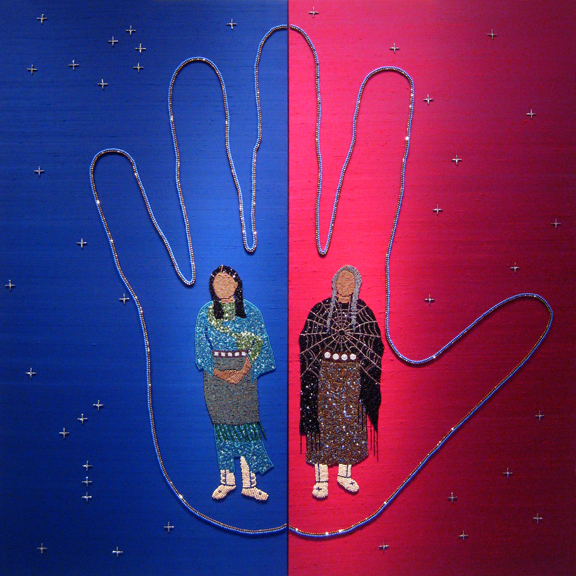
Sunboy's Women, ©2011 Teri Greeves
Storied Beads marks Teri Greeves’ first solo exhibition in Santa Fe in over three years. The Kiowa-Comanche-Italian bead artist has been busy — traveling nationwide, teaching, showing in major group exhibitions, and beading. Her new series, unveiled at the show, takes beadwork to a completely new level.

Hung in Shiprock’s main gallery hall, the works are immense. Five new, monumental beaded appliqué pieces are mounted on shimmering raw silk and luminescent vinyl. The tallest piece looms at 80” high.

The trend in beadwork is to use the smallest possible beads — to achieve fine detail and to display the beader’s technical prowess. However, an ongoing challenge for bead artists is to have their audience not just admire the technical skill in a piece but go beyond to see the composition, palette, and most importantly the content. Beadwork is an art medium loaded with historical implications; however, it’s still an art medium.

By blasting past expectations, Greeves carves a new space for expression. In these new works, she uses pony beads, large-scale beads that can be a centimeter or more width. These oversized beads, in glass, crystal, brass, and wood, coupled with mother-of-pearl disks showcase the reflective, translucent, textured, or glittering surfaces of the individual beads — approaching almost a mosaic quality, which is beautifully offset by the raw silk. While beadwork is most often seen in motion — on personal adornment, dance or ceremonial regalia, moving rattle or fan handles — the glittering quality of the cut-beads and crystals are activated when the viewer walks along, bringing the piece to life. In Sunboy's Women, Swarovski crystals flicker in the starry night sky.

Detail of Wa-Ho: The First Song After the Flood
Stars are a perfect allegory for the Kiowa oral history that inspired these works. The stories reflect unchanging truths, standing outside of daily timeframes, and serves as navigational guides like stars. “This is how our histories are passed on to us: through the vibrations of sound spoken from one individual to another,” writes Greeves in her artist’s statement. “It is also the basis of much conflict between how we see history and how history is written and read by non-Natives.” The subject matter in the show is highly specific. Greeves truly wants people to know and understand the stories, so she included lengthy artist’s statements for each work. The gallery has posted her statements in toto on their website; however, the staff at Shiprock is so gracious and outgoing, you would feel completely welcome reading the entire statements in the gallery at your leisure.

The centerpiece of the show is Sunboy's Women, a 72” x 72” diptych mounted on blue and red raw silk, the colors worn by Kiowa gourd dancers. Sun Boy or Half-Boy are cultural heroes that were born from an earth woman who fell in love with the Sun. She died trying to return to the earth from the sky world, so the orphaned Sun Boy was raised by Spider Woman, an adoptive grandmother. The figures of the two women are portrayed side by side—young and old—encased in a giant handprint, dividing in half like Sun Boy.

The figures in the show are women, each portrayed representational but faceless, giving them a timeless or universal quality. Greeves’ figurative style calls to mind the work of Virginia Stroud, a Muscogee-Cherokee artist who was adopted Kiowa and who helped revive ledger painting in the 1960s and 1970s. Text is also a key feature of the works, graffiti-esque text in the thought bubble above NDN GRRRL! and the embellished script of a lullaby in Wa-Ho: The First Song After the Flood.

detail of Wa-Ho: The First Song After the Flood
The haunting She Loved Her People struck me the most. A lone, faceless female figure stands on a burgundy background, brandishing a sword.  Curliqued script proclaims that “She loved/her people.” Strategically sewn darker beads create an illusion of shadow on the figure, and mother-of-people discs stand in for elk’s teeth on the yoke of her dress, composed of sparkling cut midnight blue beads. Greeves explains how a 16-year-old Cheyenne girl witnessed Custer’s massacre of her people, including most of her relatives, at the Washita River. The girl saw Custer slice through the belly of a pregnant woman, dismembering her unborn child. This survivor joined a war party, traveled north to Little Big Horn. She fought in that battle and ultimately found Custer. She slit him open from naval to neck with his own sword. Today the German silver trailers that Southern Plains women wear at their waist commemorates this girl’s bravery.

The juxtaposition of feminine grace and bloodshed might seem incongruent, especially expressed through the “delicate” medium of beadwork. However, this and other works are about family and the willingness to stand up and fight for family. The young Cheyenne girl’s act of resistance restores some harmony and balance in the face of atrocities. So therefore the depiction of the girl is with grace and respect. The oral histories, although not necessarily “pretty”, bind together generations of an extended families and tribes. Greeves is offering the public a window into the encompassing and protecting web of stories and relations that help shape her tribe and her own family.

Storied Beads will be on exhibit through June 30, 2011 at Shiprock Santa Fe, Old Santa Fe Trail, 2nd Floor on the Plaza.
www.shiprocksantafe.com

06 June 2011

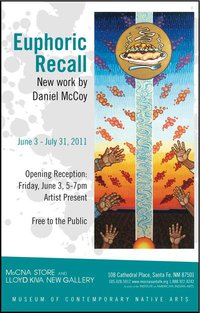
Review | Euphoric Recall: New Work by Daniel McCoy

Daniel McCoy, Jr. unveiled eight new works in his (mostly) solo exhibit, Euphoric Recall, at the Museum of Contemporary Native Arts’ Lloyd Kiva New Gallery. Euphoric Recall happens when an addict remembers only the good experiences from her or his addiction.  The description is apt—as angst and heartbreak are portrayed, to quote Henry Rollins, "with a renewed vigor and enthusiasm not seen by many."

The Muscogee Creek-Citizen Band Potawatomi artist hails from Bristow, Oklahoma, attended IAIA in the early 1990s and 2000s, and moved back to Santa Fe after living at Lake Havasu. McCoy describes his work as a “visual time line” documenting his “past triumphs, current disasters.”

In his art statement, McCoy writes of his paintings, “I try to make them as busy as possible.“ That is no lie. Repetitive mark making and patterns set the pieces in motion, and his tragicomic narration buzzes, crackles, and pulsates with a simmering dynamic energy.

The largest piece in the show, The Letter, is also the most enigmatic. The acrylic-oil enamel painting is a collaboration between McCoy and Topaz Jones (Shoshone-Lummi-Kalapuya-Molalla). Bisected vertically down the middle, McCoy predominantly paints the left side and Jones takes the right, with an oversized heart drips blood from center stage. In a heavily outlined style reminiscent of R. Crumb or José Guadalupe Posada, a celestial woman surveys a mummified man in cowboy hat reading a letter. The clouded sky is populated by classic tattoos: swallows, daggers, scrollwork emblazoned with the phrase “Impending Doom.” The sky shifts to night on the right, with a map of Turkey and a projected Bat Symbol over a purple pueblo scene. A loose leaf notebook paper is a scrawled letter, with the words “Daniel, I forgive you” and “Love always, Topaz Jones.” Below is a yeti-like form on a pillow. This chaotic soiree leaves one with more questions than answers.

The Letter, Daniel McCoy and Topaz Jones


In the drawing Forbidden Art #1, a bright-eyed and plucky Deerlady, ala Veronica Lodge from Archie comics, stands with arms akimbo in a shiny pool of blood. A stompdance skirt and turtleshell dance shackles reveal her hairy cloven hooves, as she cheerfully presides over the grasping, screaming faces of her male victims, and she beams with pride over her accomplishments.

The show’s centerpiece, The Indian Taco Made by God, an acrylic painting on canvas, is quite beautiful, with a sky is stitched together from slashes of paint. Heavily articulated hands reach out for absolution from the perfect Indian Taco. Showcasing McCoy’s flair for visual puns, the clouds resemble bubbles in hot lard.  Taco can be taken as a lightly, as a clever joke, but underneath the dazzling colors and masterful graphic strokes lies questions. Why does Indian Country fetishize a food so unhealthy, born of poverty and privation? Nostalgia for comfort food is a running theme in McCoy’s work — Frito pies, Spam, commodities — but we are what we eat.

What refreshing about McCoy’s approach is that he is more questioning than didactic. His work is socially conscious but occupies a universe filled with possibility and contradictions — a young schoolgirl hauling an oversized Bible dreaming about Liz Taylor’s Cleopatra — comic book style with theological implications.

Euphoric Recall will be up through July 31st.

09 May 2011

Blood of the Sun: Artists Respond to the Poetry of Suzan Shown Harjo, opening May 13

Red King Ghidorah, Melissa and Marlon Melero
Santa Fe, NM — The powerful poetry of Susan Shown Harjo (Cheyenne-Holdulgee Muscogee) will be celebrated and explored by visual artists in a unique exhibit, Blood of the Sun: Artists Respond to the Poetry of Suzan Shown Harjo, opening Friday, May 13, 2011 from 6:00 pm to 9:00 pm at Ahalenia Studios (1422 Second Street) in Santa Fe. Harjo will attend the opening. She made her first appearance at Ahalenia Studios to read poetry created for the Freedom of Information: The FBI, Indian Country, and Surveillance exhibit.
Blood of the Sun will remain on display until Sunday, May 22, 2011. An installation and performance piece created by artist DeCoy Gallery (Warm Springs Chiricahua Apache) will occur at both the opening and closing receptions. The closing reception will be Sunday, May 22nd, 2:00 pm—4:00 pm.

Harjo is a poet, curator, and likely the most influential policy maker in Indian Country today. She has helped Native nations to regain ownership and control of over one million acres of ancestral lands. She also has been involved in drafting and securing the passage of key legislation to promote and protect Native nations, sovereignty, children, arts, cultures, languages, and sacred spaces, as well at the 1978 American Indian Religious Freedom Act, 1989 National Museum of the American Indian Act, 1990 Native American Graves Protection and Repatriation Act, and the 1996 Executive Order on Indian Sacred Sites. She served on the Native American Policy Committee for Senator Barack Obama's presidential campaign and as an advisor to the Transition in 2008-2009.

Suzan Shown Harjo, photo by Lucy Fowler Williams
President of the Morning Star Institute, a national Native rights organization founded in 1984 for Native peoples' traditional and cultural advocacy, arts promotion and research, Harjo was one of seven prominent Native people who filed the 1992 landmark case, Harjo et al v. Pro Football, Inc., against the disparaging name of the Washington professional football team. She has been a featured guest twice on the Oprah Winfrey Show and has been profiled and her work included in myriad broadcasts, newpapers, magazines, and books. On May 13, 2011, she will receive an honorary doctorate degree for a lifetime of advocacy and contributions to Native American arts, cultures, and rights from the Institute of American Indian Arts (IAIA) in Santa Fe.

"It's an honor to be associated with such extraordinary artists," said Harjo. "Many of these artists have inspired my created and policy works for years. I look forward to the interpretations of and commentary on my poetry by these diplomats, resisters, and catalysts in the arts." Both emerging and internationally exhibited artists will be a part of Blood of the Sun, each responding to a poem or phrase of Harjo's in order to create a finished piece.

Participating artists include:
• Marcus Amerman (Choctaw Nation of Oklahoma)
• David Bradley (White Earth Ojibwe)
• Kelly Church (Grand Traverse Band of Ottawa Chippewa Indians)
• Anita Fields (Osage Nation)
• DeCoy Gallery (Chiricahua Apache)
• John Hagen (Aleut-Iñupiaq)
• Bob Haozous (Chiricahua Apache)
• Hock E Aye Vi Edgar Heap of Birds (Cheyenne-Arapaho)
• April Holder (Sac and Fox-Tonkawa-Wichita)
• Kenneth Johnson (Muscogee-Seminole)
• Linda Lomahaftewa (Hopi-Choctaw)
• Marlon Melero (Reno-Spark Paiute-Modoc-Tlingit-Haida)
• Melissa Melero (Fallon Paiute-Modoc)
• America Meredith (Cherokee Nation)
• Diego Romero (Cochiti Pueblo)
• Mateo Romero (Cochiti Pueblo)
• Hoka Skenandore (Oneida-La Jolla Luiseño-Oglala Lakota)
• Dr. John Torres-Nez (Diné)
• Richard Ray Whitman (Yuchi-Muscogee Creek)
• Brandon Williams (Diné)

Daily viewing hours for the exhibit vary. Please email for an appointment.

By Staci Golar (Welsh-American)

Art show website: www.ahalenia.com/harjo

02 May 2011

"Kanutche Dogs: Contemporary Cherokee Art" at Firegod Gallery, Opens Friday, May 6th

Image: detail of Commodity, Roy Boney
Albuquerque, NM — Eleven Cherokee artists will participate in an upcoming group art show at the Firegod Gallery, 3413 Central Ave, NE, Albuquerque, New Mexico 87106.

An opening reception will take place Friday, May 6th, from 6:00 – 9:00 pm. This event is free and open to the public. The show will run through May 31st.

On Saturday, May 7th, from 2:00 – 4:00 pm, computer animation and claymation videos in the Cherokee language by Roy Boney, Jr. and Joseph Erb will be displays, following by question and answer period about using art to preserve tribal languages. This lecture is also free and open to everyone.

Artist America Meredith will present a two-part presentation, free and open to the public, about Cherokee art history from precontact times to the present, on Saturday, May 28th, from 2:00 – 4:00pm.

The Cherokee tribe is an enigma. Over 800,000 people claimed Cherokee descent on the 2010 US Census; however, very few people are familiar with Cherokee culture or arts. Of the 300,000 actually enrolled in of the three federally recognized Cherokee tribes, only about 10,000 people speak the Cherokee language–mostly in Oklahoma and North Carolina. Only an estimated 500 Cherokee people participate regularly in stomp dances, the traditional expression of Cherokee religion, at the seven ceremonial grounds in Northeastern Oklahoma.

This show hopes to share culturally-informed contemporary Cherokee art with the general public and Cherokee people in New Mexico. New Mexico has such a large Cherokee population that it is home to the Southwest Cherokee Township, a satellite community of the Cherokee Nation.

The show’s title comes from a folk term, Kanutche Dogs, for the America dingo or Carolina dog, the indigenous dog of the American southeast that has been an important part of Cherokee society. “Kanutche” (pronounced kah-NUH-chee) is a traditional Cherokee food made from hickory nuts.
  • Roy Boney, Jr. (Cherokee Nation), from Locust Grove, Oklahoma, is a painter, illustrator, digital artist, and computer animator, who uses the Cherokee language extensively in his work. He also created a series of zombie comics for Slave Labor Graphics.
  • Ross Chaney (Cherokee Nation/Osage Nation), from Santa Fe, New Mexico, is an emerging expressionist painter and draftsperson.
  • Joseph Erb (Cherokee Nation), from Gore, Oklahoma, is a painter, digital artist, and computer animator, working to preserve the Cherokee language. Mixing new and old technology, Joseph also paints on gourds, an ancient Cherokee art media, and uses imagery from the Booger Dance, a masked dance unique to the Cherokee people.
  • Lara Evans, PhD. (Cherokee Nation) is an experimental photographer and painter, as well as a professor of Native art history at Evergreen State College in Olympia, Washington. Her work was recently published in Art in Our Lives: Native Women Artists in Dialogue.
  • Fran Hill is a contemporary ceramic artist from Albuquerque, who is an active member in the Southwest Cherokee Township.
  • Daniel Horsechief (Cherokee Nation-Pawnee) is a bronze sculptor, wood carver, and painter from Sallisaw, Oklahoma. He is an alumnus of the Institute of American Indian Arts.
  • America Meredith (Cherokee Nation) is a painter and printmaker from Santa Fe, who is also an IAIA alumna. She will exhibit her recent experiments in fumage (smoke art).
  • Mary Beth Nelson (Cherokee Nation) is a painter specializing in wildlife. She lives in Guthrie, Oklahoma.
  • Lisa Rutherford (Cherokee Nation) of Tahlequah, Oklahoma specializes in southeastern beadwork and ceramics, but is also experimenting with traditional featherwork clothing. She showed at SWAIA’s Indian Market for the first time in 2010 and won an award for ceramics.
  • Sean Ross (Eastern Band Cherokee) from Cherokee North Carolina combines humor, social commentary, and Cherokee culture in his paintings.
  • Arlo Starr (NTA Cherokee-descent), a painter, currently lives in Albuquerque but was active in the development of the Squirrel Ridge Ceremonial Ground in Kenwood, Oklahoma. He worked with Cherokee elders to create a healthy cookbook based on traditional foods.
Firegod Gallery specializes in quality and innovative contemporary Native American art. It is owned by Silvester Hustito (Zuni), an artist and curator.

22 April 2011

In Praise of Annual, Competitive Art Shows: The Trail of Tears Art Show

Resurgence, Daniel Horsechief, at the CHC
While new Indian art markets seem to pop up like mushrooms – despite the horrible economy – annual, intertribal competitive art shows have decreased, not increased, in number. With the loss of the Lawrence Indian Art Show in Kansas, which operated independently of the Haskell Indian Art Market, the number of annual shows open to all tribes is down to two. As far as I know, there is only the Red Cloud Indian Art Show and the Trail of Tears Art Show.

A few more annual shows are limited to certain tribes. Founded in 1997, “Here Forever” is an August show at the Tamástslikt Cultural Institute in Pendleton, Oregon. It’s open to enrolled members of the Confederated Tribes of the Umatilla Indian Reservation, that is Umatilla, Cayuse, and Walla Walla tribes. The Five Civilized Tribes Museum in Muskogee, Oklahoma sponsors a competitive show each June and July that is open to members of all federally and state recognized Cherokee, Chickasaw, Choctaw, Muscogee Creek, and Seminole tribes. Each August/September, the Cherokee Heritage Center in Park Hill, Oklahoma hosts the Cherokee Homecoming show open to enrolled members of the three federally recognized Cherokee tribes. For the last three years, the Cherokee Nation hosts the Cherokee National Holiday Art Show in Tahlequah, Oklahoma.

Both markets and art shows serve worthy purposes. While art markets are exciting events for socializing and networking, they can also prove expensive and exhausting for artists. Many emerging and elder artists might not have the inventory to fill a booth, and familial, academic, or job commitments or health issues prevent many artists from traveling to markets. Art shows, as opposed to markets, allow these artists to participate and share their work and ideas. And unlike markets, the art, not the artist, is showcased. One can quietly spend as long as one wants examining and reflecting on the work, allowing for a deeper understanding of content and underlying crosscurrents between works.

Both the two annual intertribal art shows are in Indian County: Pine Ridge, South Dakota and Park Hill, Oklahoma, which allows the local Native communities to see what’s going on in the contemporary indigenous art world. And both are free to enter, which in the art world in extraordinary. Usually art spaces will host a competitive art show as a fund-raiser, since it’s common to charge $5 to $50 just to enter.

The Trail of Tears show is near to my heart because it the first place I ever exhibited my art. Since 1995, I’ve shown in it every year. Now in its 40th year, the Trail of Tears art show (TOTAS) was founded in 1971 by the Cherokee National Historical Society at the Cherokee Heritage Center. All entries to first shows were limited to the Trail of Tears theme, which proved too narrow a focus. My mother says that at the shows’ low point less than half a dozen people showed up at the reception to see the four or five entries for the entire show. The following year, the show opened up to new categories.

Categories now include painting, graphics, pottery, basketry, miniatures, and Trail of Tears theme. This year was exciting because, thanks to sponsorship by the Chickasaw Nation, a jewelry category was added. The show now allows photography and digital art, but these compete with hand pulled prints, drawings, and even scrimshaw. Every year I crack up when I read the rules explicitly prohibiting painting on saw blades.

This year had an excellent turnout, and visitors at the opening reception said it was too crowded to even see the art (which is why you have to visit more than once). The show had 155 pieces from 95 different artists, but representing only 13 tribes. It seems that is has been more tribally diverse in the past, and I hope it will be in the future. I didn’t see any non-Cherokee baskets. Attention indigenous basket makers of America, please enter next year! Both sales and prize money are good, and it’s a great opportunity to share your work with a largely Native audience.

The grand prizewinner was Putting the Pieces Together, a gorgeous and haunting ceramic sculpture by Troy Jackson (Cherokee). The foot tall figurative work has an elegant Mississippian-esque man composed of black and white jigsaw puzzle pieces, holding black and white pieces in his hands. The figure sits on a blanket on top of a container bearing the word, ᏣᎳᎩ (Cherokee). The lip of the bowl has a lug of copper wire holding a white cross. Small coiled, copper earrings also provide a touch of color. Representing a mixed blood individual’s identity struggles and that of the entire tribe, the piece is ultimate serene, suggesting a resolution and acceptance of a mixed identity.

Shan Goshorn’s High Stakes; Tribes Choice won best of graphics category. Her photograph of a traditionally dressed Eastern Cherokee man is accented with an array of glitter, suggesting the glitz of casino lights more than the spiritual sparkle of mica or other sacred minerals. Sharon Irla’s very classically painted Corn Mother is a beautiful, naturalistic, oil painting of Selu as a tattooed woman with closed eyes, clad in a fur robe, and wearing wampum and shell necklace and pearl bracelets. She holds a white swan feather fan, symbol of a Beloved Woman’s authority. Before her sits a shallow tray of ripe corn. Irla delicately implies erotic energy in manner that doesn’t cross local sensibilities.

David Pruitt's Fire Carrier, a raku clay sculpture of the southeastern Mississippian water spider who brought fire to humanity, won best of the ceramics category. The large number of ceramics entries is a testimony to the work of Anna Sixkiller Mitchell and recently Jane Osti, who offers pottery classes from her studio in Tahlequah.

Lisa Forrest won best of the basket category with her ambitiously large Traditional Storage Basket, woven from vegetal dyed honeysuckle runners. This basket is a foot in diameter, with a delicately woven lid, embellished with seedpods and hazelnuts. Gathering one’s own materials and dyeing with natural dyes is greatly prized in Oklahoma basket weaving; however, I saw some nice doubleweave baskets in commercial reeds. At least the lesser materials allow new weavers to master the art of doubleweaving.

Best of sculpture category was a naturalistic wooden carving, Redtail Hawk by Darrell Smith (Cherokee Nation). The attention to detail was extraordinary with every single feather carved out.

Navajo jeweler and teacher Fritz Casuse won first place in the new jewelry category, with his impressive towering Cala ring with abstract floral designs. His wife Wanesia Misquadace (Fond du Lac Ojibwe) won second and third places. Misquadace is one of possibly a dozen birchbark biters active today, and she travels to northern Minnesota each year to harvest the bark. She incorporated birchbark bitings of turtles in her second place winner, A Song and Prayer for Mother Earth, a canister of birch embellished with silver. Personally I also greatly enjoyed Charley Johnson’s Man from Etowah.

The Trail of Tears category, open to work about any forced removal such as The Long Walk, was won by James Wing with his oil painting, Trail of Tears Water Crossing, a realistic narrative piece portraying two men and a woman trudging through the snowy forest.

Because of the nature of the show, many emerging artists participate, and the quality is uneven. Due to the uncurated nature of the show, one get a more direct feel for trends in styles and subject matter, where genre and figurative art well represented. Many works reflect agrarian culture, such as Choctaw artist Norma Howard’s painting of working cotton fields or Amy Smith’s still life of eggs. Relationships between artists are evident everywhere with relatives and teachers and students showing together. Rose Drake entered a tribute, Quiver for Gunter, in memory of the Cherokee basketweaver, Gunter Anderson, who recently passed on.

The Trail of Tears art show runs through May 8.

If you are interested in entering the Red Cloud Indian Art Show, the information is online here. You have until May 1st to let them know what you want to enter.