Translate

Showing posts with label Cheyenne. Show all posts

27 June 2012

Travels to England: Indigenous Brilliance - Messengers - Emissaries of Peace

The King's Men, part of the Rollright Stones in Warwickshire
Three events conspired to lure me over to England for the first time. Two were contemporary Native American art shows. Indigenous Brilliance opened at the Highgate Institute in London, and Messengers at Rainmaker Art Gallery in Bristol. The third event was the Emissaries of Peace, a tour sponsored by Cherokee Nation Tourism, which retraced the travels of three Cherokee leaders who traveled to England 250 years ago to meet King George. These were sandwiched just between the Queen’s Jubilee and the London Olympics, making London crowded and tickets expensive — but the trip was well worth it.

I flew into Bristol the day of the opening of Messengers—not a smart move—and muddled through it with only three hours of sleep. Marcus Amerman was in town and assisted with developing the concept of the show. Joanne Prince, owner of Rainmaker Art Gallery, saw the idea of messengers, and artists as messengers, working on many different levels. 18 contemporary artists participated in the show. While most were painters, photographers, and printmakers, Melissa Cody (Navajo) showed weavings, Kelly Church (Odawa-Ojibwe) showed birchbark bitings, and Marcus Amerman (Choctaw) showed both representational and stylized pictorial beadwork. As a former bike messenger, I took the art show’s theme extremely literately and painting small portraits of a Pawnee motorcycle messenger and Navajo/Mestizo walking messenger from San Francisco. Edgar Heap of Birds (Cheyenne) was also present, as he was traveling through London and Paris on business.

Rainmaker Gallery in Bristol, England
Joanne rented a nearby textile workshop for artist talks the next day. Marcus presented about creativity and his inspirations in working in so many media— beadwork, painting, fashion design, installation, glass, and performance art. Edgar showed videos about his 2005 public art sculpture and installation, Wheel, at the Denver Art Museum, and his 2007 art installation, Most Serene Republics. I presented about Linda Lomahaftewa and my journey through the southeast visiting archaeological sites and the art we created based on our experienced. Sarah Sense (Chitimacha-Choctaw) could not make the trip after all, so I filled in for her and presented about ancient Andean art with an emphasis on textiles art.

Unbelievably, some people stay from the beginning to the end of the talks. Max Carocci, Programme Director of World Arts and Artefacts at the British Museum, traveled over to Bristol to attend the talks. He has worked with contemporary Kiowa artists and has written several books about Plains Indian art.

It was strange but refreshing to be able to comment frankly, through art and words, on the history of US injustice against indigenous Americans without encountering the usual layers of resistance or denial. People in the audience really listened and soaked up information. They also came to the table with a great deal of knowledge. Some of the lecture-goers had traveled to Mayan temples or to South America where they had firsthand experience with Cusco School paintings or the Nazca Lines.

Bristol is the home of Banksy and actively embraces street art. They have amazing graffiti and street murals, but unfortunately I didn’t get to explore much in my short stay. Thanks so much to Maria who let me stay in her house, Andy Pink who gave myself and other artists rides, Sophie who assists at the gallery and gave Marcus and I a tour of Bath—Jane Austen’s turf!— to Emelia, my fellow Cherokee-Swede who helped with the show, and especially to Joanne whose vision brought us all together.

A messenger friend from San Francisco, Joel, lived in the sleepy northern hamlet of the Priors Marston, so I got to explore centuries-old churches and millennia-old standing stones with him, his wife Becky, and daughter Aleisha. Incredibly beautiful country steeped in history. Thank you so much for your messengerosity! (That’s Howard Williams’ term for the inherent generosity that messengers share.)

Elija below work by Bryon Archuleta (Ohkay Owingeh)
In London, Cornelia “Elija” Vandenberg curated Indigenous Brilliance with Lyle Toledo Yazzie, a Navajo jeweler and collage artist. Elija is a human rights activist originally from the Netherlands, who has curated indigenous before and is keenly interested in showcasing political work. Lyle coordinated with many artists in the US and together they showcased over 70 works by 30 different artists. Bryon Archuleta (Ohkay Owingeh) came to the show’s opening and helped hang work the day after he arrived. No rest for the wicked! Elija reported that interest was high and the show at Highgate has seen a steady stream of visitors. Paul and Max from the British Museum attended. A non-native English artist, Gary Wells showed two pieces that I thought were great, combining vibrant, Celtic-inspired calligraphy with stencilwork featuring gunpowder. Many of the artists are activists in different causes, including Michael Horse, the actor and AIM member, who has championed ledger art for years. Osage artist Matt Jarvis brought images of the Oklahoma sky into the show with his digital photocollage, Meditation No. 1—Osage Meditations, and Steve Hapy (Anishinaabe) commented on diabetes in his visceral and highly textural piece, Diabetes, painting on an American flag.

Edward Chamberlain and Lyle Toledo Yazzie examine jewelry
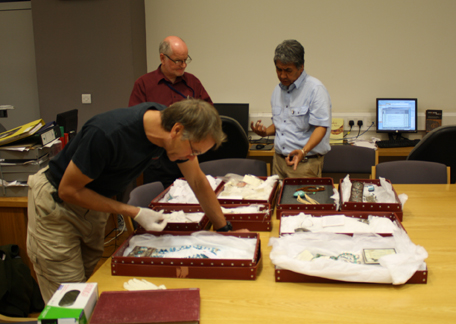
Lyle had arranged with the British Museum to see their collection of contemporary southwest jewelry, and graciously let me tag along. We were please to see Hopi jeweler Michael Kabotie’s work in their collection, as well as a beautiful piece by Gail Bird (Santa Domingo) and Yazzie Johnson (Navajo)—who helped enable me to make the trip over! Jack Davy, Museum Assistant for North America, shows the items from the permanent collection and shared with us the internal database for the museum.

The North American room at the British Museum featured a survey of Canadian and United States indigenous art, from precontact, historical, modern, and contemporary, which included works by Bob Haozous and Diego Romero on permanent display. Their collection of avian and feline Hopewellian platform pipes is extraordinary. But their indigenous Mexican room is truly incredible, featuring elaborate turquoise mosaic sculptures, including the famous Aztec double-headed serpent. Believed to be a gift from Moctezuma II to the Spanish invader Hernán Cortés from 1519, the carved wooden serpent is covered with over 2000 pieces of turquoise, conch, and delicate crab shell.

Early 18th century Cherokee incised gourd
The next day, I returned to the British Museum to meet up with the Cherokee delegation. They arrived, joking and laughing more than anyone else I’d seen in the country (except maybe Marcus). The trip was arranged by Cherokee Nation Tourism, and everyone paid their own way. People from all three Cherokee tribes participated and they retraced the steps of Ostenaco, Standing Turkey (Cunne Shote), and Woyi. The Cherokee men were accompanied by Henry Timberlake and met with King George III. The 2012 group of Cherokees met with a wide range of officials and politicians (the Queen, presumably was too preoccupied with jubilee-ing it up to meet with our friends). I actually have no idea why I didn’t join this trip, since I met a bunch of interesting Cherokee people just in that short afternoon, including beadwork and storyteller Corey Still.

Jack Davy’s showed us several early 18th century Cherokee prints from the British Museum’s permanent collection, as well as a rare geometric beaded sash on stroud cloth with intact selvage, an incised gourd with a wooden stopper, and a double-woven rivercane basket with lid whose dyes were incredibly brilliant considering the basket was almost two centuries old. Afterwards, my cousin and Cherokee historian and genealogist extraordinaire Jack Baker; historian
Cherokee visitors presenting British Museum staff
with gifts of Cherokee pottery
and director of the Gilcrease Museum, Duane King; and writer and former curator at the IAIA museum, B. Lynne Harlan got to see rare, seldom published portraits of Richard Justice and Moses Price (both Cherokee) by William Hodges (1744-1797) at the Hunterian Royal College of Surgeons. Ironically, a graduate student was taking a survey about how comfortable people felt seeing human remains on display. She certainly got a mouthful from us, and she already knew about NAGPRA.

Other than that, I ate a million pasties, functioned (barely) without my phone or internet in my hotel, and finally located and paid homage to the house from Spaced. Thanks so much to everyone who made this trip possible and who I met on the way. I've heard that CN Tourism is a little done in from planning the England, but my sister pointed out, we can organize our own Cherokee trip through Wales!

London Calling 1762, America Meredith, acrylic, gel medium, five pound note, and map on panel, 2012

15 June 2011

Review | Teri Greeves: Storied Beads

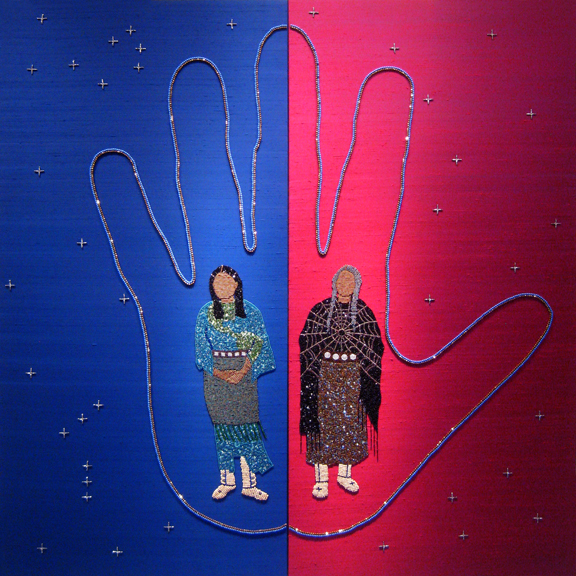
Sunboy's Women, ©2011 Teri Greeves
Storied Beads marks Teri Greeves’ first solo exhibition in Santa Fe in over three years. The Kiowa-Comanche-Italian bead artist has been busy — traveling nationwide, teaching, showing in major group exhibitions, and beading. Her new series, unveiled at the show, takes beadwork to a completely new level.

Hung in Shiprock’s main gallery hall, the works are immense. Five new, monumental beaded appliqué pieces are mounted on shimmering raw silk and luminescent vinyl. The tallest piece looms at 80” high.

The trend in beadwork is to use the smallest possible beads — to achieve fine detail and to display the beader’s technical prowess. However, an ongoing challenge for bead artists is to have their audience not just admire the technical skill in a piece but go beyond to see the composition, palette, and most importantly the content. Beadwork is an art medium loaded with historical implications; however, it’s still an art medium.

By blasting past expectations, Greeves carves a new space for expression. In these new works, she uses pony beads, large-scale beads that can be a centimeter or more width. These oversized beads, in glass, crystal, brass, and wood, coupled with mother-of-pearl disks showcase the reflective, translucent, textured, or glittering surfaces of the individual beads — approaching almost a mosaic quality, which is beautifully offset by the raw silk. While beadwork is most often seen in motion — on personal adornment, dance or ceremonial regalia, moving rattle or fan handles — the glittering quality of the cut-beads and crystals are activated when the viewer walks along, bringing the piece to life. In Sunboy's Women, Swarovski crystals flicker in the starry night sky.

Detail of Wa-Ho: The First Song After the Flood
Stars are a perfect allegory for the Kiowa oral history that inspired these works. The stories reflect unchanging truths, standing outside of daily timeframes, and serves as navigational guides like stars. “This is how our histories are passed on to us: through the vibrations of sound spoken from one individual to another,” writes Greeves in her artist’s statement. “It is also the basis of much conflict between how we see history and how history is written and read by non-Natives.” The subject matter in the show is highly specific. Greeves truly wants people to know and understand the stories, so she included lengthy artist’s statements for each work. The gallery has posted her statements in toto on their website; however, the staff at Shiprock is so gracious and outgoing, you would feel completely welcome reading the entire statements in the gallery at your leisure.

The centerpiece of the show is Sunboy's Women, a 72” x 72” diptych mounted on blue and red raw silk, the colors worn by Kiowa gourd dancers. Sun Boy or Half-Boy are cultural heroes that were born from an earth woman who fell in love with the Sun. She died trying to return to the earth from the sky world, so the orphaned Sun Boy was raised by Spider Woman, an adoptive grandmother. The figures of the two women are portrayed side by side—young and old—encased in a giant handprint, dividing in half like Sun Boy.

The figures in the show are women, each portrayed representational but faceless, giving them a timeless or universal quality. Greeves’ figurative style calls to mind the work of Virginia Stroud, a Muscogee-Cherokee artist who was adopted Kiowa and who helped revive ledger painting in the 1960s and 1970s. Text is also a key feature of the works, graffiti-esque text in the thought bubble above NDN GRRRL! and the embellished script of a lullaby in Wa-Ho: The First Song After the Flood.

detail of Wa-Ho: The First Song After the Flood
The haunting She Loved Her People struck me the most. A lone, faceless female figure stands on a burgundy background, brandishing a sword.  Curliqued script proclaims that “She loved/her people.” Strategically sewn darker beads create an illusion of shadow on the figure, and mother-of-people discs stand in for elk’s teeth on the yoke of her dress, composed of sparkling cut midnight blue beads. Greeves explains how a 16-year-old Cheyenne girl witnessed Custer’s massacre of her people, including most of her relatives, at the Washita River. The girl saw Custer slice through the belly of a pregnant woman, dismembering her unborn child. This survivor joined a war party, traveled north to Little Big Horn. She fought in that battle and ultimately found Custer. She slit him open from naval to neck with his own sword. Today the German silver trailers that Southern Plains women wear at their waist commemorates this girl’s bravery.

The juxtaposition of feminine grace and bloodshed might seem incongruent, especially expressed through the “delicate” medium of beadwork. However, this and other works are about family and the willingness to stand up and fight for family. The young Cheyenne girl’s act of resistance restores some harmony and balance in the face of atrocities. So therefore the depiction of the girl is with grace and respect. The oral histories, although not necessarily “pretty”, bind together generations of an extended families and tribes. Greeves is offering the public a window into the encompassing and protecting web of stories and relations that help shape her tribe and her own family.

Storied Beads will be on exhibit through June 30, 2011 at Shiprock Santa Fe, Old Santa Fe Trail, 2nd Floor on the Plaza.
www.shiprocksantafe.com