Translate

Showing posts with label Native American art. Show all posts

16 August 2012

Low-Rez: Native American Lowbrow Art


l
"Reclamation: Manifestations of Changing Woman," Nani Chacon, oil on masonite
Santa Fe, NM — Low-Rez: Native American Lowbrow Art is a group art show of emerging and established Native artists working in the “lowbrow” genre of Pop Surrealism. The show runs from August 17 to September 1, 2012, and opens with a reception on Friday, August 17, 5:30 – 9:00 pm at 131 West San Francisco Street, First Floor near the downtown Santa Fe Plaza. A closing reception will be held on Saturday, September 1st, from 6:00 pm – 9:00 pm. Both events are free and open to the public.

Participating artists include: Jamison Chas Banks (Seneca-Cayuga-Cherokee), Nanibah “Nani” Chacon (Navajo), Brent Greenwood (Ponca-Chickasaw), Amber Gunn Gauthier (Ho-Chunk–Menominee), April Holder (Sac and Fox-Wichita-Tonkawa), Topaz Jones (Shoshone-Lummi-Kalapuya-Molalla), Randy Kemp (Choctaw-Yuchi), Linda Lomahaftewa (Hopi-Choctaw), Cannupa Hanska Luger (Mandan-Hidatsa-Arikara), Daniel McCoy, Jr. (Potawatomi-Muscogee Creek), America Meredith (Cherokee Nation), Chris Pappan (Osage-Kaw-Cheyenne River Sioux), Jeremy Singer (Navajo), Monty Singer (Navajo), Ryan Singer (Navajo), Hoka Skenandore (Luiseño-Oneida-Oglala Lakota), “The Werewulf” Micah Wesley (Kiowa-Muscogee Creek), and Debra Yepa-Pappan (Jemez-Korean). The show will also feature a mural by Jamison Chas Banks and Keith Secola (Northern Ute), both recent IAIA graduates.

Coming from diverse backgrounds and experiences, these artists are united in their use of pop cultural imagery to express themselves as contemporary indigenous peoples. Most of the artists attended the Institute of American Indian Arts, a school dedicated to Native artists choosing their own path in self-representation, and most are participating in SWAIA’s Indian Market.

Redemption March, Ryan Singer (Navajo), acrylic, 2012
Lowbrow Art, also called Pop Surrealism, has mushroomed over the last few decades, as a response to overblown bombastic excesses of conceptual art and a return to a love of craft and technique in art making. Santa Fe has been an epicenter for the Native Pop movement, in which artists use pop imagery to explode non-native fantasies of Indians as the timeless “Noble Savage” and to establish entry points for audiences who might not be familiar with tribal histories or imagery. The subversive humor of Native Pop and Lowbrow Art provides a perfect vehicle for social commentary without becoming preachy or propagandist.

The pop imagery used by the artists isn’t random. Often it reflects traditional Native imagery that was co-opted by mass media—Trickster Rabbit as Bugs Bunny, Princess Leia’s Hopi butterfly whorl hair-do, Taos Pueblo artist Pop Chalee’s blue deer paintings transformed by Walt Disney into “Bambi”—acts of re-appropriation.

Pin-up girls are transformed by the hand of Amber Gunn Gauthier and Nani Chacon from sex objects for voyeurs to symbols of empowered women who own their sexuality. Chris Pappan turns traditional ledger art on its head. Linda Lomahaftewa was part of the initial wave of Native Pop artists and was a classmate of T. C. Cannon at IAIA. Lomahaftewa lived in the Bay Area in the 1960s and 1970s and will exhibit monotypes with UFO-imagery. Micah Wesley and Cannupa Hanska Luger were part of the Humble Collective, an artist-run space that challenged and inspired waves of artists over the last decade.

Daniel McCoy combines comic book imagery with imagery from traditional Muscogee ceremonial grounds of his youth, with wry to dark humor. McCoy will create a large scale, site-specific installation at the street-level San Francisco gallery space.

The art show’s website is at www.ahalenia.com/lowrez.

23 June 2012

Changing Hands CONNECTIONS: We Are Here, Monday, June 25th

Ironworker Cradleboard, Donald "Babe" Hemlock, maple, pine, ash, painter, fur, hide, instestines, 2011
Last in a series of cutting-edge contemporary Native art exhibitions, the newest Changing Hands exhibition will feature Eastern Woodlands art. The National Museum of the American Indian Heye center in New York City will host a series of lectures and discussions on Monday, June 25th. The event is free and open to the public.

 Changing Hands CONNECTIONS: We Are Here
Monday, June 25th: 11 AM–6 PM
This one-day program explores contemporary art from an indigenous perspective—aesthetics, ideas, contexts and contrasts—with leading artists, curators, and critical thinkers. Work by artists featured in We Are Here, Eiteljorg Contemporary Art Fellowship, and Changing Hands: Art Without Reservation, Part 3, the final exhibition in the groundbreaking series surveying cutting edge contemporary Native art, organized by the Museum of Arts and Design, will serve as the launching point for this continuing discourse.

CONNECTIONS: The Curators and the Artists, a Conversation
11 AM–12 noon
Diker Pavilion, Ground Floor
NMAI in New York
1 Bowling Green

Ellen Taubman, Curator, Changing Hands: Art Without Reservation (2002–present) Jennifer McNutt, Curator, Eiteljorg Fellowship for Contemporary Art (1999–present) Marie Watt, Artist and former Eiteljorg Fellow Barry Ace, Artist and Changing Hands participating artist

CONNECTIONS: Contemporary Native Art in Context, a Panel
3:30–6 PM
Theatre, Lower Level
Museum of Arts and Design
2 Columbus Circle

Artists: Jeffrey Gibson, Robert Houle, George Longfish, Kent Monkman, Sarah Sense, and Skawennati

Moderators: Kate Morris, Santa Clara University, Judith Rodenbeck, Sarah Lawrence College
Limited seating. Please RSVP by June 11th for both events at: ChangingHands3@madmuseum.org.
For more information, click here.

12 June 2012

Messengers 2012 at Rainmaker Art Gallery, Bristol, UK

Messengers 2012 a group art show curated by Joanne Prince, an advocate for Native art and owner of Rainmaker Gallery in Bristol, England. The show features 18 contemporary Native American Indian artists from tribes across the continent.

As Prince says, "2012 is a pivotal year for the indigenous peoples of the Americas. As the current cycle of the Mayan calendar draws to a close, and in preparation for a new beginning when indigenous values will perhaps be more widely recognised and adopted, it is time to welcome the diverse and authentic messages and manifestations of contemporary Aboriginal American artists."

"My people will sleep for 100 years, and when they awake, it will be the artists who give them back their spirit." –Louis Riel, Métis revolutionary (Boyle and Racette 21).

Marcus Amerman (Choctaw), Sarah Sense (Chitimacha-Choctaw), Edgar Heap of Birds (Cheyenne), and myself will fly in especially to attend the opening and give talks, demonstrations, film screenings and discussions on Thursday June 14th.

Please contact the gallery for details:
call 0117 944 3101 or email jo@rainmakerart.co.uk.


Participating artists include:
  • Cupcake (Pawnee), America Meredith, 2012
    Tony Abeyta (Navajo)
  • Marcus Amerman (Choctaw)
  • Shonto Begay (Navajo)
  • David Bradley (White Earth Ojibwe)
  • Kelly Church (Grand Traverse Odawa-Ojibwe)
  • Melissa Cody (Navajo)
  • Edgar Heap of Birds (Cheynne)
  • Frank Buffalo Hyde (Onondaga)
  • Linda Lomahaftewa (Hopi-Choctaw)
  • America Meredith (Cherokee Nation
  • Chris Pappan (Kaw-Osage-Lakota
  • Debra Yepa-Pappan (Jemez Pueblo
  • Cara Romero (Chemehuevi)
  • Diego Romero (Cochiti Pueblo)
  • Mateo Romero (Cochiti Pueblo)
  • Sarah Sense (Chitimacha-Choctaw)
  • Ryan Singer (Navajo)
  • Werewulf Micah Wesley (Kiowa-Muscogee Creek)
For more information, visit Rainmaker Art Gallery, online or at: 123 Coldharbour Road, Redland Bristol, BS6 7SN. Map.
  • Boyle, John and Sherry Farrell Racette. Rielisms. Winnipeg, MB: Winnipeg Art Gallery, 2001.

06 March 2012

54th Annual Heard Museum Guild Indian Fair & Market

Singers at the Fair modeling awesome regalia
The weather for this year’s Heard Fair was perfect. Cool and calm, which set the tone for the weekend. Comparisons to SWAIA’s Indian Market are inescapable, and the Heard is much more relaxed, genteel affair, being affiliated with and taking place on the grounds of the Heard Museum. Due to the accessibility of Phoenix, being a major hub for air travel, the Heard draws proportionally more artists from farther regions, especially Alaska, than Indian Market, which has a specific focus on southwestern/ Oasisamerican tribes. I wonder, though, how many non-artist visitors travel into town for the weekend or if the main draw is from residents of the Phoenix metropolitan area?

For some reason I have a strong desire to understand how the fair, the museum, and the Phoenix art scene tick, since it’s clearly very different than New Mexico or Oklahoma. Native Peoples Magazine and Southwestern Art Collector cover the fair. The Arizona Republic ran a preview in February saying that 20,000 visitors attend the fair, garnering $200,000 in proceeds, which makes the fair the Heard Museum Guild’s largest annual fundraiser. The article confirms that the number of artists, expanded last year, is still 700. Perhaps the expansion was made for financial reasons for the Heard Guild, but the number of artists seems to overwhelm the space, and certainly the facilities.
Best of Show: Techno Kid on the Run

The Heard does a fantastic job getting through own information out through the Heard Guild’s and the Heard Museum’s websites museum store’s and Berlin Gallery blogs, twitter, and other social media. I found out who the Grand Prize winner was when my friend from Tahlequah posted it on Facebook.

Stetson Honyumptewa (Hopi) won Best of Show with his action-packed, intricate, and humorous carving, “Techno Kid on the Run,” which, to the best of my limited understanding on the subject, features Wiharu, the white-faced ogre, attacking a misbehaving youth.

Classification winners include Samuel LaFountain (Diné/Ojibwe, from New Mexico) for Jewelry and Lapidary; Anita Fields (Osage, from Oklahoma) for Pottery; Micah Wesley (Kiowa/Muscogee Creek, from Oklahoma) for Paintings, Drawings, Graphics, Photography; Stetson Hunyumptewa (Hopi, from Arizona) for Wood Carvings; Ryan Benally (Diné, from
Pima-Maricopa Roy Manuel's kiaha, burden basket, in action
New Mexico, born in Arizona) for Sculpture; Catherine Blackhorse (Seminole, from Washington) for Textiles, Weavings, Clothing; Dyanni Hamilton-Youngbird (Diné) for Diverse Art Forms; and Jeremy Frey (Passamaquoddy, from Maine) for Baskets. Each category had three judges, except Wooden Carvings and Sculpture, which were combined, for a total of 21 judges. I’ve never heard an estimate of how many of the 700 artists enter the competition.

Entries must be delivered by 5pm on Thursday and can no longer be mailed in due to widespread damage to works in shipping (or so goes the word on the street). Judging takes place that evening. The Heard doesn’t have a ceremony to announce the winners, but by the time the dinner and Best of Show reception, which are quite wonderful, takes place, visitors are treated to a printing listing of the winners and brief biographies of the judges.

Good news about the economy flooded the airwaves in days leading up to the fair. This, like all other markets, is a jeweler’s market. I would love to see an overview of who was buying what. Some new artists did extraordinarily well. Many established artists whose work I have the utmost respect for sold nothing all weekend. Many veteran artists didn’t attend due to the economy, and several others said they couldn’t return next year. Even if you want to attend, the expenses are steep and it’s just not feasible, even if the event is enjoyable. Since I quizzed so many friends about how their market went, I made a chart to show the ups and downs of my own sales at the Heard.

The Heard used to permit artists to sell two reproductions in their booths but ceased. Unfortunately many fairgoers can’t afford major original works. The prints and note cards were the artist’s gas money. While a booth entirely of reproductions isn’t desirable, allowing two reproductions would not lower the quality of the market; and certainly not as much placing as a kettle corn booth across from an art booth.

The courtyard at times was swarmed, as was the museum store and bookstore. Several authors were honored at the event. A variety of musicians and dancers performed, including Navajo flautist R. Carlos Nakai. In the Berlin Gallery, Sarah Sense (Chitimacha-Choctaw) signed copies of her newly published catalog, Weaving the Americas, which documents artists she interview on her travels through North and South America.

People from the Heard Guild do definitely take care of their artists. The dinner reception was, as always, really wonderful, as was Native Peoples party. Thanks so much to Jose and Frances for their annual parties. And thanks to my two major artist collectors who like to fly under the radar! Maybe next year I’ll finish up my painting before the weekend and actually get to see some of the art shows around town again.

21 November 2011

Questionart #4

Do you think Native Pop is an art movement? If so, what are some of its characteristics and the thoughts that inspire it?

First of all, yes I do think it is a valid/vibrant subcategory of Native Art. Some characteristics would include the visual cacophony that a lot of us grew up with from Saturday morning cartoons to films like Star Wars, and other types of things grew out of mass media in general. I also think that these various things get filtered through the lens of our particular
Kill Your Idols, Hoka Skenandore, acrylic on canvas
experience,  (urban/rez/young/old/traditional/etc.) and the end result is something not quite like the Pop art of the 1960's, but is perhaps a little more personal because it resonates and sometimes clashes with our individual tribal backgrounds.

In terms of thoughts that inspire it I think that all Native Art has been influenced by outside materials/terms/experiences from contact until today, and a lot of the time what is right in front of the artist can readily become art. Speaking for myself, I find it amusing that what I do is considered Pop, a lot of the imagery that I appropriate/steal/make ugly is old, literally taken from really old sources or from magazines thrown out in the garbage. I've found that Pop Art imagery tends to lean toward the "Now" and I tend to pilfer the past... anyhoo, I digress into the "me-me-I-me" artist-ego, let-me-talk-some-more-about-my-vision crap...

–Hoka Skenandore
(Luiseño-Oneida-Oglala Lakota) | website


You're My Best Friend, April Holder, acrylic
I totally think native pop is an art movement. If Native Americans live in two worlds, then native pop is the bridge between those two worlds. Native pop art is the combination of the essence of traditional identity and the embrace of the ever changing world around us. I love native pop; this is a cool question. Hope my answer helps.

–April Holder
(Sac and Fox-Wichita-Tonkawa)


I don't know if Native Pop is so much a movement as it is an instinct to decide to do whatever you desire to do. When I first learned beadwork, I did Mickey Mouse. I didn't know anything about art or native art. I was doing beadwork and I wanted to do what I liked.

A friend in high school commissioned me to do a "Rush 2012" beaded belt buckle and I did it. I don't think I had created any boundaries at that age about what I could or couldn't, should or shouldn't, or if it was Indian. It was me. From the beginning, I and other people thought my stuff was cool and different. There was no intellectual discussion of it's artistic merits, it was just neat.  I consider myself a citizen of the world and as such I feel enabled and maybe entitled to do or depict or comment on anything in my world.

Marilyn Monroe, Marcus Amerman, beaded rosette
I also consider myself an Indian and therefore more closely related to the Indigenous populations of America, North America and the Americas. Because I felt like the same blood courses through my veins that coursed through all Indians, I felt comfortable and proud to depict great chiefs and leaders from all tribes. Perhaps, marketing is a factor that can encourage or support the use of popular imagery in Native Expression. I did beaded bracelet series of musicians, actors and civil rights leaders and they all sold.

I really never had to think about what I was doing, because I was too busy doing it. I later discovered that I was making art and specifically, pop art.
–Marcus Amerman
(Choctaw Nation of Oklahoma) | website
 

20 September 2011

Moundville, Alabama

Jones Museum, Moundville, Alabama
You definitely need an entire day to take in Moundville. Adjacent to the gorgeous Black Warrior River, the 172-acre park has 32 platform mounds, museum, gift shop, coffee shop, campgrounds, natural walk, reconstructed village, visitor's center, and even conference room.

This southern Mississippian settlement is second only to Cahokia in size. Moundville was built and occupied between 1000 to 1450 CE (MAP). Mound A sits in the center of a large rectangular plaza. This was clearly a stratified society but we had to laugh at all the various mound museums' signage which repeatedly emphasis the "elite" nature of the societies.

Architectural details
The recently renovated Jones Museum was first built in 1939 and combines art deco and Mississippian architectural elements in a way that I hope enjoys a revival and grows in popularity. Wouldn't it be cool if the town of Moundville, Alabama decided all new construction should be in the Neo-Mississippian Deco style? The skull and bone friezes comes from ceramics found at Moundville, while the wooden columns carved as birds resemble intact wood carvings pulled up from muck ponds in Florida.

The museums have extraordinary relics on display, many on loan from the National Museum of the American Indian. It's good to see the artifacts in the location in which they were created.

When I first saw a Mississippian feline pipe at the National Museum of Natural History's collections, I thought it had been misplaced from the Asian collections. The Florida panther, a subspecies of Puma concolor once lived in Alabama, and bobcats, Lynx rufus, are still common in the state.

The displays are flashy and attractive but far too speculative for my tastes. For instance the wall text states that Moundville religion was obsessed on death and the afterlife. Images of uktena and hand-in-eyes are presented as "death" imagery. If people studied contemporary American culture exclusively based on digging up cemeteries — the burials with fine clothes and jewelry, in elaborate coffins, and the extensive engraved stone sculptures marking the graves — they might think Americans were completely devoted to a death cult as well.

The mannikins and people portrayed in wall murals simply did not look like Indians. I thought the image of the bride being carrying on a litter to her husband was a bit over the top, but then discovered the Theodore De Bry engraving, A Bride Is Carried to the Chief, published in 1591, which no doubt inspired the scene.

Left: display in the Ford Museum; right: A Bride Is Carried to the Chief, Theodore De Bry, published in Frankfurt, 1591
Nonetheless, the museum had gorgeous pieces. I kept look at the labels to see if they were replicas, but they weren't. From October 5th to 8th Moundville with host its annual Native American Festival, featuring artists, performers, and educators and sounds like a major event. I'm curious to know which artists participate. The park also hosts gatherings of flintknappers.

The people thought to have built Moundville are Upper Creeks belonging to the tribal town Tuskegee, called Napochi in one early chronicle, who were Upper Creeks, members of the Muscogee Creek confederacy.

Mounds at Moundville, Alabama

Reconstructed Mississippian house on the top of a platform mound, Moundville, Alabama

"Ancient Site." Moundville Archaeological Park. 2011.
"Carnivores." Alabama Department of Conservation and Natural Resources: Outdoor Alabama. 2008.

For more information about our trip, please visit Exploring the Ancient Southeastern Woodlands

12 September 2011

Winterville Mounds, MS and Poverty Point, LA

Mound A, Winterville Site, Mississippi
Today, things became more unpredictable. We naïvely followed the GPS, past cottonfields,  through a burning field of sugarcane, past semi-suicidal dogs, to a gravel road, to a rutted dirt road in the thick woods for miles until reaching an extensively (mostly) abandoned settlement of shipping containers and trailers on metal slits straight out of the worst '70s horror movie, before beating a hasty retreat.

Winterville Mounds

We visited Winterville Mounds north of Greenville, Mississippi. Until last week, I'd never even heard of the site, but at one time it boasted 23 mounds around two grand plazas, surrounded by settlements of farmers. Built around 1000 CE by ancestral Choctaw and Chickasaw peoples or possibly relatives of the Natchez, Winterville Mounds has a protected park and museum with twelve of the mounds, most of which have never by excavated (MDAH).

Winterville Museum
Archaeologists believe that only elite families lived in the mound complex, many of which form an oval around Mound A, which towers at 55 feet even today (MDAH). Another mound, almost as tall, is completely surrounded by woods. A major fire burned the complex in the late 14th century, and it was abandoned by the 1450s (MDAH).

I love the architecture of the museum, with earth shored up around the sides. This construction would make so much sense in the windy Plains, where the earth would stabilize interior temperatures. On display is a fantastic photo of cows saving their lives from the 1927 flood by standing on the top of Mound A. This brings the possibility to mind that one reason for mound building might not be status but the practical purpose of preserving temples and sacred items from flooding, which would have been more prevalent during the Mississippian era, with its heavy rainfalls and lack of levees and dams.

Having seen thousands of Mississippian artifacts in museum collections, it's exciting to see the environments these art works and tools originated — lush with oak trees, bald cypress, sumac, frogs, butterflies, dragonflies, and turtles. One word of warning, if you visit this site, get bug spray or boots because the little black ants sting like crazy.
Poverty Point

The Bird Mound or Mound A, Poverty Point
Much much ancient than the Mississippian mounds, Poverty Point has arrowheads dating back over 10,000 years. The complex earthworks date back to 1600 BCE. Mound A, an effigy mound that once formed the shape of a bird, was the largest mound in the Americas when it was built in 1400 BCE. Even today it still has over 90,000 tons of dirt. There's no evidence of structures on the top of the mound (PPSHS).

Mound B was a platform mound that has been mostly excavated. There's no evidence of buildings on the mound.

Mound B, once a platform mound
The site is defined by six concentric semi-circles of earthwork embankments, that were once five feet high, that enclosed a central plaza and face the Bird Mound. It's been suggested that houses sat on top of these ridges. This elaborately planned architecture predates agriculture. The Poverty Point people were hunter-gatherers, and they built on the site between 1600—700 BCE.

Thousands of variously-shaped clay blobs have been found at the site. Called Poverty Point Objects or PPOs, they were heated and put into cooking pots. I don't think they'd be difficult to make; it'd be interesting to try to cook stew with them.
  • "Driving Guide." Poverty Point State Historical Site. Epps, LA.

      06 September 2011

      Exploring the Ancient Southeastern Woodlands

      Mound B at Moundville, Hale County, AL, photo: Jeffrey Reed
      For two weeks, Choctaw-Hopi artist and professor Linda Lomahaftewa and I will travel through the south to visit archaeological sites in Oklahoma, Arkansas, Louisiana, Mississippi, Alabama, Georgia, North Carolina, and Tennessee. Our goal is to further our research of the Mississippian and earlier indigenous cultures and the iconography of the Southeastern Ceremonial Complex. We will both visit the mother mounds of our respective tribes for the first time. Our hope is to better understand connections between ancient peoples and contemporary tribes, intertribal relations, and the way oral histories connect to the land.

      To contribute (even a dollar is gratefully appreciated!), visit our Kickstarter project page.

      Some locations we will visit include:
      We will extensively photograph these sites and will place some of our photographs into the public domain to be used by teachers and artists. During the trip, we'll sketch sites and post blogs. Upon our return to Santa Fe, we'll create new series of works based on the journey, which will be exhibited in the spring of 2012 at Ahalenia Studios in Santa Fe. We will give presentations of our travels in both New Mexico and Oklahoma, with the goal of sharing information and creating dialogue with artists, writers, storytellers, and researchers from a wide range of tribes.

      Bibliography
      • Bartram, William. William Bartram on the Southeastern Indians. Lincoln: University of Nebraska Press, 2002.
      • Chapman, Jefferson. Tellico Archaeology: Twelve Thousand Years of Native American History. Knoxville: University of Tennessee Press, 1985.
      • Dickens, Roy S. Cherokee Prehistory, The Pisgah Phase in the Appalachian Summit Region. Knoxville: University of Tennessee Press, 1976.
      • Fundaburk, Emma Lila. Sun Circles and Human Hands: The Southeastern Indians Art and Industries. Tuscaloosa: University of Alabama Press, 2001.
      • Gouge, Earnest. Totkv Mocvse/New Fire: Creek Folktales. Norman: University of Oklahoma Press, 2004.
      • Power, Susan C. Early Art of the Southeastern Indians: Feathered Serpents and Winged Beings. Athens: University of Georgia Press, 2004.
      • Reilly, F. Kent and James Garber, eds. Ancient Objects and Sacred Realms. Austin: University of Texas Press, 2004.
      • Townsend, Richard F., ed. Hero, Hawk, and Open Hand: Hero, Hawk, and Open Hand: American Indian Art of the Ancient Midwest and South. New Haven, CT: Yale University Press, 2004.
      • Welch, Paul D. Moundville's Economy. Tuscaloosa: University of Alabama Press, 1991.

      23 August 2011

      2011 SWAIA Indian Market

      First time market goer
      Art can be distinguished from design, propaganda, decoration, or advertising by its polyvalence — it works simultaneously on many different levels. As an art event, Santa Fe Indian Market is certainly polyvalent. People from all perspectives encounter a dizzying range of art forms and walk away with a myriad of different conclusions. Unfortunately as an SWAIA artist I had to work or attempt to sleep, so missed out on some of the amazing extracurricular activities but got to check out Friday’s art openings, when it feels like the entire town has come alive.

      Best of show: ash splint basket by Jeremy Frey (Passamaquoddy)
      Passamaquoddy artist Jeremy Frey’s brown ash basket was fantastic and subverted many narratives about the direction Native art is heading.  The basket is a boldly graphic, abstract, nonobjective sculpture. The sweeping lines of its form are broken up by the fine porcupine points—the delicate curls of brown ash splints that embellish the basket’s exterior—creating an almost wavelike effect. The shadow play of their repeating forms call to mind the work of minimalist sculptor Donald Judd. The piece terminates with a lid capped by a circular splint ring featuring a dynamic pattern of chevrons. The pure aesthetics of the piece is complemented by its materiality — it’s constructed from Fraxinus nigra, also commonly known as the black ash, a tree used by Northeastern Woodland basket makers for centuries that is currently under dire threat of extinction from the invasive emerald ash borer. Harvesting and processing the ash splints is usually more labor intensive and takes longer than the actual weaving. Word of mouth says that Jeremy Frey is only the second artist to ever win Best of Show at both the Heard Market and SWAIA’s Indian Market in the same year, and this appears to be the first basket to ever win Best of Show. Baskets only gained their own classification last year.

      Classification winners are as follows.
      Best of sculpture: ceramic sculpture by Marcus Wall (Jemez)
      • Jeremy Frey (Passamaquoddy), basketry
      • Joyce Growing Thunder (Sioux-Assiniboine), beadwork and quillwork
      • Jamie Okuma (Luiseño-Shoshone-Bannock) for diverse arts
      • Chris Pruit (Laguna Pueblo) for jewelry
      • Bennie Klain (Navajo) for moving images
      • Dyani Reynolds-Whitehawk (Rosebud Lakota) for painter, drawings, graphics, and photography
      • Jody Naranjo (Santa Clara Pueblo) for pottery
      • Marcus Wall (Jemez Pueblo) for sculpture
      • Lynda Teller-Pete (Navajo) for textiles
      • Arthur Holmes Jr. (Hopi) for wooden carvings
      • Valerie Calabaza (Santo Domingo Pueblo) for youth.
      Overall most of the artists I talked to did modestly well. The turnout was great with no major breaks of visitors, which is a huge relief after last year when the market felt like a ghost town after 10am Saturday. Many artists reported better sales on Sunday than Saturday. Perhaps the negative ions generated by all the rainfall contributed to an overall cheerfulness, but this market actually felt fun. It was great to visit with everyone and meet new curators and artists. I’m humbled by the generosity of my fellow artists. Innumerable academic papers study the sales at Indian Market; how many people write about the very active bartering, as well as sharing and gift giving?

      25 July 2011

      In a Nutshell

      Why is the false dichotomy between so-called "traditional" and "contemporary" art so insidious? "Contemporary art" is art from a certain time period, usually defined as being after World War II to the present day (1945–present) or from the fall of the Berlin Wall and rise of the Internet (1989–present). It's a chronological term. "Traditional" refers to culture of one's tribe, whether religious, artistic, social, or material. Pairing these terms inaccurately places a chronological framework on tribal culture. The implication is "contemporary," usually exemplified by Western art media, materials, and messages, is "new." Therefore,  "traditional," as exemplified by tribally specific, Indigenous art practices, must be "old." I've watched art forms specific to my cultural region, the Southeastern Woodlands, increase in practitioners and scope within my own lifetime. There are more Cherokee ceramic artists and shell carvers today than there were 30 years ago. Tribal arts are contemporary, tribal artists are activing contributing to and responding to current events, and our customary practices will continue well into the future.

      12 July 2011

      Questionartist: In Conversation with Bobby Martin and Tony Tiger

      Bobby Martin and Tony Tiger
      Tony Tiger and Bobby Martin are two artists and educators from Tahlequah on an art-inspired road trip to Alberta, Canada. I had the pleasure of visiting with them while they traveled through Santa Fe. Tiger, previously interviewed on this blog here, is a Sac and Fox-Muscogee Creek-Seminole mixed media artist and photographer from Muskogee, Oklahoma. He is head of the Bacone College art department, the oldest continuing Native art department in the country. Martin is a Muscogee Creek painter, printmaker, and designer who teaches at John Brown University, a private college in Siloam Springs, Arkansas. Together they are members of the Southeastern Indian Artists Association, a non-profit group working to promote Eastern Woodlands art.

      What are some of the issues and concerns in your corner of the contemporary Native art world?

      Tiger: Some of our little group, the SEIAA, are pushing to show outside the area. However the market shows hurt the artist by lowering their expectations.
      Martin: For some artists, that’s the best they can do.
      Tiger: If you’re in it for the cash. But if you are into it for the art, then you need to focus on that. For Native artists, we need to ask ourselves what we’re doing as art. Such as the water spider image [we had previously been discussing] — do you just regurgitate that image or try to add something to it? Do you try to make it your own and bring it into your own times?
      Martin: Joseph [Erb] tries to start that discussion on his Facebook discussion group. What does it mean to be a Native fine artist? Should you show at a booth show?
      Tiger: As contemporary Native artists, we aren’t given much credibility as artists. At Eiteljorg, they have me a questionnaire. Who taught you how do art? Your ancestors? It was all about marketing instead of asking about subject matter/content/concept.
      Martin: That university in Indonesia that where I presented and talked asked about Native art, but they really just wanted to know about marketing. They have a lot of tribal artists, who are wondering how to sell their art. They don’t see it as creativity or a way to communicate ideas.
      Tiger: Walking around Santa Fe, so many galleries carry the exact same work. Here people are looking for the “exotic.” It’s not LA; it’s the East Coast. They want something “Native”—but only the stereotype. You have to experiment and show in other venues, not just Native venues. It goes back to: what are you?
      Martin: It’s a double-edged sword. Many Native artists would prefer to break out.
      Tiger: I’ve shown in both [Native and non-Native venues]. By participating in Native art markets—biting the bullet—that’s just not the road I want to hoe. The economic downfall has been good in some ways since the economic incentive to cater to the market has dwindled.
      Martin: At some point you can’t worry about labels, you just need to make your art.
      Tiger: At Bill Wiggins’ talk, we discussed how contemporary Native artists aren’t recognized today, but twenty years from now, they will be the ones who’s shown and studied. That’s what Rauschenberg said as well. So much art is about recreating the part. I’m recording my time period. It’s related to the past but it’s not the past. I love the old photos—that’s my father, that’s my great-great-grandfather. But my art records my time and how government policy is affecting my time.
      Martin: Some of the artists in our little area, Roy Boney, Joseph Erb, and Troy Jackson are creating fresh work and branching out to multimedia. It stems from ideas we’re familiar with but moves on. That’s why I like printmaking. That’s where you can collaborate and experiment and get something new — some nice art out it. I’m not a scholar about Native art from all regions — just our corner, there’s good energy there.
      Tiger: I like to go the markets, like the Heard. Just to see what is going on. For instance, Molly Murphy, the beadwork at Lovett’s. She incorporating science and medicine. She’s beaded works about tuberculosis and its effects on lungs.
      Martin: Isn’t she the one beading about biology and scientific theories?
      Tiger: I’d like to see contemporary Native art without boundaries. And that’s one reason I wanted to take this trip—get out of Oklahoma and see what’s out there.
      Martin: I want to take all these different mixtures of people—get them into my studio to makes prints together—and get a show out of that. Collaboration is the most interesting thing going on right now.
      Tiger: When museums start showing contemporary art of living artists, it makes a big difference.
      Martin: It’s cool that the Sam Noble Museum is collecting contemporary art.
      Tiger: That gives you credibility—museum collections.
      Martin: But when artists ask about marketing and how to get into museums… that’s not my focus. I’m in seven museums’ collections, but did I go out and look for those? No.
      Tiger: But someone saw your work at the shows you do.
      Martin: If I tried to put a booth up at Mayfest [art market in Tulsa], I couldn’t sell a thing. You just have to keep producing and producing art that’s true to you. Trying to create art to sell—that’s a sure route to failure.
      Tiger: But that happens all the time.
      Martin: You see artists painting the same thing for ten years. Well, I’m still painting the same things, but it’s still interesting to me!

      05 July 2011

      T. C. Cannon documentary

      A friend just turned me on to this amazing, short documentary about T. C. Cannon, with interviews from various IAIA staff and students. I like his classmates' comment that he was the only student in his art history class to get an A!

      29 June 2011

      Carving of a Mammoth Could Be the Oldest Known Artwork in the Americas

      rough sketch of the etched Vero bone
      Since 1913, numerous bones of Pleistocene megafauna have been found in Vero Beach and nearby Van Valkenburg Creek in Florida. These have ranged from the remains of mammoths, mastodons, ground sloths, tapirs, horses, llamas, dire wolves, and even saber-tooth cats (Purdy et al 5). In 2006 or 2007, a fossil collector, James Kennedy, found a 15.75” long, fragmented bone from near the site (4). It wasn't until February 2009, that he noticed the faint carving of a proboscidean—that is, the order of elephants and mammoths—on the bone's surface. The significance of this carving sank in, and he contacted several anthropologists to examine the bone.

      Over the next years, a team of scientists from at least six different institutions conducted a battery of tests to determine the age of the carving and its authenticity. Forgeries of ancient indigenous art have been common in the last century, such as the Holly Oak pendant that surfaced in 1889. The shell gorget carved with the image of a mammoth was radiocarbon dated to 1530±110 (Corliss), and appears to be a 19th-century carving on an older shell.

      To dispel the possibilities of forgery, the Vero bone was subjected to rare earth analysis, optical microscopy, scanning electron microscopy (SEM), examination of backscattered SEM, energy dispersive x-ray spectroscopy, and reflectance transformation imaging (Purdy et al 3).

      Research determined the bone was from the Vero area (7) and that the engravings are from the same era as the bone. The incised areas bear the same weathering marks as the bone's surface. The fragment contrasted greatly with a modern bone found in the area (8). The original cuts into the bone revealed no trace metals and were extremely different than an intentional incision made by the scientists with a razor (10).

      The image is clearly recognizable as a mammoth, due to the shape of its high-domed skull, the proportionally correct tusks and trunk, and its front legs being longer than its hind legs (Purdy et al 4, 13). Such imagery is common in ancient Europe, but heretofore unproven to exist in the ancient Americas. Mammoths became extinct 13,000 years ago, so that establishes the minimum age for the bone (4), while the possibility exists that it could date back to 20,000 years ago.

      An intriguing diamond pattern of the cross-hatched lines flanks the mammoth image. While visible to the left, the lines fade and aren’t visible on the worn, weathered right side of the bone (11).

      The artistic subject matter may be clear, but the species of the bone cannot be precisely determined. It is a mineralized bone, so DNA cannot be extracted (5). Due to its size and shape, mostly likely it belonged to a mammoth, mastodon, or, possibly, but less likely, a giant sloth (4).

      In the scholarly article published the Journal of Archaeological Science, the research team is cautious about declaring this Vero mammoth engraving the oldest art of the Americas. They point out a curious discovery in 1959 at the highly contested archaeological site, Hueyatlaco, near Valsequillo, Mexico. There Juan Armenta Camacho found a mastodon pelvis incised with images of several Ice Age animals, including a mammoth. The pelvis has since been lost (Purdy et al 14). Shrouded with controversy, this object will hopefully resurface. Found in Oklahoma, the Cooper Bison skull is the oldest known painted object in the Americas and dates back to 12,200 years ago. Cross-hatched lines and other abstract designs appear on rocks found in Texas, which date from approximately 11,500 years ago (Bower).

      The research team briefly writes, “The similarity of the Vero engraving with Upper Paleolithic European art begs the question of whether this similarity is simply due to coincidence or if there exists a more direct Ice Age connection between North American and Europe as Stanford and Bradley (2004) have argued” (Purdy et al 12). That is as far as they state. Personally, I believe time will reveal that ancient peoples’ migration routes are more complex than imaginable; however, logically, it would follow that if two different groups both saw a mammoth, their rendering of the animal would be similar.

      The carving is quite elegant. The lines are curvilinear, and one would imagine that an artist who can butcher a mammoth would be extremely deft at handling a knife. The multiple carving marks along the contour could be mistakes, but they imply motion. The far, hind leg is completely carved out, suggesting a shadow. The base of the trunk and front foreleg are not clearly terminated; rather, they fade into the negative space.

      Online responses to mainstream press articles about the find are predictably horrible. Some suggest that the artist had to be European not Native American, even though it accepted by even the staunchest Clovis First advocate that Paleo-Indians had widely settled the Americas by 11,000 BCE. Basic science, both Native American and Western, is apparently not getting through the general public.

      Other people can’t believe anything so realistic could be made so long ago. But much ancient art is highly naturalist due to the keen observational skills a hunter would require. The artist had living models from which to work. The profile of the walking mammoth shows receding perspective in the tusks and legs. Popular culture has dictated that Native American art is flat with no perspective, but this view comes from the early 20th century, and even pre-20th century ledger art often displayed foreshortening and perspective. The artist was observing from life, not necessary from a stylized artistic tradition, so the realistic rendering makes sense.

      • Bower, Bruce. "Bone may display oldest art in Americas." Science News. 27 June 2011.
      • Purdy, B.A., Jones, K.S., Mecholsky, J.J., Bourne, G., Hulbert, R.C., MacFadden, B.J., Church, K.L., Warren, M.W., Jorstad, T.F., Stanford, D.J., Wachowiak, M.J., Speakman, R.J. "Earliest Art in the Americas: Incised Image of a Proboscidean on a Mineralized Extinct Animal Bone from Vero Beach, Florida." Journal of Archaeological Science (2011), doi: 10.1016/j.jas.2011.05.022
      • Corliss, William R. "A Mammoth Fraud In Science." Science Frontiers. No. 61: Jan-Feb 1989.

      15 June 2011

      Review | Teri Greeves: Storied Beads

      Sunboy's Women, ©2011 Teri Greeves
      Storied Beads marks Teri Greeves’ first solo exhibition in Santa Fe in over three years. The Kiowa-Comanche-Italian bead artist has been busy — traveling nationwide, teaching, showing in major group exhibitions, and beading. Her new series, unveiled at the show, takes beadwork to a completely new level.

      Hung in Shiprock’s main gallery hall, the works are immense. Five new, monumental beaded appliqué pieces are mounted on shimmering raw silk and luminescent vinyl. The tallest piece looms at 80” high.

      The trend in beadwork is to use the smallest possible beads — to achieve fine detail and to display the beader’s technical prowess. However, an ongoing challenge for bead artists is to have their audience not just admire the technical skill in a piece but go beyond to see the composition, palette, and most importantly the content. Beadwork is an art medium loaded with historical implications; however, it’s still an art medium.

      By blasting past expectations, Greeves carves a new space for expression. In these new works, she uses pony beads, large-scale beads that can be a centimeter or more width. These oversized beads, in glass, crystal, brass, and wood, coupled with mother-of-pearl disks showcase the reflective, translucent, textured, or glittering surfaces of the individual beads — approaching almost a mosaic quality, which is beautifully offset by the raw silk. While beadwork is most often seen in motion — on personal adornment, dance or ceremonial regalia, moving rattle or fan handles — the glittering quality of the cut-beads and crystals are activated when the viewer walks along, bringing the piece to life. In Sunboy's Women, Swarovski crystals flicker in the starry night sky.

      Detail of Wa-Ho: The First Song After the Flood
      Stars are a perfect allegory for the Kiowa oral history that inspired these works. The stories reflect unchanging truths, standing outside of daily timeframes, and serves as navigational guides like stars. “This is how our histories are passed on to us: through the vibrations of sound spoken from one individual to another,” writes Greeves in her artist’s statement. “It is also the basis of much conflict between how we see history and how history is written and read by non-Natives.” The subject matter in the show is highly specific. Greeves truly wants people to know and understand the stories, so she included lengthy artist’s statements for each work. The gallery has posted her statements in toto on their website; however, the staff at Shiprock is so gracious and outgoing, you would feel completely welcome reading the entire statements in the gallery at your leisure.

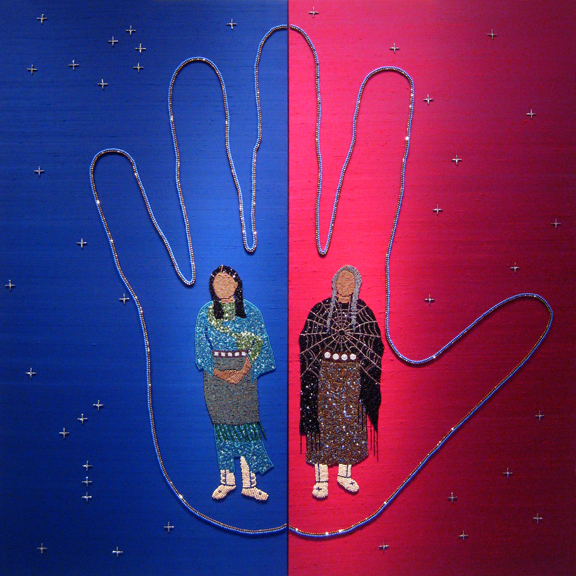
      The centerpiece of the show is Sunboy's Women, a 72” x 72” diptych mounted on blue and red raw silk, the colors worn by Kiowa gourd dancers. Sun Boy or Half-Boy are cultural heroes that were born from an earth woman who fell in love with the Sun. She died trying to return to the earth from the sky world, so the orphaned Sun Boy was raised by Spider Woman, an adoptive grandmother. The figures of the two women are portrayed side by side—young and old—encased in a giant handprint, dividing in half like Sun Boy.

      The figures in the show are women, each portrayed representational but faceless, giving them a timeless or universal quality. Greeves’ figurative style calls to mind the work of Virginia Stroud, a Muscogee-Cherokee artist who was adopted Kiowa and who helped revive ledger painting in the 1960s and 1970s. Text is also a key feature of the works, graffiti-esque text in the thought bubble above NDN GRRRL! and the embellished script of a lullaby in Wa-Ho: The First Song After the Flood.

      detail of Wa-Ho: The First Song After the Flood
      The haunting She Loved Her People struck me the most. A lone, faceless female figure stands on a burgundy background, brandishing a sword.  Curliqued script proclaims that “She loved/her people.” Strategically sewn darker beads create an illusion of shadow on the figure, and mother-of-people discs stand in for elk’s teeth on the yoke of her dress, composed of sparkling cut midnight blue beads. Greeves explains how a 16-year-old Cheyenne girl witnessed Custer’s massacre of her people, including most of her relatives, at the Washita River. The girl saw Custer slice through the belly of a pregnant woman, dismembering her unborn child. This survivor joined a war party, traveled north to Little Big Horn. She fought in that battle and ultimately found Custer. She slit him open from naval to neck with his own sword. Today the German silver trailers that Southern Plains women wear at their waist commemorates this girl’s bravery.

      The juxtaposition of feminine grace and bloodshed might seem incongruent, especially expressed through the “delicate” medium of beadwork. However, this and other works are about family and the willingness to stand up and fight for family. The young Cheyenne girl’s act of resistance restores some harmony and balance in the face of atrocities. So therefore the depiction of the girl is with grace and respect. The oral histories, although not necessarily “pretty”, bind together generations of an extended families and tribes. Greeves is offering the public a window into the encompassing and protecting web of stories and relations that help shape her tribe and her own family.

      Storied Beads will be on exhibit through June 30, 2011 at Shiprock Santa Fe, Old Santa Fe Trail, 2nd Floor on the Plaza.
      www.shiprocksantafe.com

      06 June 2011

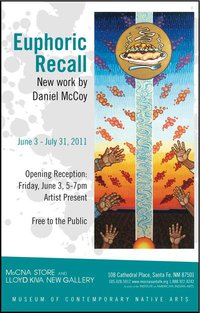
      Review | Euphoric Recall: New Work by Daniel McCoy

      Daniel McCoy, Jr. unveiled eight new works in his (mostly) solo exhibit, Euphoric Recall, at the Museum of Contemporary Native Arts’ Lloyd Kiva New Gallery. Euphoric Recall happens when an addict remembers only the good experiences from her or his addiction.  The description is apt—as angst and heartbreak are portrayed, to quote Henry Rollins, "with a renewed vigor and enthusiasm not seen by many."

      The Muscogee Creek-Citizen Band Potawatomi artist hails from Bristow, Oklahoma, attended IAIA in the early 1990s and 2000s, and moved back to Santa Fe after living at Lake Havasu. McCoy describes his work as a “visual time line” documenting his “past triumphs, current disasters.”

      In his art statement, McCoy writes of his paintings, “I try to make them as busy as possible.“ That is no lie. Repetitive mark making and patterns set the pieces in motion, and his tragicomic narration buzzes, crackles, and pulsates with a simmering dynamic energy.

      The largest piece in the show, The Letter, is also the most enigmatic. The acrylic-oil enamel painting is a collaboration between McCoy and Topaz Jones (Shoshone-Lummi-Kalapuya-Molalla). Bisected vertically down the middle, McCoy predominantly paints the left side and Jones takes the right, with an oversized heart drips blood from center stage. In a heavily outlined style reminiscent of R. Crumb or José Guadalupe Posada, a celestial woman surveys a mummified man in cowboy hat reading a letter. The clouded sky is populated by classic tattoos: swallows, daggers, scrollwork emblazoned with the phrase “Impending Doom.” The sky shifts to night on the right, with a map of Turkey and a projected Bat Symbol over a purple pueblo scene. A loose leaf notebook paper is a scrawled letter, with the words “Daniel, I forgive you” and “Love always, Topaz Jones.” Below is a yeti-like form on a pillow. This chaotic soiree leaves one with more questions than answers.

      The Letter, Daniel McCoy and Topaz Jones


      In the drawing Forbidden Art #1, a bright-eyed and plucky Deerlady, ala Veronica Lodge from Archie comics, stands with arms akimbo in a shiny pool of blood. A stompdance skirt and turtleshell dance shackles reveal her hairy cloven hooves, as she cheerfully presides over the grasping, screaming faces of her male victims, and she beams with pride over her accomplishments.

      The show’s centerpiece, The Indian Taco Made by God, an acrylic painting on canvas, is quite beautiful, with a sky is stitched together from slashes of paint. Heavily articulated hands reach out for absolution from the perfect Indian Taco. Showcasing McCoy’s flair for visual puns, the clouds resemble bubbles in hot lard.  Taco can be taken as a lightly, as a clever joke, but underneath the dazzling colors and masterful graphic strokes lies questions. Why does Indian Country fetishize a food so unhealthy, born of poverty and privation? Nostalgia for comfort food is a running theme in McCoy’s work — Frito pies, Spam, commodities — but we are what we eat.

      What refreshing about McCoy’s approach is that he is more questioning than didactic. His work is socially conscious but occupies a universe filled with possibility and contradictions — a young schoolgirl hauling an oversized Bible dreaming about Liz Taylor’s Cleopatra — comic book style with theological implications.

      Euphoric Recall will be up through July 31st.

      09 May 2011

      Blood of the Sun: Artists Respond to the Poetry of Suzan Shown Harjo, opening May 13

      Red King Ghidorah, Melissa and Marlon Melero
      Santa Fe, NM — The powerful poetry of Susan Shown Harjo (Cheyenne-Holdulgee Muscogee) will be celebrated and explored by visual artists in a unique exhibit, Blood of the Sun: Artists Respond to the Poetry of Suzan Shown Harjo, opening Friday, May 13, 2011 from 6:00 pm to 9:00 pm at Ahalenia Studios (1422 Second Street) in Santa Fe. Harjo will attend the opening. She made her first appearance at Ahalenia Studios to read poetry created for the Freedom of Information: The FBI, Indian Country, and Surveillance exhibit.
      Blood of the Sun will remain on display until Sunday, May 22, 2011. An installation and performance piece created by artist DeCoy Gallery (Warm Springs Chiricahua Apache) will occur at both the opening and closing receptions. The closing reception will be Sunday, May 22nd, 2:00 pm—4:00 pm.

      Harjo is a poet, curator, and likely the most influential policy maker in Indian Country today. She has helped Native nations to regain ownership and control of over one million acres of ancestral lands. She also has been involved in drafting and securing the passage of key legislation to promote and protect Native nations, sovereignty, children, arts, cultures, languages, and sacred spaces, as well at the 1978 American Indian Religious Freedom Act, 1989 National Museum of the American Indian Act, 1990 Native American Graves Protection and Repatriation Act, and the 1996 Executive Order on Indian Sacred Sites. She served on the Native American Policy Committee for Senator Barack Obama's presidential campaign and as an advisor to the Transition in 2008-2009.

      Suzan Shown Harjo, photo by Lucy Fowler Williams
      President of the Morning Star Institute, a national Native rights organization founded in 1984 for Native peoples' traditional and cultural advocacy, arts promotion and research, Harjo was one of seven prominent Native people who filed the 1992 landmark case, Harjo et al v. Pro Football, Inc., against the disparaging name of the Washington professional football team. She has been a featured guest twice on the Oprah Winfrey Show and has been profiled and her work included in myriad broadcasts, newpapers, magazines, and books. On May 13, 2011, she will receive an honorary doctorate degree for a lifetime of advocacy and contributions to Native American arts, cultures, and rights from the Institute of American Indian Arts (IAIA) in Santa Fe.

      "It's an honor to be associated with such extraordinary artists," said Harjo. "Many of these artists have inspired my created and policy works for years. I look forward to the interpretations of and commentary on my poetry by these diplomats, resisters, and catalysts in the arts." Both emerging and internationally exhibited artists will be a part of Blood of the Sun, each responding to a poem or phrase of Harjo's in order to create a finished piece.

      Participating artists include:
      • Marcus Amerman (Choctaw Nation of Oklahoma)
      • David Bradley (White Earth Ojibwe)
      • Kelly Church (Grand Traverse Band of Ottawa Chippewa Indians)
      • Anita Fields (Osage Nation)
      • DeCoy Gallery (Chiricahua Apache)
      • John Hagen (Aleut-Iñupiaq)
      • Bob Haozous (Chiricahua Apache)
      • Hock E Aye Vi Edgar Heap of Birds (Cheyenne-Arapaho)
      • April Holder (Sac and Fox-Tonkawa-Wichita)
      • Kenneth Johnson (Muscogee-Seminole)
      • Linda Lomahaftewa (Hopi-Choctaw)
      • Marlon Melero (Reno-Spark Paiute-Modoc-Tlingit-Haida)
      • Melissa Melero (Fallon Paiute-Modoc)
      • America Meredith (Cherokee Nation)
      • Diego Romero (Cochiti Pueblo)
      • Mateo Romero (Cochiti Pueblo)
      • Hoka Skenandore (Oneida-La Jolla Luiseño-Oglala Lakota)
      • Dr. John Torres-Nez (Diné)
      • Richard Ray Whitman (Yuchi-Muscogee Creek)
      • Brandon Williams (Diné)

      Daily viewing hours for the exhibit vary. Please email for an appointment.

      By Staci Golar (Welsh-American)

      Art show website: www.ahalenia.com/harjo

      02 May 2011

      "Kanutche Dogs: Contemporary Cherokee Art" at Firegod Gallery, Opens Friday, May 6th

      Image: detail of Commodity, Roy Boney
      Albuquerque, NM — Eleven Cherokee artists will participate in an upcoming group art show at the Firegod Gallery, 3413 Central Ave, NE, Albuquerque, New Mexico 87106.

      An opening reception will take place Friday, May 6th, from 6:00 – 9:00 pm. This event is free and open to the public. The show will run through May 31st.

      On Saturday, May 7th, from 2:00 – 4:00 pm, computer animation and claymation videos in the Cherokee language by Roy Boney, Jr. and Joseph Erb will be displays, following by question and answer period about using art to preserve tribal languages. This lecture is also free and open to everyone.

      Artist America Meredith will present a two-part presentation, free and open to the public, about Cherokee art history from precontact times to the present, on Saturday, May 28th, from 2:00 – 4:00pm.

      The Cherokee tribe is an enigma. Over 800,000 people claimed Cherokee descent on the 2010 US Census; however, very few people are familiar with Cherokee culture or arts. Of the 300,000 actually enrolled in of the three federally recognized Cherokee tribes, only about 10,000 people speak the Cherokee language–mostly in Oklahoma and North Carolina. Only an estimated 500 Cherokee people participate regularly in stomp dances, the traditional expression of Cherokee religion, at the seven ceremonial grounds in Northeastern Oklahoma.

      This show hopes to share culturally-informed contemporary Cherokee art with the general public and Cherokee people in New Mexico. New Mexico has such a large Cherokee population that it is home to the Southwest Cherokee Township, a satellite community of the Cherokee Nation.

      The show’s title comes from a folk term, Kanutche Dogs, for the America dingo or Carolina dog, the indigenous dog of the American southeast that has been an important part of Cherokee society. “Kanutche” (pronounced kah-NUH-chee) is a traditional Cherokee food made from hickory nuts.
      • Roy Boney, Jr. (Cherokee Nation), from Locust Grove, Oklahoma, is a painter, illustrator, digital artist, and computer animator, who uses the Cherokee language extensively in his work. He also created a series of zombie comics for Slave Labor Graphics.
      • Ross Chaney (Cherokee Nation/Osage Nation), from Santa Fe, New Mexico, is an emerging expressionist painter and draftsperson.
      • Joseph Erb (Cherokee Nation), from Gore, Oklahoma, is a painter, digital artist, and computer animator, working to preserve the Cherokee language. Mixing new and old technology, Joseph also paints on gourds, an ancient Cherokee art media, and uses imagery from the Booger Dance, a masked dance unique to the Cherokee people.
      • Lara Evans, PhD. (Cherokee Nation) is an experimental photographer and painter, as well as a professor of Native art history at Evergreen State College in Olympia, Washington. Her work was recently published in Art in Our Lives: Native Women Artists in Dialogue.
      • Fran Hill is a contemporary ceramic artist from Albuquerque, who is an active member in the Southwest Cherokee Township.
      • Daniel Horsechief (Cherokee Nation-Pawnee) is a bronze sculptor, wood carver, and painter from Sallisaw, Oklahoma. He is an alumnus of the Institute of American Indian Arts.
      • America Meredith (Cherokee Nation) is a painter and printmaker from Santa Fe, who is also an IAIA alumna. She will exhibit her recent experiments in fumage (smoke art).
      • Mary Beth Nelson (Cherokee Nation) is a painter specializing in wildlife. She lives in Guthrie, Oklahoma.
      • Lisa Rutherford (Cherokee Nation) of Tahlequah, Oklahoma specializes in southeastern beadwork and ceramics, but is also experimenting with traditional featherwork clothing. She showed at SWAIA’s Indian Market for the first time in 2010 and won an award for ceramics.
      • Sean Ross (Eastern Band Cherokee) from Cherokee North Carolina combines humor, social commentary, and Cherokee culture in his paintings.
      • Arlo Starr (NTA Cherokee-descent), a painter, currently lives in Albuquerque but was active in the development of the Squirrel Ridge Ceremonial Ground in Kenwood, Oklahoma. He worked with Cherokee elders to create a healthy cookbook based on traditional foods.
      Firegod Gallery specializes in quality and innovative contemporary Native American art. It is owned by Silvester Hustito (Zuni), an artist and curator.