Translate

Showing posts with label art review. Show all posts

09 July 2012

Heather Ahtone Reads Beneath the Surface

Parking Lot, Joe Feddersen (Colville), glass, 2003
In her 2009 essay, “Designed to Last,” Choctaw-Chickasaw artist, writer, and curator heather ahtone proposed a means of critiquing Indigenous American art based on Indigenous art theory. In her essay “Reading Beneath the Surface: Joe Feddersen’s Parking Lot,” presented at the College Art Association Conference and published earlier this year in Wicazo Sa Review, she puts her ideas into action by critiquing a sculpture by Joe Feddersen using Indigenous methodologies.

Her introduction lets us know exactly what's at stake. “Every time an Indigenous artist creates an object that reflects concepts rooted within her culture this same artists is perpetuating the culture one more day as an act of self-determination,” Ahtone writes at the opening of the essay. She continues, “While every effort of political and religious assault has been made historically to subdue these same cultures, their survival can be partially attributed to the continued production of visual and performance arts” (Ahtone 73).

Ahtone writes that Indigenous epistemology—“ways of knowing”—differs fundamentally from Western ways of knowing (74). While this is relatively obvious to most readers, she further points out that Indigenous learning is not “parallel or perpendicular” (74); that is, Indigenous knowledge is not the Other or opposite of Western knowledge. Indigenous knowledge is not universal but instead must be grounded in local tribal cultures and worldviews. To critique an artwork based on Indigenous values, Ahtone examines materiality, metaphor and symbolism, and cultural reciprocity (74).

Joe Feddersen, whose glass sculpture is critiqued here, is Okanagan and an enrolled member of the Confederated Tribes of the Colville Reservation in Washington State. He earned his MFA at the University of Wisconsin-Madison and was a printmaker and basket weaver before moving into glass art. Using textures from Plateau textiles that symbolize aspects of the natural environment, Feddersen creates a dialogue about the shifting environment and the impact of human development in the Columbia Basin (Askren).

Collaborating with Tlingit artist Preston Singletary, Feddersen embarked on an Urban Indian series. In 2003, he created Parking Lot, a 14 inch tall blown and sandblasted glass sculpture. The translucent, milky-white surface carries the texture of …, which is overlaid with an olive green rim and structures of perpendicular black lines.

Ahtone sees the overall cylindrical form as being reminiscent of a “sally bag,” a flexible basket common throughout the Plateau region (76). The materiality of the piece juxtaposes the implied basket’s soft and pliable surface with the rigidity of glass. Navajo-Wasco artist and author Elizabeth Woody wrote, “Feddersen’s use of glass speaks of our human fragility” and of his choice of the color white, Woody writes “the shell of the basket with the ephemeral density of a cloud” (78).

Feddersen’s use of metaphor and symbolism is overt and deliberate. A metaphor directly substitutes on concept or object for another, while a symbol implies something else. The symbol might be a much more simplistic shorthand for the concept it references. The Plateau weaving designs that Feddersen has incorporating into his printmaking, weaving, and glasswork are extremely spare, abstract geometric designs, and yet they are symbolic and inspired by elements seen in daily life, such as snake tracks on the ground (Askren). The textured surface of Parking Lot has four repeating patterns of chevrons etched on its surface. Feddersen explains that the chevrons “are actually the designs for woman in Plateau culture, kind of like an hourglass design, kind of a winding vase” (79). He learned traditional symbolism from Okanagan weavers but an elder pointed out that the meanings of the widespread symbols change from community to communities (79). By using this symbol, Feddersen “invigorates it as a continued part of the cultural dialogue and… contemporizes the language in its usage” (79).

Vessels themselves are commonly allegories for women. In the Okanagan worldview, “woman is a living metaphor for the earth” (79). The art audience can automatically juxtapose this view with the European-American view of woman as earth, and therefore, ripe for domination. Dynamical tension is conjured between these two referenced worldviews. Okanagan oral history describes the earth “as a woman ‘who gives birth to life forms’” who was once a human being and is still alive (79-80). The etched basket surface suggested grass, which is seen as the hair of the living female earth (80).

Then the black lines on the vessel are diagrams for parking lots, invented in the late 1920s. Ahtone sees these as referencing contemporary migration patterns, which “form the basis of how most Americans relate to the earth—through a mediated system of transit routes…” (80).

Cultural reciprocity is the third lens in which Ahtone critiques Indigenous art and is “an act of gratitude by an artist for their culture heritage” (81). Feddersen is keenly aware of place-based culture, and he incorporates landmarks, or “vital signs,” such as electric lines and railroad tracks into his expression of evolving Okanagan culture (81). “By using the traditional signs,” Feddersen says, “we talk about what the meaning is and they become part of our visual vocabulary rather than something that is purely historical” (82).

Looking at the artwork from a strict formalist approach, that is, looking only at visual aesthetic qualities of the work—an approach espoused by mid-20th century art critics—would completely miss the content of a work such as Parking Lot. Feddersen deliberately uses contemporary imagery and symbols to bring his cultural traditions into the present. Ahtone’s critique brings the content forward in a manner that could be understood by Native and non-Native readers alike. Personally, I’m well acquainted with the mental wall that some non-Native art audiences reach when viewing Indigenous artwork. Facing the situation of having to understand the cultural contexts of hundreds of different tribes seems overwhelming to fully understand Native art; however, it’s not a matter of getting cultural background to then get the works’ content. The cultural background is much the works’ content, and further understanding the worldview enhances the audience’s understanding of being Human.
  • heather ahtone, “Reading Beneath the Surface: Joe Feddersen’s Parking Lot,” Wicazo Sa Review, 27, no. 1 (Spring 2012), 73–84.
  • Mique’l.Askren,  “Joe Feddersen,” IAIA Museum of Contemporary Native Arts: Vision Project. Web.

15 June 2011

Review | Teri Greeves: Storied Beads

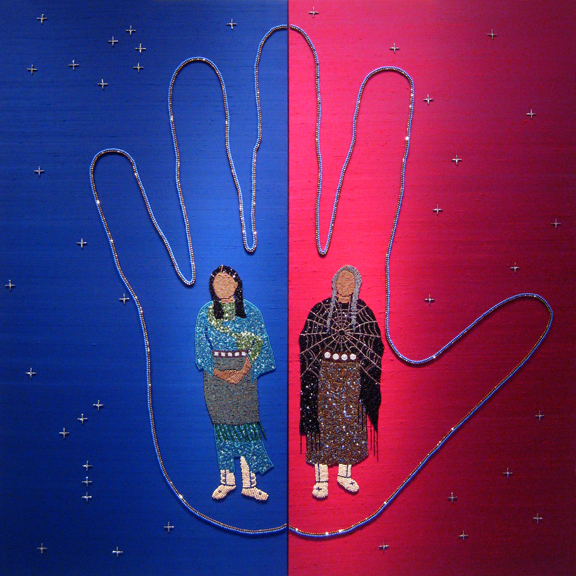
Sunboy's Women, ©2011 Teri Greeves
Storied Beads marks Teri Greeves’ first solo exhibition in Santa Fe in over three years. The Kiowa-Comanche-Italian bead artist has been busy — traveling nationwide, teaching, showing in major group exhibitions, and beading. Her new series, unveiled at the show, takes beadwork to a completely new level.

Hung in Shiprock’s main gallery hall, the works are immense. Five new, monumental beaded appliqué pieces are mounted on shimmering raw silk and luminescent vinyl. The tallest piece looms at 80” high.

The trend in beadwork is to use the smallest possible beads — to achieve fine detail and to display the beader’s technical prowess. However, an ongoing challenge for bead artists is to have their audience not just admire the technical skill in a piece but go beyond to see the composition, palette, and most importantly the content. Beadwork is an art medium loaded with historical implications; however, it’s still an art medium.

By blasting past expectations, Greeves carves a new space for expression. In these new works, she uses pony beads, large-scale beads that can be a centimeter or more width. These oversized beads, in glass, crystal, brass, and wood, coupled with mother-of-pearl disks showcase the reflective, translucent, textured, or glittering surfaces of the individual beads — approaching almost a mosaic quality, which is beautifully offset by the raw silk. While beadwork is most often seen in motion — on personal adornment, dance or ceremonial regalia, moving rattle or fan handles — the glittering quality of the cut-beads and crystals are activated when the viewer walks along, bringing the piece to life. In Sunboy's Women, Swarovski crystals flicker in the starry night sky.

Detail of Wa-Ho: The First Song After the Flood
Stars are a perfect allegory for the Kiowa oral history that inspired these works. The stories reflect unchanging truths, standing outside of daily timeframes, and serves as navigational guides like stars. “This is how our histories are passed on to us: through the vibrations of sound spoken from one individual to another,” writes Greeves in her artist’s statement. “It is also the basis of much conflict between how we see history and how history is written and read by non-Natives.” The subject matter in the show is highly specific. Greeves truly wants people to know and understand the stories, so she included lengthy artist’s statements for each work. The gallery has posted her statements in toto on their website; however, the staff at Shiprock is so gracious and outgoing, you would feel completely welcome reading the entire statements in the gallery at your leisure.

The centerpiece of the show is Sunboy's Women, a 72” x 72” diptych mounted on blue and red raw silk, the colors worn by Kiowa gourd dancers. Sun Boy or Half-Boy are cultural heroes that were born from an earth woman who fell in love with the Sun. She died trying to return to the earth from the sky world, so the orphaned Sun Boy was raised by Spider Woman, an adoptive grandmother. The figures of the two women are portrayed side by side—young and old—encased in a giant handprint, dividing in half like Sun Boy.

The figures in the show are women, each portrayed representational but faceless, giving them a timeless or universal quality. Greeves’ figurative style calls to mind the work of Virginia Stroud, a Muscogee-Cherokee artist who was adopted Kiowa and who helped revive ledger painting in the 1960s and 1970s. Text is also a key feature of the works, graffiti-esque text in the thought bubble above NDN GRRRL! and the embellished script of a lullaby in Wa-Ho: The First Song After the Flood.

detail of Wa-Ho: The First Song After the Flood
The haunting She Loved Her People struck me the most. A lone, faceless female figure stands on a burgundy background, brandishing a sword.  Curliqued script proclaims that “She loved/her people.” Strategically sewn darker beads create an illusion of shadow on the figure, and mother-of-people discs stand in for elk’s teeth on the yoke of her dress, composed of sparkling cut midnight blue beads. Greeves explains how a 16-year-old Cheyenne girl witnessed Custer’s massacre of her people, including most of her relatives, at the Washita River. The girl saw Custer slice through the belly of a pregnant woman, dismembering her unborn child. This survivor joined a war party, traveled north to Little Big Horn. She fought in that battle and ultimately found Custer. She slit him open from naval to neck with his own sword. Today the German silver trailers that Southern Plains women wear at their waist commemorates this girl’s bravery.

The juxtaposition of feminine grace and bloodshed might seem incongruent, especially expressed through the “delicate” medium of beadwork. However, this and other works are about family and the willingness to stand up and fight for family. The young Cheyenne girl’s act of resistance restores some harmony and balance in the face of atrocities. So therefore the depiction of the girl is with grace and respect. The oral histories, although not necessarily “pretty”, bind together generations of an extended families and tribes. Greeves is offering the public a window into the encompassing and protecting web of stories and relations that help shape her tribe and her own family.

Storied Beads will be on exhibit through June 30, 2011 at Shiprock Santa Fe, Old Santa Fe Trail, 2nd Floor on the Plaza.
www.shiprocksantafe.com

06 June 2011

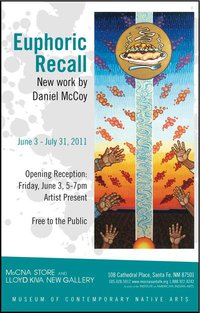
Review | Euphoric Recall: New Work by Daniel McCoy

Daniel McCoy, Jr. unveiled eight new works in his (mostly) solo exhibit, Euphoric Recall, at the Museum of Contemporary Native Arts’ Lloyd Kiva New Gallery. Euphoric Recall happens when an addict remembers only the good experiences from her or his addiction.  The description is apt—as angst and heartbreak are portrayed, to quote Henry Rollins, "with a renewed vigor and enthusiasm not seen by many."

The Muscogee Creek-Citizen Band Potawatomi artist hails from Bristow, Oklahoma, attended IAIA in the early 1990s and 2000s, and moved back to Santa Fe after living at Lake Havasu. McCoy describes his work as a “visual time line” documenting his “past triumphs, current disasters.”

In his art statement, McCoy writes of his paintings, “I try to make them as busy as possible.“ That is no lie. Repetitive mark making and patterns set the pieces in motion, and his tragicomic narration buzzes, crackles, and pulsates with a simmering dynamic energy.

The largest piece in the show, The Letter, is also the most enigmatic. The acrylic-oil enamel painting is a collaboration between McCoy and Topaz Jones (Shoshone-Lummi-Kalapuya-Molalla). Bisected vertically down the middle, McCoy predominantly paints the left side and Jones takes the right, with an oversized heart drips blood from center stage. In a heavily outlined style reminiscent of R. Crumb or José Guadalupe Posada, a celestial woman surveys a mummified man in cowboy hat reading a letter. The clouded sky is populated by classic tattoos: swallows, daggers, scrollwork emblazoned with the phrase “Impending Doom.” The sky shifts to night on the right, with a map of Turkey and a projected Bat Symbol over a purple pueblo scene. A loose leaf notebook paper is a scrawled letter, with the words “Daniel, I forgive you” and “Love always, Topaz Jones.” Below is a yeti-like form on a pillow. This chaotic soiree leaves one with more questions than answers.

The Letter, Daniel McCoy and Topaz Jones


In the drawing Forbidden Art #1, a bright-eyed and plucky Deerlady, ala Veronica Lodge from Archie comics, stands with arms akimbo in a shiny pool of blood. A stompdance skirt and turtleshell dance shackles reveal her hairy cloven hooves, as she cheerfully presides over the grasping, screaming faces of her male victims, and she beams with pride over her accomplishments.

The show’s centerpiece, The Indian Taco Made by God, an acrylic painting on canvas, is quite beautiful, with a sky is stitched together from slashes of paint. Heavily articulated hands reach out for absolution from the perfect Indian Taco. Showcasing McCoy’s flair for visual puns, the clouds resemble bubbles in hot lard.  Taco can be taken as a lightly, as a clever joke, but underneath the dazzling colors and masterful graphic strokes lies questions. Why does Indian Country fetishize a food so unhealthy, born of poverty and privation? Nostalgia for comfort food is a running theme in McCoy’s work — Frito pies, Spam, commodities — but we are what we eat.

What refreshing about McCoy’s approach is that he is more questioning than didactic. His work is socially conscious but occupies a universe filled with possibility and contradictions — a young schoolgirl hauling an oversized Bible dreaming about Liz Taylor’s Cleopatra — comic book style with theological implications.

Euphoric Recall will be up through July 31st.

22 April 2011

In Praise of Annual, Competitive Art Shows: The Trail of Tears Art Show

Resurgence, Daniel Horsechief, at the CHC
While new Indian art markets seem to pop up like mushrooms – despite the horrible economy – annual, intertribal competitive art shows have decreased, not increased, in number. With the loss of the Lawrence Indian Art Show in Kansas, which operated independently of the Haskell Indian Art Market, the number of annual shows open to all tribes is down to two. As far as I know, there is only the Red Cloud Indian Art Show and the Trail of Tears Art Show.

A few more annual shows are limited to certain tribes. Founded in 1997, “Here Forever” is an August show at the Tamástslikt Cultural Institute in Pendleton, Oregon. It’s open to enrolled members of the Confederated Tribes of the Umatilla Indian Reservation, that is Umatilla, Cayuse, and Walla Walla tribes. The Five Civilized Tribes Museum in Muskogee, Oklahoma sponsors a competitive show each June and July that is open to members of all federally and state recognized Cherokee, Chickasaw, Choctaw, Muscogee Creek, and Seminole tribes. Each August/September, the Cherokee Heritage Center in Park Hill, Oklahoma hosts the Cherokee Homecoming show open to enrolled members of the three federally recognized Cherokee tribes. For the last three years, the Cherokee Nation hosts the Cherokee National Holiday Art Show in Tahlequah, Oklahoma.

Both markets and art shows serve worthy purposes. While art markets are exciting events for socializing and networking, they can also prove expensive and exhausting for artists. Many emerging and elder artists might not have the inventory to fill a booth, and familial, academic, or job commitments or health issues prevent many artists from traveling to markets. Art shows, as opposed to markets, allow these artists to participate and share their work and ideas. And unlike markets, the art, not the artist, is showcased. One can quietly spend as long as one wants examining and reflecting on the work, allowing for a deeper understanding of content and underlying crosscurrents between works.

Both the two annual intertribal art shows are in Indian County: Pine Ridge, South Dakota and Park Hill, Oklahoma, which allows the local Native communities to see what’s going on in the contemporary indigenous art world. And both are free to enter, which in the art world in extraordinary. Usually art spaces will host a competitive art show as a fund-raiser, since it’s common to charge $5 to $50 just to enter.

The Trail of Tears show is near to my heart because it the first place I ever exhibited my art. Since 1995, I’ve shown in it every year. Now in its 40th year, the Trail of Tears art show (TOTAS) was founded in 1971 by the Cherokee National Historical Society at the Cherokee Heritage Center. All entries to first shows were limited to the Trail of Tears theme, which proved too narrow a focus. My mother says that at the shows’ low point less than half a dozen people showed up at the reception to see the four or five entries for the entire show. The following year, the show opened up to new categories.

Categories now include painting, graphics, pottery, basketry, miniatures, and Trail of Tears theme. This year was exciting because, thanks to sponsorship by the Chickasaw Nation, a jewelry category was added. The show now allows photography and digital art, but these compete with hand pulled prints, drawings, and even scrimshaw. Every year I crack up when I read the rules explicitly prohibiting painting on saw blades.

This year had an excellent turnout, and visitors at the opening reception said it was too crowded to even see the art (which is why you have to visit more than once). The show had 155 pieces from 95 different artists, but representing only 13 tribes. It seems that is has been more tribally diverse in the past, and I hope it will be in the future. I didn’t see any non-Cherokee baskets. Attention indigenous basket makers of America, please enter next year! Both sales and prize money are good, and it’s a great opportunity to share your work with a largely Native audience.

The grand prizewinner was Putting the Pieces Together, a gorgeous and haunting ceramic sculpture by Troy Jackson (Cherokee). The foot tall figurative work has an elegant Mississippian-esque man composed of black and white jigsaw puzzle pieces, holding black and white pieces in his hands. The figure sits on a blanket on top of a container bearing the word, ᏣᎳᎩ (Cherokee). The lip of the bowl has a lug of copper wire holding a white cross. Small coiled, copper earrings also provide a touch of color. Representing a mixed blood individual’s identity struggles and that of the entire tribe, the piece is ultimate serene, suggesting a resolution and acceptance of a mixed identity.

Shan Goshorn’s High Stakes; Tribes Choice won best of graphics category. Her photograph of a traditionally dressed Eastern Cherokee man is accented with an array of glitter, suggesting the glitz of casino lights more than the spiritual sparkle of mica or other sacred minerals. Sharon Irla’s very classically painted Corn Mother is a beautiful, naturalistic, oil painting of Selu as a tattooed woman with closed eyes, clad in a fur robe, and wearing wampum and shell necklace and pearl bracelets. She holds a white swan feather fan, symbol of a Beloved Woman’s authority. Before her sits a shallow tray of ripe corn. Irla delicately implies erotic energy in manner that doesn’t cross local sensibilities.

David Pruitt's Fire Carrier, a raku clay sculpture of the southeastern Mississippian water spider who brought fire to humanity, won best of the ceramics category. The large number of ceramics entries is a testimony to the work of Anna Sixkiller Mitchell and recently Jane Osti, who offers pottery classes from her studio in Tahlequah.

Lisa Forrest won best of the basket category with her ambitiously large Traditional Storage Basket, woven from vegetal dyed honeysuckle runners. This basket is a foot in diameter, with a delicately woven lid, embellished with seedpods and hazelnuts. Gathering one’s own materials and dyeing with natural dyes is greatly prized in Oklahoma basket weaving; however, I saw some nice doubleweave baskets in commercial reeds. At least the lesser materials allow new weavers to master the art of doubleweaving.

Best of sculpture category was a naturalistic wooden carving, Redtail Hawk by Darrell Smith (Cherokee Nation). The attention to detail was extraordinary with every single feather carved out.

Navajo jeweler and teacher Fritz Casuse won first place in the new jewelry category, with his impressive towering Cala ring with abstract floral designs. His wife Wanesia Misquadace (Fond du Lac Ojibwe) won second and third places. Misquadace is one of possibly a dozen birchbark biters active today, and she travels to northern Minnesota each year to harvest the bark. She incorporated birchbark bitings of turtles in her second place winner, A Song and Prayer for Mother Earth, a canister of birch embellished with silver. Personally I also greatly enjoyed Charley Johnson’s Man from Etowah.

The Trail of Tears category, open to work about any forced removal such as The Long Walk, was won by James Wing with his oil painting, Trail of Tears Water Crossing, a realistic narrative piece portraying two men and a woman trudging through the snowy forest.

Because of the nature of the show, many emerging artists participate, and the quality is uneven. Due to the uncurated nature of the show, one get a more direct feel for trends in styles and subject matter, where genre and figurative art well represented. Many works reflect agrarian culture, such as Choctaw artist Norma Howard’s painting of working cotton fields or Amy Smith’s still life of eggs. Relationships between artists are evident everywhere with relatives and teachers and students showing together. Rose Drake entered a tribute, Quiver for Gunter, in memory of the Cherokee basketweaver, Gunter Anderson, who recently passed on.

The Trail of Tears art show runs through May 8.

If you are interested in entering the Red Cloud Indian Art Show, the information is online here. You have until May 1st to let them know what you want to enter.

07 April 2011

Review | Double Vision: New Works by Hulleah J. Tsinhnahjinnie

Recovering forgotten histories of 19th century Native American photographers, curating shows, and organizing international indigenous photography conferences, the self-identified “aboriginal savant” Hulleah J. Tsinhnahjinnie has dedicated herself to furthering  the cause of Native photography. The Diné-Seminole-Muscogee artist created a new series of digital prints on fabric at the Great Plains Art Museum in downtown Lincoln, Nebraska. She responds to photography by non-Natives — photographs in the Great Plains Art Museum’s permanent collection.

When invited to view early photos of indigenous peoples, Tsinhnahjinnie writes that she does “hesitate when invited to view or respond to them. I scan the messages, intentional and unintentional messages” and “reflect[s] upon the intention of the ‘subject’."

“It is my hope that these new works present a visual confrontation,” Tsinhnahjinnie writes, “an argument with premise that should be critically reviewed and endless questioned.”

Tsinhnahjinnie created large-scale digital prints on poly-satin, hung from curtain rods. Digital art, existing in the zero-space of a computer, can take a range of forms from computer monitors, light projections, or on prints on paper resembling traditional photographic prints. By choosing poly-satin, a polyester fabric with a dramatic sheen, Tsinhnahjinnie ‘s pieces become movie theater-esque — "silver screens."

Her dark palette of blacks, silvery blues, purples, browns, and a process cyan referencing CMYK prints, imbues the work with a dreamlike or nightmarish quality, punctuated by bright citron, red, and orange accents.

The first piece that confronts the viewer is one of the strongest, A Penny for Your Thoughts, derived from Laton Alton Huffman’s Stereoscope postcard, Taking the Tongues. Images of the buffalo nickel form a border below a giant buffalo nickel combines with Huffman’s print, featuring a man stretching a tongue for cutting from a buffalo corpse, one of eight – some partially butchered. The overarching, larger buffalo from the nickel resembles snowcapped mountains. Tsinhnahjinnie  changed the nickel’s text to “United States of Amnesia,” which is a little predictable; however, the text E Pluribus Unum takes an ominous tone, when one considers that the buffalo were slaughtered almost to extinction to destroy Plains Indians way of life and pen them on reservation to ultimately try to assimilate them in mainstream American society; that is, to make many people into one.

Laton Alton Huffman’s Taking the Tongues, is displayed next to Tsinhnahjinnie’s response. It’s a diminutive and faded sepia-toned Stereopticon (think View-Master) from Miles City, Montana, of the lone hunter butchering the eight buffalo carcasses; his rifle resting on one. I studied the piece carefully to clues to the hunter’s identity–was he Native or not? Ultimately it didn’t matter; one man killing eight buffalo at once is excessive no matter what their background is.

This image and the presence of the “Buffalo Nation/Bison Nation,” as the artist describes the animals so crucial to Plains culture, form a backbone to the show. The second work by Tsinhnahjinnie, Taking the Tongues, shows the same image darkened with the right image reversed to form a mirror with Ronald McDonald leaping through the frames. Ronald McDonald, who looks fairly demonic even in the best of times, presents a jarring representation of contemporary consumer culture, the demise of buffalo, and our own health – a food imperialist.

Another of Tsinhnahjinnie’s digital collages, Five Minutes Work, uses an earlier photo from the same series. The inversed image, mostly cyan, reminiscent of an architect’s blueprint, features the same eight buffalo carcasses with a lone horse instead of a man. In the first panel, “Excuse me” is scrawled above the horse and in the second, “I did not sign up for this!” Tsinhnahjinnie’s multilayered, darkly humorous work, braiding together history and 21st century banality,  reminds me of my favorite contemporary British artist, David Godbold. Anticolonialism figures strongly in both the artists’ work.

Two photographers provide Tsinhnahjinnie with the majority of her inspiration: Laton Alton Huffman (1854-1931) from Iowa, learned photography from his father, was attached once by Dull Knife (Cheyenne), and settled in Fort Keogh, Montana in 1879-1880. He later became a hunting guide and rancher and sold buffalo hides to supplement his photography sales (Sharyl Ferrall). The second photographer is William Henry Jackson (1843-1942), who owned a portrait studio in Omaha, Nebraska and was the first published photographer of Yellowstone National Park and the Ancestral Pueblo cliff dwelling at Mesa Verde (Getty Museum).


The Jackson Brothers provide the albumen print, Pawnee Indian—the inspiration for Mega Sale.  The Pawnee man in a fur hat and buffalo space is given a black scrawl down his face (a single tear?) and is treated to either the “dry brush” or “watercolor” filter in Photoshop, a program that also surprisingly has a “smudge stick” filter. A graffiti monkey and writing complete the piece, which is captioned by a Hawaiian Punch-esque font proclaiming: “The idea that history is about us.”

Since Photoshop is so associated with advertising and desktop publishing, it’s disconcerting when the rules of typography and graphic design are broken. For instance, The Special features a variety of disconcordant fonts from the original William Henry Jackson photograph, with “Pawnee, Omaha Special, specializing in authenticity!”  added in a font featuring stars for the i-dots. This piece is flanked by several 19th century photographs of the photographer’s work places — ranging from a cowhide tent, with a railroad and power lines faintly visible in the background to images of large interior spaces with workers a sinks, revealing that photography of Native Americans and the West were big business.

The show concludes with a tetraptych, Today I Was Thinking… At first it seemed like an afterthought, but luckily the space is ideal for sitting with the art. After awhile it began working on me. The four horizontal printed textiles were inspired by L. A. Huffman’s hand-colored platinum print, copyrighted in 1912, Buffalo Grazing the Big Open, shot in northern Montana in 1880. They feature the buffalo herd on a black background, accents with yellow and orange. The first has a photographs of moon phases, the second warped citron moons arching over the sky, as if referencing the eons passing with the buffalo herds shaping the Plains landscape; in the third Ronald McDonald once again rears his ugly head; and finally peace is restored and the buffaloes quip that “Real Indians eat curry.” This piece seems like Paiute prophet Wovoka’s vision of the buffalo returning but really says they never left the Plains and contemporary consumerism is just a blip in the timeframe of the Bison Nation/Buffalo Nation.

Hulleah Tsinhnahjinnie's website

Images: © Hulleah J. Tsinhnahjinnie. Nota bene: Images in art show reviews fall under the doctrine of fair use. Landes, William M. “Copyright, Borrowed Images, and Appropriation Art: An Economic Approach.” George Mason Law Review. Fall 2000: 6.

23 January 2011

Wheel: Polly Nordstrand

Looking Back to Look Forward
Polly Nordstrand (Hopi-Norwegian)

Polly Nordstrand examines Native art writing published since 1990 as a means of assessing progress in Native art. She begins with Lucy Lippard’s 1990, Mixed Blessings: New Art in a Multicultural America, which looks at Asian-, African-, and Latin American art, as well as Native American art. It stands out because it is not a catalog and covers contemporary and experimental Native artists that have been underrepresented.

Since Native art is left out of mainstream art history texts, exhibit catalogs are particularly important. Rennard Strickland and Margaret Archuleta’s 1993 Shared Visions: Native American Painters and Sculptors in the Twentieth Century is a catalog accompanying a major exhibit responding to the quincentennial of Columbus’ arrival in the American. Strickland and Archuleta voice the desire for Native artists to achieve visibility, an ongoing sentiment, echoed in David W. Penney’s 2004 North American Indian Art. Shared Visions traces the influence of federal Indian policy on 20th century Native arts, and Nordstrand feels this casts the artists in the role of the victim (146). She wonders if survival narratives are compelling or relevant to mainstream society.

In the 2002 After the Storm: The Eiteljorg Fellowship for Native American Fine Art, 2001, edited by Jackson Rushing, writer Colleen Cutschall (Oglala Lakota) compares cross-cultural communication in art as aboriginal multi-lingualism” (151).

Nordstrand points out the lack of critical review of Native American art by the art world, but looks at one art magazine with an issue dedicated to Native art: the 1992 volume of Art Journal Vol. 51 (1992) No. 3 (Fall), co-edited by Jackson Rushing and Kay WalkingStick (Cherokee/Winnebago). The lack of art criticism and lack of judgments is a widespread problem that exists throughout the art world. Nancy Mithlo (Chiricahua Apache) writes, “the purpose of contemporary Native arts criticism in a more proactive frame of reference is less about what others think (getting in and being witnessed by others as in a ceremony) and more about what we thinking of ourselves in relationship with others” (152).

Since catalogs are geared towards a general readership, Nordstrom argues that they are no substitute for scholarly art history. She criticizes Janet Berlo and Ruth Phillips’ 1998 Native North American Art for bending interpretations of art terminology, specific the term “modern,” in respect to Native art.

She mentions the catalog for the 2004 National Museum of the American Indian exhibit, Native Modernisms: The Art of George Morrison and Allan Houser, edited by Truman Lowe, 2005. Finally looking at Linda B. Eaton’s 1990 A Separate Vision: Case Studies of Four Contemporary Indian Artists, Nordstrand asks, “Can we identify true movements and aesthetics in history of art by American Indians?” (156).

The last two decades have seen a groundswell of books about Native art, including an increasing number of monographs. More Native writers are publishing and some tribes and tribal schools have their own presses. This bodes well for generating realistic art histories, and there are far more works than could ever be examined in a single essay.